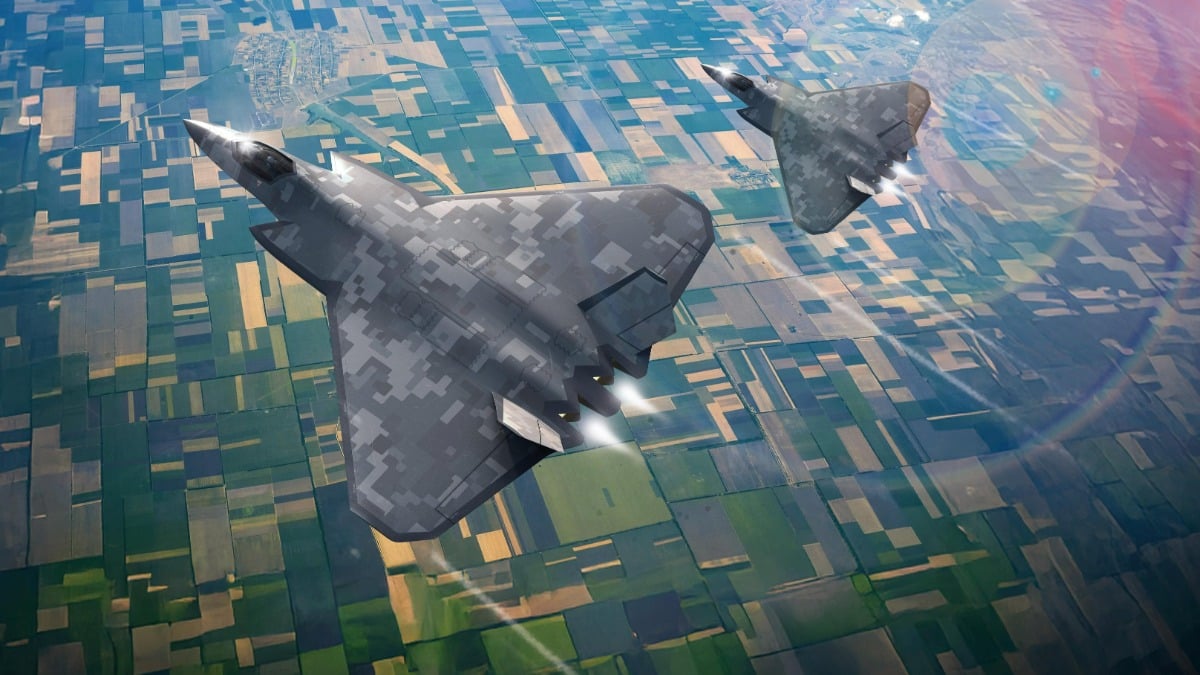
Air superiority isn't cheap, and it certainly isn't easy. While pundits love to claim that drones have made manned fighter jets obsolete, three major global powers are betting billions that the future of warfare still belongs to the skies.
The Global Combat Air Programme is the massive trilateral alliance between Britain, Italy, and Japan. They want to build a sixth-generation stealth fighter by 2035. They aren't just sketching concepts on napkins anymore. They just put serious money on the table.
Yesterday, the three nations signed a massive £4.6 billion contract with Edgewing. That's the joint venture company they set up last year, split equally between BAE Systems, Leonardo, and Japan Aircraft Industrial Enhancement Co Ltd. This massive cash injection advances the aircraft's design phase and kickstarts rigorous physical testing. For months, critics wondered if the alliance would crumble under the weight of domestic budget fights. This deal effectively silences them.
It comes at a critical moment. Just last month, the rival Franco-German fighter project collapsed spectacularly after years of bitter infighting over industrial leadership. With Europe's other major defense alliance in tatters, this trilateral effort stands as the dominant Western fighter project outside the United States. If you want to understand where global defense architecture is heading, you need to look at what's happening right here.
The Global Combat Air Programme Solves a Massive Funding Problem
No single country can afford to build a sixth-generation fighter alone. Even the United States struggles with the runaway costs of its Next Generation Air Dominance project. By pooling their financial resources and industrial talents, London, Rome, and Tokyo are spreading the immense financial risk.
The UK government recently unveiled its long-awaited Defence Investment Plan. That plan locked in £8.6 billion for this specific project over the next four years. It was a vital move. British budget hesitation had previously caused nearly nine months of delays, sparking deep frustration in Tokyo and Rome. Japan was particularly vocal about its annoyance, fearing that political waffling in London would blow past the strict 2035 deadline.
With the money now secured, the timeline is locked. The three nations aren't just buying airplanes. They're trying to preserve their sovereign defense industrial bases. Without a major project like this, engineering talent drifts away, factories close, and capabilities disappear. You can't just turn a defense industry back on like a light switch.
What Makes This Jet Different From an F35
People keep asking why these countries don't just buy more American F-35s. The answer comes down to sovereignty, range, and raw firepower. The F-35 is a brilliant multi-role aircraft, but it has limitations. It's relatively short-ranged and relies heavily on American software locks.
This new fighter is being built with an entirely different philosophy. Initial designs showed a modified cranked delta-wing shape. However, the updated physical model revealed at the Farnborough Airshow showcased a true delta-wing design. The wings are massive. Think along the lines of the classic F-111 Aardvark wingspan.
That massive wing area serves a simple purpose. It holds fuel. This aircraft needs to operate across the vast distances of the Indo-Pacific. It needs to cross the Atlantic on internal fuel without needing three or four mid-air refuelings like a Eurofighter Typhoon does.
Let's talk about weapons capacity. An MoD official revealed that this fighter is designed to carry roughly double the internal payload of an F-35A. That means it can hunt stealthily without hanging missiles off its wings and ruining its radar profile. It will also pack enough onboard computing power and advanced sensor arrays to independently form its own kill-chain. It won't just be an airplane. It will be a flying command center capable of directing fleets of loyal wingman drones.
Radical Recycling and the Tornado 2 Tempest Project
One of the most surprising elements of this development process is how the engineers are sourcing materials. They aren't just buying raw titanium from global markets. They're recycling old Cold War bombers.
Under an initiative called the Tornado 2 Tempest project, British engineers took retired Royal Air Force Tornado jets out of storage. They took the strategic metals, high-grade steel, aluminum, and titanium, and literally atomized them into fine metallic powders. They used this recycled material as feedstock for advanced 3D printing.
They successfully printed new compressor blades and a nose cone out of that recycled metal. Then they slapped those parts into a Rolls-Royce Orpheus test engine and ran it at full operational conditions. It worked flawlessly.
This approach changes the game for military logistics. Instead of waiting months for complex supply chains to forge custom titanium parts, defense ministries can reuse the high-value metals they already own. They're also implementing a Digital Product Passport system to track every ounce of material. It eliminates the risk of counterfeit metals slipping into production. It's smart, it's efficient, and it keeps costs down.
The Geopolitical Ripple Effects of the Franco German Collapse
Defense procurement is never just about engineering. It's always deeply political. When France and Germany watched their own joint fighter project disintegrate in June, the entire strategic equation shifted.
Now, the trilateral alliance is looking highly attractive to other nations. Italy's defense minister openly stated that opening up the project to external partners is the best way to share the crushing burden of development costs. Rumors are flying about who might join next. Germany is suddenly looking like a viable partner because of its massive industrial base and lack of an alternative option.
Canada has already stepped up, officially joining the project as an observer while it evaluates a future purchase. Saudi Arabia has also knocked on the door. Any expansion requires the unanimous agreement of the three founding members, which won't be easy to negotiate. Japan has historically been cautious about exporting military hardware, though it recently loosened its rules to allow this specific fighter to be sold to friendly nations.
Leonardo executives estimate that the three founding nations will need a minimum of 290 airframes just to replace their aging fleets of Typhoons and Mitsubishi F-2s. But they're aiming much higher. They expect total orders to top 350 aircraft by the time full-rate production hits its stride.
Building an Aircraft That Never Soft Clowds Into Obsolescence
The biggest mistake of past fighter programs was locking the design into a rigid framework. Upgrading an older jet often requires ripping out miles of wiring and redesigning the physical frame. The Global Combat Air Programme is taking a completely different path.
The defense chiefs guiding this project aren't aiming for a traditional full operational capability date. Instead, they're building the aircraft with an open-architecture digital core. BAE Systems representatives emphasize that this approach allows for continuous software and hardware iterations throughout its decades-long lifespan. Production is expected to stretch well past 2060.
Think of it like a modern smartphone. The hardware framework stays stable, but you can swap out sensors, upgrade radars, and upload new software capabilities as threats evolve. The electronics consortium, which brings together Mitsubishi Electric, Leonardo UK, and Italy's ELT Group, is building an integrated sensor system that treats the entire skin of the aircraft as a massive radar dish.
Next Steps for the Program
Now that the £4.6 billion contract is active, the industrial teams have a clear set of immediate tasks. If you're watching this space, here is what needs to happen next:
- The Edgewing joint venture must finalize the formal system requirements review by the end of 2027.
- Engineers will begin constructing high-fidelity digital twins of the final airframe to simulate radar signatures and aerodynamic performance before cutting any metal.
- The trilateral government agency based in Reading will need to formalize the framework for allowing observer nations like Canada to transition into full industrial partners.
This project is a massive gamble. It relies on three countries with vastly different strategic priorities staying aligned for over a decade. But with billions of pounds committed, a collapsed rival in Europe, and a soaring demand for long-range air power, the project has suddenly become the most important defense initiative in the Western world. If they pull it off, it will redefine global air power for the next fifty years.