The heat in Upper Egypt does not merely surround you; it sits on your chest. Standing near the banks of the Nile, staring out toward the ancient sandstone temple of Kom Ombo, I could feel the invisible weight of centuries pressing against the air. Tourists usually come here for the double-dedicated sanctuary of Sobek, the crocodile god. They photograph the sun-baked reliefs, marvel at the symmetry, and listen to guides talk casually about the sacred reptiles that once crawled freely through these waters.
Beneath the limestone and the dust, however, a much darker, more profound story rested in total darkness.
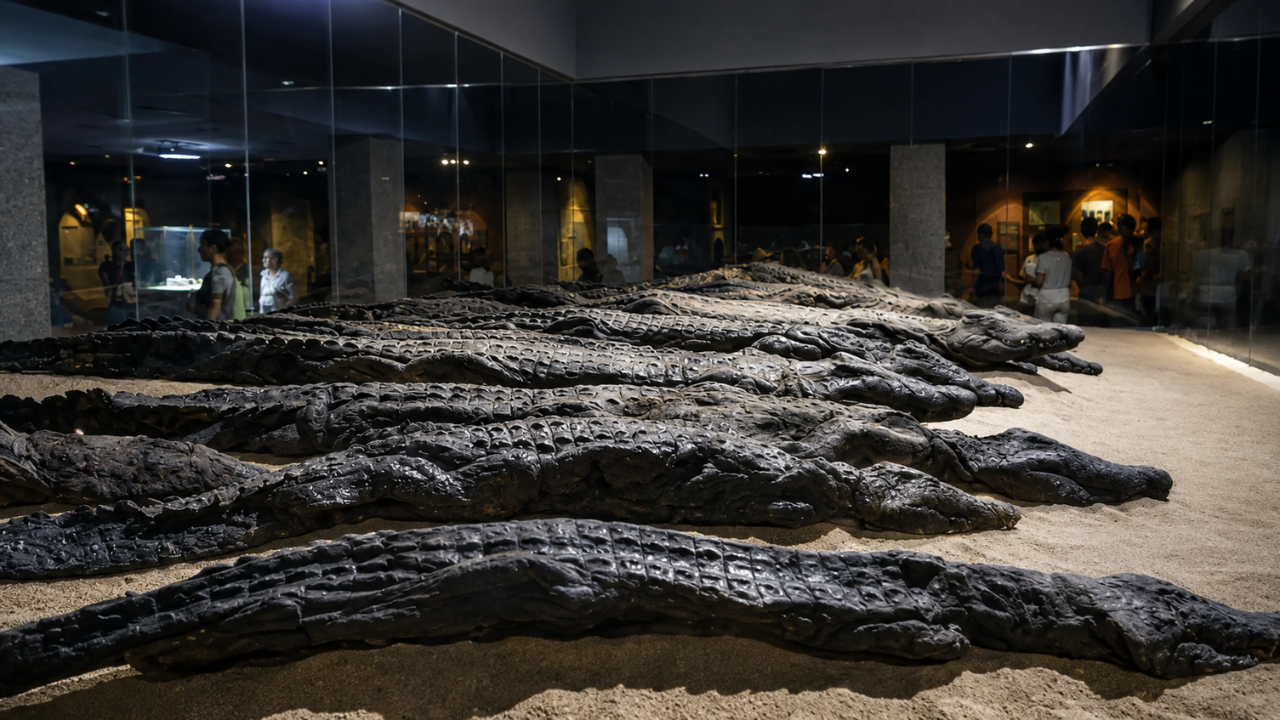
For generations, archaeologists knew about the catacombs. They knew that the ancient priests of Kom Ombo did not merely worship Sobek from afar. They bred, raised, killed, and mummified thousands of Nile crocodiles, stacking them in subterranean vaults like cords of ancient firewood. Generation after generation of animals, carefully wrapped in linen, smeared with resin, and offered to a hungry deity.
Yet, for the longest time, science missed the heartbeat behind the bones.
Where did they all come from?
Picture an Egyptian priest standing on the riverbank two thousand years ago. He is not just a holy man. He is a manager of a massive, sacred industry. Pilgrims are arriving by the boatload, clutching coins, desperate to purchase a divine conduit. They need a physical body to carry their prayers across the veil. They need a mummified baby crocodile to appease Sobek, ensuring their crops grow, their children survive, and the floods arrive on schedule.
Logistics. Scale. Supply chains in the time of the pharaohs.
We tend to think of ancient religious practices as completely divorced from our own modern, pragmatic realities. We imagine pure mysticism. But when you walk through the dust of Kom Ombo, you realize this was an enterprise of staggering proportions. Thousands upon thousands of creatures needed to be harvested or hatched.
For years, standard academic consensus leaned toward a neat, tidy hypothesis. The ancient Egyptians must have farmed them. They must have built massive enclosures along the river, penned the massive reptiles, managed breeding pairs, and controlled the entire lifecycle from egg to embalming table. It makes sense on paper. It sounds efficient.
It also happens to be completely wrong.
Science caught up with the romance in a laboratory, peering not at grand architectural remains, but at something far smaller and infinitely more stubborn: ancient DNA.
Geneticists pulled tissue samples from mummified crocodiles housed in museums across the world. They extracted mitochondrial genomes, looking deep into the molecular code of creatures that died during the Ptolemaic and Roman periods. They wanted a family tree. What they found instead was a wilderness.
Imagine looking at a family album where every single cousin comes from a different branch of a massive, untamed forest. That is what the genetic data showed. There was no stagnant, inbred pool of captive-bred farm animals. There was astonishing genetic diversity.
Consider what that means.
The priests were not running a controlled industrial hatchery. They were sending men out into the wild, roaring heart of the Nile.
I stood by the river imagining those catchers. No modern gear. No reinforced cages. Just woven nets, long wooden poles, deep courage, and a profound, trembling reverence for the predator swimming beneath the surface. They had to plunge into waters choked with massive, aggressive Nile crocodiles—creatures that could easily grow to fifteen feet and crush bone with a single snap of powerful jaws.
They hunted them. One by one.
Why? Because the gods could not be fobbed off with factory-farmed shortcuts. Or perhaps, simply, the sheer abundance of the wild river made trapping easier than building artificial nurseries. Whatever the motivation, the DNA whispered a stark truth: every mummified offering in those dark vaults represents a terrifying, breathless encounter between a human being and a wild apex predator.
The priests embalmed them with meticulous care. They used palm wine, natron, and expensive resins imported from distant lands. They treated these creatures not as mere pests or commodities, but as vessels of the divine.
When you touch the rough, darkened linen of a mummified crocodile in a museum case today, you are touching the physical evidence of an ancient bargain. Humanity looking at the most terrifying thing in its environment, taking its measure, and trying to negotiate with it through ritual, sacrifice, and endless rows of bandages.
The silence in the catacombs of Kom Ombo is heavy now. The live crocodiles are gone from this stretch of the river, pushed south by dams and modern development. The priests are dust. The pilgrims are forgotten names.
Only the bones remain, whispering secrets locked in their cells for millennia, reminding us that the wild world we try so hard to conquer once demanded everything we had just to earn its blessing.