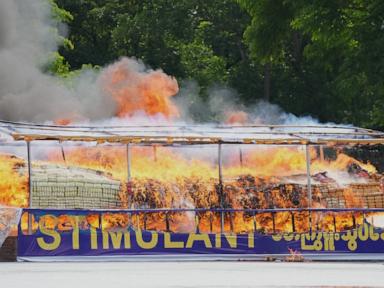
The thick columns of black smoke rising from the outskirts of Yangon look like a definitive victory against transnational crime. To mark the United Nations International Day Against Drug Abuse and Illicit Trafficking, Myanmar authorities publicly torched over 50 tons of seized narcotics, including more than 28 tons of crystal methamphetamine, heroin, opium, and ketamine. The military regime values this incinerated haul at over 600 million dollars, a figure proudly displayed as proof of their uncompromising stance against the regional drug trade. But look closer at the ashes. This massive public bonfire is a carefully choreographed illusion designed to obscure a grimmer reality, because while the junta burns millions of dollars in narcotics on camera, Myanmar has quietly surpassed Afghanistan as the world's leading producer of opium while concurrently operating as Southeast Asia's uncontested hub for synthetic drugs.
The spectacle of destroying narcotics has long been a public relations staple for unstable regimes, yet the numbers behind this specific burn reveal a paradox that regional security analysts find deeply alarming. The volume of drugs slated for destruction this year is double the quantity destroyed last year. In a functional law enforcement environment, a surge in seizures might indicate successful interdiction strategies. In a country fractured by structural collapse and violent civil conflict, it indicates something entirely different: a market so oversaturated that hundreds of millions of dollars in product can be treated as disposable overhead.
The Economics of a Failed State
To understand why the drug trade is expanding despite massive seizures, one must examine the baseline manufacturing costs of synthetic narcotics. Synthetic drugs like methamphetamine do not require vast fields of agricultural land or favorable weather conditions. They require industrial chemicals, rudimentary glassware, and territory completely insulated from the rule of law.
In the rugged, mountainous expanse of Shan State, international syndicate networks have constructed production facilities that mirror small industrial villages. These complexes feature dedicated internal road systems, heavy-duty electrical infrastructure, and sophisticated water management systems designed to process chemical runoff. When the military claims to dismantle these super-labs, they are merely scratching the surface of a highly decentralized production apparatus.
The underlying math explains why a 600 million dollar loss is easily absorbed by these criminal syndicates. A single kilogram of high-purity crystal methamphetamine that costs less than 1,000 dollars to manufacture in a Shan State jungle laboratory commands a wholesale price of roughly 30,000 dollars when it crosses the border into Thailand. By the time that same kilogram reaches the streets of Sydney or Tokyo, its retail value can skyrocket past 200,000 dollars. When profit margins routinely exceed 20,000 percent, losing a few dozen tons of product to a state-sponsored bonfire is not a fatal blow. It is an acceptable cost of doing business.
The Weaponization of the Narco Economy
The current conflict in Myanmar has transformed the narcotics trade from an opportunistic criminal enterprise into an essential survival mechanism for competing factions. The military regime has frequently utilized state media to accuse ethnic armed organizations of engineering the drug trade to fund their insurgencies. This accusation contains elements of historical truth, as various rebel factions have relied on opium and methamphetamine taxes for decades to buy weaponry and sustain autonomy.
However, independent border analysts point out that the military's narrative conveniently omits its own reliance on proxy militias. To maintain a semblance of control over hostile border regions, the central military command has long tolerated the drug trafficking activities of local Border Guard Forces and anti-rebel militias. These pro-regime groups are granted implicit immunity to manufacture and transport narcotics in exchange for acting as a counterweight against pro-democracy forces and ethnic armies.
This multi-sided complicity creates a scenario where almost every faction in the conflict has a financial incentive to keep the chemical precursors flowing. The breakdown of formal banking networks and the collapse of the legitimate agrarian economy since the 2021 coup have left millions of citizens with few options. For impoverished farmers in remote regions, cultivating opium poppies is no longer a choice between poverty and wealth; it is a desperate bid to survive inflation and food scarcity.
The Precursor Pipeline
Interdiction strategies focused on burning finished products fundamentally misunderstand the supply chain of the modern drug trade. The Achilles' heel of any synthetic drug syndicate is not the distribution of the final product, but the acquisition of precursor chemicals like pseudoephedrine, sodium cyanide, and various industrial esters. None of these chemicals are manufactured in the jungles of Myanmar.
They flow across porous borders from industrial chemical hubs in neighboring China and India. The sheer volume of legitimate chemical commerce in Asia provides the perfect cover for illicit diversion. Containers filled with industrial solvents or manufacturing agents are mislabeled, routed through complex networks of shell logistics companies, and driven across border checkpoints where underpaid customs officials are easily bribed.
Focusing law enforcement resources exclusively on public burnings in Yangon is the geopolitical equivalent of treating a systemic infection with a bandage. Until regional governments coordinate a strict, traceable oversight mechanism for the chemical manufacturing sectors inside their own borders, the laboratories in Shan State will continue to operate at maximum capacity. The syndicates do not fear the fire; they fear a shortage of raw materials.
The Regional Spillover
The consequences of Myanmar’s governance vacuum are felt far beyond its immediate geographical borders. The Mekong sub-region has been flooded with cheap, high-potency methamphetamine, driving down retail prices and overwhelming local healthcare systems in Thailand, Laos, and Cambodia. The oversupply is so severe that regional cartels are actively seeking new consumer bases, shifting trafficking routes maritime through the Andaman Sea to penetrate lucrative markets in Australia, New Zealand, and parts of East Asia.
International drug enforcement agencies acknowledge that traditional containment strategies are failing. Maritime patrols can intercept only a tiny fraction of the vessels departing from Myanmar's coastline. The wealth generated by this unhindered trafficking is heavily integrated into the regional legitimate economy, laundered through casinos operating in special economic zones along the Mekong, unregulated real estate developments, and digital currency networks that operate beyond the reach of traditional banking regulations.
Public ceremonies celebrating the destruction of seized contraband offer a convenient political narrative for a regime desperate for international legitimacy. But the smoke rising over Yangon cannot hide the reality that the narcotics industry has become the structural foundation of a war-torn economy. The bonfires will eventually burn out, the ash will settle, and the hidden production lines deep in the jungle will keep moving without interruption.
An investigative broadcast tracking the scale of these deep-jungle manufacturing sites can be seen in this report on Myanmar's Record Drug Seizures, which provides an on-the-ground look at the infrastructure fueling Southeast Asia's illegal narcotics trade.