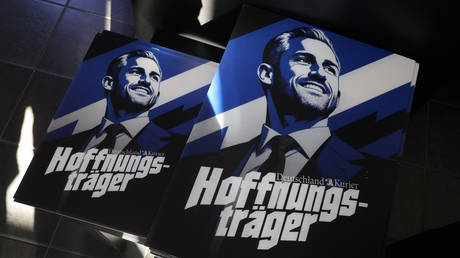
The coffee in the Berlin café was lukewarm, tasting of chicory and compromise. Outside, the autumn wind carried the scent of wet asphalt and dead leaves, a familiar European melancholy that usually feels like background noise. But on this Tuesday, the silence between sentences at the next table held a different weight. Two men in wool coats were talking about parliamentary seats, polling data, and percentages that ticked upward like a fever graph. They weren't shouting. They weren't wearing jackboots or carrying torches. They spoke with the tired, pragmatic exhaustion of commuters discussing a delayed train.
That is the trick.
When the Alternative for Germany party wins another district, when a town council shifts, when the blue posters of AfD candidates begin to outnumber the neutral municipal signage in rural Saxony, the television pundits reach for their favorite vocabulary. They talk about fascism reborn. They warn of Weimar ghosts rising from the archival dust. They point to the extremists within the party ranks, the radical fringes shouting slogans that belong in the darker chapters of the twentieth century.
And they miss the point entirely.
Look closer. Strip away the theatrical outrage of cable news and the defensive posturing of mainstream politicians. The real danger of the AfD is not that it is dragging Germany back to 1933. The danger is much more modern, much quieter, and infinitely more seductive. It is a danger born of democratic failure, not democratic overthrow.
To understand this, we have to talk about Stefan.
Stefan is a hypothetical mechanic living in a small town near Cottbus, a man whose daily reality serves as a lens for a wider tectonic shift. (To be clear, Stefan is a composite portrait built from demographic data, sociological interviews, and regional voting trends across eastern Germany). Stefan wakes up at five in the morning. His hands are permanently stained with motor oil and brake dust. For twenty years, he has paid his taxes, fixed the suspensions of cars owned by people who live three hours away in Berlin, and trusted the social contract.
The contract was simple: work hard, play by the rules, and the state will keep the lights on, the hospital open, and the future predictable.
Except the hospital twenty minutes down the road closed last year. The local bank branch shuttered its doors, replaced by an ATM that frequently runs out of cash. The bus that used to take his daughter to vocational school now runs twice a day instead of every hour. When Stefan listens to national politicians on the radio talking about a booming macroeconomic climate, green transitions, and a digitalized future, he looks around his workshop and feels like he is watching a movie filmed on a different planet.
This is the breeding ground of the new authoritarian appeal. It does not begin with ideological conversion. It begins with abandonment.
When mainstream political parties treat regional decline as collateral damage in the name of modernization, they create a vacuum. When establishment politicians dismiss local anxieties as provincial backwardness, they hand the opposition its most powerful weapon. The AfD understood this before anyone else. They did not win votes by convincing people that ethnic nationalism is a noble philosophy. They won votes by showing up at the village green when everyone else was busy drafting white papers in Berlin. They listened. Even if their solutions are toxic, even if their scapegoating is dangerous, they offered a visceral validation of pain that the rest of the political class pretended did not exist.
Here lies the fundamental misunderstanding of the democratic threat.
The alarmists warn us that democracy will end with a sudden crash. A coup. A constitutional crisis. A dramatic midnight seizure of state media. They expect a cinematic climax.
Democracy rarely dies in a Hollywood script. It erodes through exhaustion.
When citizens feel that their votes are functionally irrelevant—that no matter which coalition takes power in the Reichstag, the local post office still closes and the cost of heating an apartment still doubles—they stop believing in the system itself. The AfD feeds on this post-democratic apathy. They use the machinery of representative democracy to hollow it out from the inside. They turn parliament into a stage for grievance, transforming legislative debate into permanent theater.
Consider what happens next in this cycle.
Every time a mainstream party responds to the rise of the AfD by simply adopting their talking points on immigration while offering no structural alternative to economic decay, they validate the premise. Every time the political establishment builds a cordon sanitaire—a firewall isolating the party from coalition talks—without addressing the grievances of the millions who voted for it, they turn voters into martyrs. The wall keeps the politicians feeling pure, but it leaves the voters outside in the cold.
The danger, then, is not that the AfD will violently overthrow the German constitution. The danger is that they won't have to.
They are demonstrating that a democracy can hollow out while its institutions remain formally intact. Elections will still happen. Ballots will still be counted. Parliaments will still convene. But the underlying social trust—the invisible glue that holds a pluralistic society together—will have turned to dust. When trust is gone, procedure is just a shell.
We have seen this movie before in other languages, on other shores. It begins with the quiet alienation of people who feel left behind by the speed of history. It grows through the weaponization of legitimate frustration by cynical actors who offer simple enemies for complex problems. And it culminates in a society so fractured that citizens no longer see their neighbors as compatriots with differing views, but as existential threats to be neutralized.
The remedy is not moral scolding. Telling a mechanic in Cottbus that he is on the wrong side of history does not lower his heating bill or reopen his local clinic. Labeling every protest vote as an endorsement of fascism may feel righteous in a university seminar, but it is political suicide on the ground.
Saving democracy requires doing the hard, unglamorous work of making it function for the people who feel forgotten by it. It means rebuilding infrastructure, restoring public services to rural peripheries, and listening with actual humility to the communities that the modern economy has treated as expendable.
The coffee shop in Berlin empties out. The two men in wool coats pay their bill and step out into the gray afternoon, disappearing into the crowd of a city that feels very far away from the towns where the real political weather is turning. Back in the workshop, Stefan turns off the overhead fluorescent light, locks the heavy metal door, and walks out into a quiet evening where the future feels like something that happens to other people, somewhere else, while nobody is watching.


