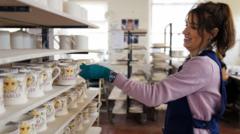
The British ceramics sector has been quietly bleeding out for years. While casual observers might only think of teacups or decorative bowls from Stoke-on-Trent, the reality is far more brutal. If you run a manufacturing plant relying on kilns, you've spent the last few years watching your profits vanish up the chimney. Sky-high gas bills and relentless foreign competition have shuttered dozens of historic operations.
That's why the Government's newly announced £120 million package for the UK ceramics industry isn't just a routine handout. It's a high-stakes rescue mission. Chancellor Rachel Reeves and Business Secretary Peter Kyle confirmed the multi-year funding to help the sector survive an incredibly volatile economic climate.
If you're a manufacturer trying to plan your capital investments, or an investor tracking industrial resilience, this announcement shifts the playing field. Here's what's actually happening behind the headlines, why gas costs ruined previous rescue attempts, and how your firm can get a piece of the pie.
What the Million Funding Actually Looks Like
Let's cut through the standard political spin. The £120 million injection isn't a vague promise for future infrastructure. It's explicitly split down the middle to target two distinct pain points that have kept factory owners awake at night.
The package allocates £60 million directly toward capital investment for new equipment. The goal here is simple: force a transition away from inefficient, carbon-heavy production methods. The remaining £60 million goes toward operational support. This second half is critical because it offers cash flow relief to successful applicants who need immediate help managing day-to-day cost spikes.
This is a massive departure from previous initiatives like the British Industry Supercharger. Those older schemes focused almost entirely on electricity bill relief. For the ceramics industry, that was basically useless. Making bricks, refractory materials, or fine china requires massive, sustained heat.
Because of that technical reality, gas accounts for roughly 90% of total energy consumption across the sector. By expanding the support to include operational costs and gas-to-electricity transitions, the new fund actually aligns with how these factories function.
Who Qualifies for a Slice of the Fund?
The Department for Business and Trade has confirmed that the scheme won't just look at traditional tableware. It spans a massive footprint across several manufacturing subsectors.
- Refractory Products: The heat-resistant bricks lining heavy industrial furnaces. Without these, domestic steel and glass production instantly grinds to a halt.
- Clay Building Materials: Think bricks and roof tiles. These are foundational elements for the housing market.
- Household Ceramics: The traditional pottery, plates, and sanitaryware that define regional heritage.
- Technical Ceramics: Specialized components used in electronics, aerospace, and medical devices.
The Blind Spot in the Modern Industrial Strategy
Most people treat the pottery industry like a museum piece—something to be preserved out of sentimentality rather than economic necessity. That's a massive mistake. The reason the Government stepped in with £120 million isn't just to save heritage jobs in Devon or Staffordshire. It's because the entire UK supply chain is terrifyingly dependent on these foundational materials.
Consider advanced manufacturing. When a company builds components for a jet engine or a defence system, they rely on technical ceramics capable of withstanding extreme thermal environments. If the domestic capacity to manufacture these materials collapses, UK aerospace firms end up completely dependent on foreign imports. In a world of fragile global supply chains and rising geopolitical tension, that's an unacceptable vulnerability.
The data backs up the danger. An independent economic assessment commissioned by Stoke-on-Trent City Council highlighted a worrying trend: the number of active ceramics firms in North Staffordshire dropped from 137 in 2018 down to 123 in 2024. Heavily exposed to gas price shocks following the war in Ukraine, iconic names simply ran out of cash.
Yet, the same report found that the net worth of surviving companies in advanced ceramics and refractory products actually jumped. Supply chain turnover in those specific subsectors grew by 35% over that same period. There's a booming market here, but only if firms can survive the transition costs.
Real Dollars and Practical Relief on the Factory Floor
To understand why this funding matters, look at a real-world operator like Portmeirion Group PLC. They employ over 660 people globally, with 433 workers stationed in Stoke-on-Trent. They export over £35 million worth of British-manufactured homewares to 60 countries.
Despite their global footprint, their UK energy costs hit roughly £2.8 million in the 2025 financial year. Even with smart forward-hedging strategies running through 2027, absorbing those kinds of utility spikes makes it incredibly difficult to compete with low-cost overseas manufacturers.
For a company like Portmeirion, which is currently running its "Made in Stoke-on-Trent" strategy to boost domestic production, this fund provides the financial breathing room needed to upgrade kilns and scale up operations safely. They increased their local production by 7% last year alone—amounting to an extra 280,000 pieces of tableware. Direct government support means they can keep that momentum going without betting the farm on energy market stability.
Trade Defence and the Fight Against Cheap Imports
Skeptics will rightly point out that throwing cash at energy efficiency won't solve the structural problem of cheap, subsidized foreign imports flooded into the UK market. Industry trade body Ceramics UK, led by Chief Executive Rob Flello, has been shouting about this for years.
The Government seems to have finally caught on. Along with the cash injection, ministers are actively pushing ceramics producers to engage directly with the Trade Remedies Authority.
The goal? Build airtight cases to slap tariffs on unfair foreign trade practices. If you're an independent manufacturer, the message from Whitehall is clear: document the dumping practices of foreign competitors and use the regulatory framework to fight back. Cash helps you upgrade your equipment, but trade defence is what protects your market share long-term.
How Your Firm Should Prepare for the Rollout
The official design of this support scheme is being hammered out right now in a collaboration between independent industry experts, trade bodies, and civil servants. The formal consultation kicks off in summer 2026, with the funds scheduled to roll out over a multi-year period.
Don't wait around for the application portal to go live before you start organizing your strategy. If you want to position your business to secure a portion of this £120 million fund, you need to take three specific actions immediately.
First, audit your current energy profile. You need precise data on your current gas-to-electricity ratio and a clear picture of your kiln efficiencies. The capital investment side of the fund will require detailed projections showing exactly how new equipment will lower your carbon footprint.
Second, map out your capital expenditure plans for the next three years. If you've been delaying a kiln upgrade or an automation project because the ROI didn't make sense at current interest rates, re-run those numbers with a potential 50% government co-investment built in.
Third, get loud. Join the consultation process through Ceramics UK or your local chamber of commerce. The final rules of the fund—such as the minimum turnover requirements and the exact definition of "operational support"—are being written over the next few months. Make sure the civil servants designing the application process understand the specific operational constraints of your subsector.