Li Wei sits in a small, glass-walled office in Shenzhen, watching a digital map of the world. On his screen, tiny glowing pulses represent shipments of electric vehicles moving across the oceans. They are landing in Bangkok. They are rolling off ramps in Munich. They are clogging the ports of Sao Paulo. But as his eyes drift toward the massive landmass of North America, the pulses vanish. To Li and the thousands of engineers behind China’s battery revolution, the United States isn’t just a market. It’s a void.
For a decade, the narrative of the electric vehicle was a story about Silicon Valley bravado and the cult of the luxury sedan. We were told that the future would be expensive, exclusive, and unmistakably Western. While we were distracted by stainless steel trucks and charismatic CEOs, a different kind of revolution was brewing in the mega-factories of the East. It wasn’t flashy. It was efficient. It was subsidized. And now, it is everywhere else.
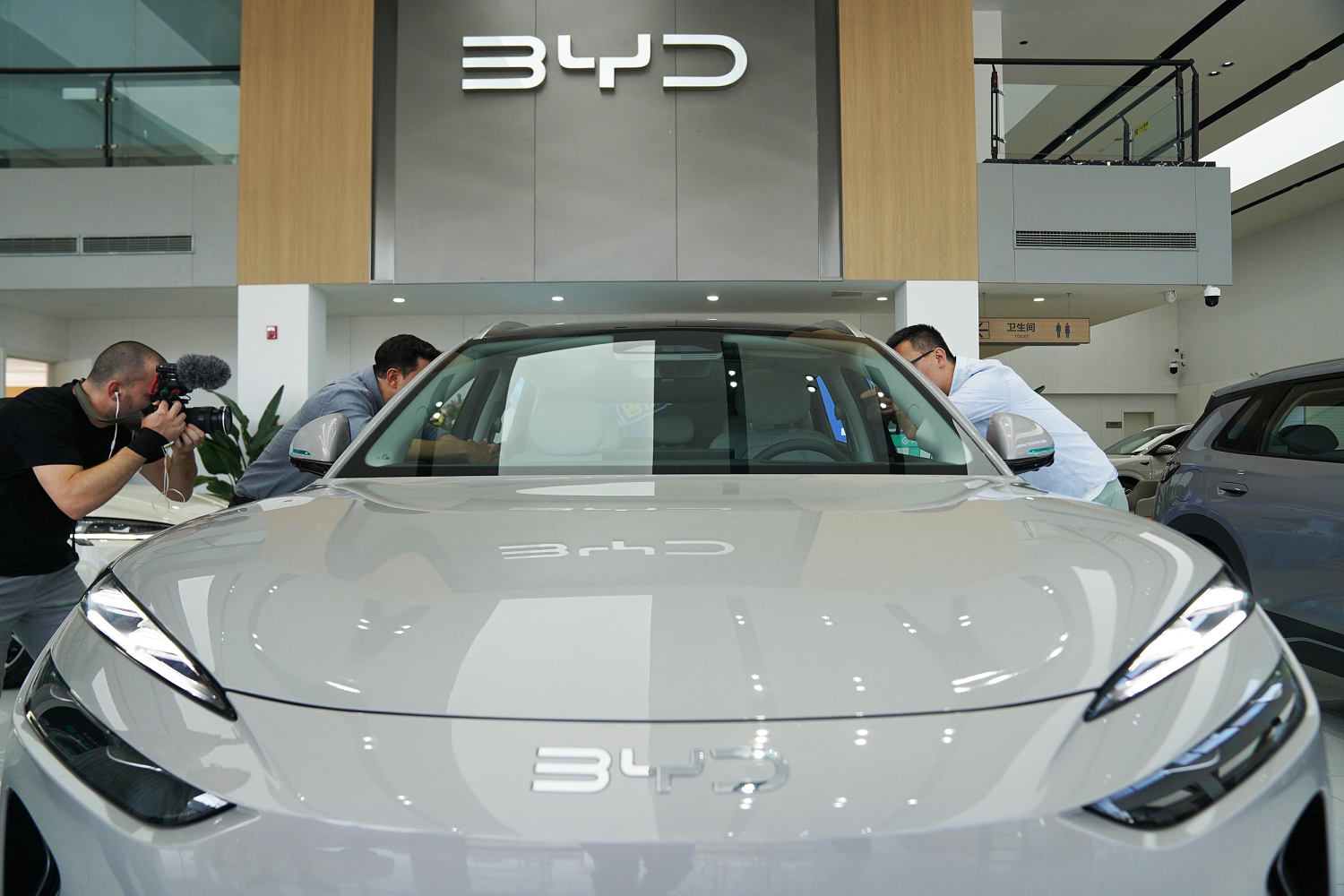
Consider the math of a middle-class family in Marseille or Mexico City. They want to go green, but they aren’t interested in a $60,000 status symbol. They need a car that costs $12,000, charges in thirty minutes, and doesn’t rattle on the highway. In the past, that car didn't exist. Today, it wears a badge from BYD, MG, or Wuling.
The Factory that Ate the World
China didn't stumble into this dominance. They built a vertical trap. In most industries, companies buy parts from a sprawling web of global suppliers. In the Chinese EV ecosystem, the person who makes the battery often owns the mine that produced the lithium and the factory that stamps the chassis.
This isn't just "cheap labor." That is a tired myth that ignores the sheer scale of the engineering at play. By controlling the entire life cycle of the battery—the most expensive part of any EV—companies like BYD have achieved a level of cost-reduction that seems like magic to Western observers. When you own the mine, the refinery, and the assembly line, you don't just save money. You save time. You iterate. You fail faster and fix things before the competition has even finished their first meeting.
The result is a price gap that feels like a canyon. In China, you can buy a functional, stylish EV for less than the price of a used Honda Civic in the States. This isn't a "budget" option in the way we usually think of it. These cars feature rotating touchscreens, voice-activated controls, and ranges that compete with the best of what Detroit has to offer.
The world is biting. In Southeast Asia, Chinese brands have seized nearly 80% of the EV market share in just a few years. In Brazil, sales are tripling. In Europe, despite new tariffs and political grumbling, the cars are appearing on every street corner. The "storm" isn't coming; the rain is already hitting the pavement.
The Fortress of Rust and Policy
So, why can’t you buy one?
If you live in Peoria or Portland, the Chinese EV revolution feels like a rumor. You see the headlines, but your local dealership is still stocked with $50,000 gas-guzzlers and the occasional high-priced domestic electric. This isn't an accident of geography. It is a deliberate, multi-layered wall built from a mixture of old-fashioned protectionism and modern geopolitical anxiety.
The first layer of the wall is financial. The U.S. government recently slapped a 100% tariff on Chinese-made electric vehicles. Effectively, if a company wants to sell a $20,000 car in America, they have to pay the government another $20,000 just for the privilege of crossing the border. It’s a move designed to protect the "Big Three"—Ford, GM, and Stellantis—who are still trying to figure out how to make an affordable EV without losing billions of dollars in the process.
The second layer is psychological. There is a deep-seated fear of data. Modern EVs are essentially rolling smartphones. They have cameras, microphones, and GPS trackers that are constantly pinging servers. Washington looks at a Chinese EV and doesn't see a car; they see a potential surveillance device on wheels. Whether that fear is grounded in reality or fueled by a New Cold War mentality matters less than the outcome: the door is locked, barred, and bolted.
The Invisible Stakes for the American Driver
Protectionism always comes with a hidden bill, and it’s the consumer who pays it.
Imagine a hypothetical driver named Sarah. She lives in an American suburb, drives forty miles a day, and is watching her gas budget eat into her grocery money. She wants an EV. She sees a news clip of a $10,000 "Seagull" hatchback that could solve her problems tomorrow. But she can’t have it. Instead, she is told to wait for a domestic model that might be ready in three years and will likely cost twice as much.
By keeping Chinese competition out, the U.S. has created a "walled garden" for its own automakers. On the surface, this saves American jobs. It keeps the factories in Michigan and Ohio humming. But underneath, it creates a dangerous lack of urgency. If Detroit doesn't have to compete with the most efficient manufacturers on the planet, will they ever actually become efficient?
History suggests the answer is no. When you remove the threat of a faster, cheaper competitor, innovation tends to stall. We are essentially betting that we can build a world-class EV industry in a vacuum, shielded from the very companies that have already solved the puzzle.
The Cobalt and the Cold Shoulder
There is a certain irony in the American stance. We want to lead the green energy transition. We want to be the "battery capital of the world." Yet, we are cutting ourselves off from the primary source of the world's battery expertise.
China accounts for roughly 75% of global battery cell production. They have spent two decades refining the chemistry of Lithium Iron Phosphate (LFP) batteries, which are cheaper and more durable than the Nickel-based batteries favored by many Western brands. By excluding Chinese vehicles and, in many cases, their battery components, the U.S. is choosing to take the hardest, most expensive path to electrification.
It is a gamble of staggering proportions. If American automakers can use this breathing room to catch up, the tariffs will be remembered as a masterstroke of industrial policy. But if they use this time to simply produce more of the same high-margin, high-cost vehicles, they will find themselves increasingly isolated.
The rest of the world is standardizing around Chinese technology. The chargers in Thailand, the repair shops in Spain, and the software interfaces in Australia are all being shaped by the needs of these new Eastern giants. If the U.S. stays behind its wall for too long, it may find that when it finally decides to come out, the rest of the world is playing a game it no longer understands.
The Choice at the Border
This isn't just about cars. It’s about who gets to define the next century of movement.
For the person standing in a dealership in Beijing, the future is already here. It’s quiet, it’s digital, and it’s accessible to the masses. For the person in Chicago, the future is still a luxury item, a political football, and a source of constant debate.
We are watching a Great Divergence. On one side of the ocean, a hyper-efficient, state-backed machine is flooding the globe with cheap electricity on wheels. On the other, a storied industrial powerhouse is trying to reinvent itself behind a fortress of taxes and trade barriers.
As Li Wei looks back at his map in Shenzhen, he doesn't look angry. He looks patient. He knows that gravity is a powerful force. Eventually, the pressure of a cheaper, better product usually finds a way to crack even the thickest wall. Until then, the American road remains a strange island of the past, while the rest of the world accelerates into a silent, electric dawn.
The silence isn't just the sound of a motor; it's the sound of a shift in the global order that no tariff can truly stop.