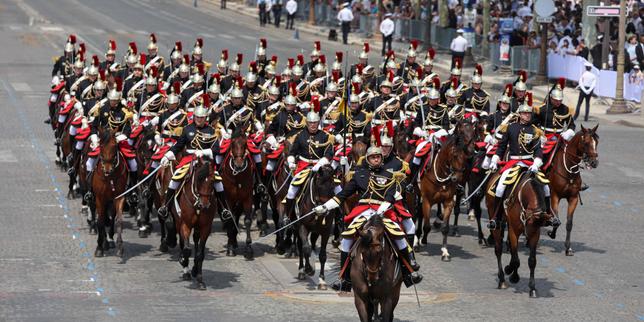
French political leaders love a military parade on July 14th, but behind the gleaming tanks and flyovers lies a mathematical fiction. The much-touted 413 billion euro Military Programming Law, designed to rebuild France’s armed forces between 2024 and 2030, is a ticking financial time bomb. The country has promised its military a dramatic spending surge, but the bulk of this cash is backloaded to the years following the 2027 presidential election. France is essentially ordering a fleet of expensive military hardware today and leaving the bill for a future, highly uncertain government to pay.
This funding structure is not an accident of accounting. It is a deliberate political calculation that avoids hard choices today by creating an unsustainable cliff tomorrow.
The Backloaded Trap of the Military Planning Law
Military budgeting is usually a game of gradual increases. But the current French defense plan resembles a steep ski ramp. To reach the promised 413 billion euro total, the defense budget must rise by modest increments of 3 billion to 3 billion euro annually in the early years. Then comes the catch. After 2027, the yearly budget increases must suddenly balloon to nearly 6 billion euros annually.
This delay keeps the peace in the short term. By keeping early spending modest, the current administration avoids having to slash popular public services or raise taxes to fund the army. The problem is that 2027 is the hard limit of Emmanuel Macron’s second presidential term. Whoever succeeds him will inherit a mandatory, legally binding commitment to inject historic sums of cash into the military, just as the bill for decades of neglected domestic infrastructure comes due.
Military commanders are already quietly panicking about this timeline. They know that a commitment on paper is only as good as the political will of the parliament that votes on the annual budget. If the next administration decides to rewrite the law, the entire modernization plan collapses.
The Hard Math of a Sovereign Debt Crisis
Defense spending does not exist in a vacuum. It is tethered to the state of the national treasury, and France’s treasury is in deep trouble.
The national deficit has repeatedly blown past Eurozone targets, hovering near 6% of gross domestic product. Credit rating agencies have repeatedly downgraded France's sovereign debt, driving up the cost of borrowing. The European Commission has placed Paris under an excessive deficit procedure, demanding immediate and drastic fiscal consolidation.
France's Projected Debt-to-GDP Trajectory vs. EU Target
-------------------------------------------------------
EU Stability Pact Limit:    60% of GDP
France (Current):          ~112% of GDP
Projected Deficit (2026):  ~5.5% of GDP
To keep the defense budget on its planned trajectory, the French state must find tens of billions of euros in savings from other public sectors. In a country where public services are already strained, cutting education, healthcare, or social safety nets to pay for fighter jets is a political non-starter.
Governments always prefer social peace over military preparedness when the domestic pressure builds. When the next fiscal crisis hits, the defense budget will be the easiest target for cuts, regardless of what the current planning law says.
The Illusions of Sovereign Grandeur
For decades, French strategic doctrine has insisted on maintaining a "complete model" of defense. This means France insists on being able to do everything. It maintains a permanent sea-and-air nuclear deterrent, operates a nuclear-powered aircraft carrier, deploys troops overseas, and develops its own military satellites, fighter jets, and main battle tanks.
It is an expensive point of national pride. But trying to maintain every single capability on a restricted budget means France does nothing at scale.
The French army currently has fewer than 200 main battle tanks. In a high-intensity European land conflict, that entire fleet could be destroyed in a matter of weeks. The navy operates a single aircraft carrier, meaning that when the Charles de Gaulle is in drydock for maintenance, France has no carrier strike capability at all. The country is building a massive, next-generation nuclear carrier to replace it, a project estimated to cost upward of 10 billion euros.
That single ship will devour resources that could otherwise fund ammunition reserves, air defense systems, and drone fleets. France is prioritizing prestige platforms over the gritty, unglamorous supplies needed to wage a prolonged, modern war.
The Political Gridlock Awaiting the Next Commander in Chief
The political landscape in Paris has fractured. The days of stable parliamentary majorities that routinely waved through defense budgets are over.
A future government led by either the hard right or the broad left coalition would bring wildly different priorities to the defense ministry. The left-wing factions have already signaled a desire to redirect military funds toward climate initiatives and public services. Meanwhile, the nationalist right remains deeply skeptical of joint European defense programs, preferring localized production that often increases unit costs and delays delivery.
Joint programs like the Future Combat Air System, a planned Franco-German-Spanish stealth fighter, are already plagued by industrial disputes and political friction. If a new French government pulls back on these partnerships to protect domestic factories, the costs of developing these systems will skyrocket. France cannot afford to build these systems alone, but it lacks the political stability to remain a reliable partner.
The Brutal Choices French Commanders Must Make
Military planners cannot afford to rely on political promises. They must prepare for the realistic scenario where the post-2027 budget increases simply do not happen.
This means making hard choices now rather than waiting for a crisis to force their hand. The first choice involves the nuclear deterrent. France spends roughly a quarter of its procurement budget on maintaining and modernizing its nuclear arsenal. This is the ultimate insurance policy, but it starving the conventional forces of basic necessities. If the budget is cut, does France reduce its nuclear posture to keep its conventional army from shrinking into irrelevance?
The second choice is the abandonment of the "complete model" doctrine. France may have to accept that it can no longer be a global military power with a hand in every domain. It may have to retire certain capabilities entirely, relying on NATO allies to fill the gaps.
Giving up the ability to conduct independent, high-end carrier operations or heavy armored warfare would be a massive blow to French diplomatic pride. But continuing to fund under-resourced, hollowed-out versions of these capabilities is a recipe for military disaster. The illusion of grandeur is a luxury the French treasury can no longer support.