Cold does not hurt at first. It lies.
At minus twenty-five degrees Celsius, with wind howling off the Ellsworth Mountains at thirty knots, the human body initiates a quiet, polite negotiation. First, the surface capillaries in your cheeks and fingertips slam shut, hoarding warm blood for the heart and brain. You feel a sharp, glass-like sting. Ten minutes later, the sting vanishes. A strange, heavy warmth spreads over your skin. That warmth is the danger. It means the nerves have stopped reporting back to headquarters.
Now imagine staying inside that negotiation for thirty-two consecutive hours.
For most people, running a hundred miles—roughly four back-to-back marathons—on a flat, paved trail in mild autumn weather is an incomprehensible feat of endurance. Doing it at Union Glacier, deep inside the Antarctic Circle, where the sun never sets yet casts zero warmth, and where every single footstep sinks two inches into shifting, sugar-grain snow, changes the math entirely. You are no longer running a race. You are managing a slow-motion biological emergency while your brain tries to convince you to lie down in the snow and go to sleep.
When the headlines broke that a mother had become the first woman to run 100 miles across the frozen interior of Antarctica, the internet did what it always does. People shared the clip, typed a few fire emojis, marveled at the sheer grit of it, and scrolled on to the next novelty.
They missed the real story.
To understand what actually happened out there on the blue ice, you have to stop looking at the finish line and start looking at the kitchen table six months earlier.
The Invisible Ledger of Leaving
Let us invent a runner for a moment—a hypothetical composite built from the lived reality of the women who actually toe the line at the bottom of the world. Call her Clara.
Clara is thirty-nine. She has two kids under the age of ten, a full-time job that does not pause for polar expeditions, and a calendar color-coded down to fifteen-minute increments. When an elite male ultrarunner decides to tackle an extreme polar objective, the narrative surrounding him is almost universally heroic. He is an explorer. A conqueror. He goes into the pain cave, emerges victorious, and returns to a chorus of admiration.
When a mother does the exact same thing, the cultural script changes. The questions shift from How did you train? to Who is watching your kids?
Every long run becomes a moral calculation. To prepare for a hundred miles in Antarctica, you cannot simply jog around the neighborhood three times a week. You have to log eighty to a hundred miles every seven days for months. You have to drag heavy tractor tires through sand or gravel for hours to simulate pulling a gear sled, or to build the specific hip-flexor armor required to lift your legs out of deep snow thousands of times in a row. You have to sit in walk-in freezers or train at midnight in the dead of winter to learn how your zippers, goggles, and hydration tubes behave when moisture turns instantly to solid ice.
All of those hours come out of a finite bank account. They are subtracted from bedtime stories, Saturday morning soccer games, quiet dinners, and the invisible domestic labor that keeps a household from drifting into chaos.
I have stood at the starting line of ultramarathons in sub-zero conditions, watching my breath freeze into white crust on my collar, and I can tell you with absolute certainty that the hardest mile is never on the course. The hardest mile is walking out your own front door while a seven-year-old asks why you have to leave again.
That guilt is heavy. It weighs far more than thermal base layers, chemical hand warmers, or a pack stuffed with high-calorie freeze-dried rations. Yet it is also the exact fuel that keeps a mother moving when a younger, unencumbered athlete might step off the course. If you have already paid the emotional price of absence, quitting at mile sixty is not just a athletic failure. It feels like a theft from your own family.
The Physics of Running on Sugar
To appreciate why an Antarctic 100-miler breaks even seasoned marathoners, you have to understand the surface.
On normal asphalt, roughly eighty percent of the energy your leg muscles generate is returned to you through the elastic recoil of your Achilles tendon and the foam in your shoe. You bounce forward. It is an efficient, rhythmic pendulum.
Antarctic snow has zero recoil.
Think of the last time you walked across deep, dry beach sand. Every time you push off, the ground gives way beneath your heel, stealing your momentum and forcing your calves, hamstrings, and lower back to do twice the work for half the distance. Now freeze that sand to thirty below zero, carve jagged ridges called sastrugi across it with katabatic winds, and stretch the course across a vast, featureless white bowl where the horizon disappears into the sky.
There are no trees. There are no mile markers with cheering crowds. There are no smells—because at those temperatures, volatile organic compounds do not evaporate, leaving the air completely sterile and metallic.
Your senses starve.
Without visual landmarks to measure your progress, your brain loses its ability to judge speed or distance. You can run for forty minutes and feel as though you are moving on a giant, frozen treadmill. The terrain looks identical to the terrain you passed four hours ago. In sensory deprivation studies, human subjects begin experiencing mild auditory and visual hallucinations in less than twenty-four hours. Out on the ice, exhausted and dehydrated, runners routinely see black dogs trotting beside them, hear distant radio broadcasts in the howl of the wind, or become convinced that a jagged pressure ridge half a mile away is a warm cabin with smoke rising from the chimney.
And then there is the sweat problem.
In warm weather, sweat is your radiator; it evaporates and cools you down. In Antarctica, sweat is a death sentence. If you run too hard during the first twenty miles and soak your merino wool base layer, the moment you slow down to walk an incline or eat a gel, that moisture freezes against your skin. Your body temperature plummets. Hypothermia does not arrive with dramatic shivering; it arrives with slurred speech, fumbling fingers that can no longer unbuckle a chest strap, and sudden, lethal apathy.
Winning—or simply surviving—requires running on a razor’s edge of effort. You must move fast enough to generate internal furnace heat, yet slow enough that you never break a sweat. You have to eat three hundred calories every hour even when your stomach has shut down and the sight of a frozen energy bar makes you gag. You have to melt snow or keep water bottles tucked inside your armpits so your drinking supply does not turn into a solid brick of ice.
Why Women Own the Deep End of Endurance
There is a persistent myth in sports culture that extreme physical suffering is a male domain, and that women who enter ultra-endurance events are anomalies beating the odds.
The physiological data tells the exact opposite story.
While men generally possess higher VO2 max ceilings and greater explosive muscle mass—advantages that dominate distances from the 100-meter dash up to the standard 26.2-mile marathon—those advantages evaporate once a race crosses the fifty-mile mark. Beyond seventy, eighty, or a hundred miles, biology flips the script.
Female athletes metabolize fat more efficiently than men during prolonged, sub-maximal exercise. When your glycogen stores—the body's high-octane sugar fuel—are completely depleted after four hours of movement, the athlete who can smoothly burn fat reserves without hitting a catastrophic metabolic wall wins. Furthermore, women have higher percentages of Type I slow-twitch muscle fibers, which are remarkably resistant to fatigue and microscopic tearing over thirty-hour efforts.
Look at the historic records across ultra-endurance sports over the past decade. Women have won the overall Moab 240, finished first outright in the grueling 268-mile Spine Race across the Pennine Way in winter, and shattered transcontinental cycling records.
So why had no woman ever run 100 miles in Antarctica before?
Not because of physiology. Because of access.
An expedition to the Antarctic interior is not a $150 local race entry. Between specialized polar logistics, flights on cargo planes from Punta Arenas, Chile, onto blue-ice runways, mandatory safety extraction insurance, and expedition-grade gear, the financial barrier easily clears thirty to fifty thousand dollars. Historically, corporate sponsors have poured that kind of capital into male adventurers while asking female athletes how they plan to balance their training with motherhood.
Breaking that barrier was never about proving a woman's body could survive the cold. It was about refusing to accept the invisible gatekeeping that kept women off the starting line in the first place.
Mile Eighty-Two
Let us go back to the ice, deep into the second day, when the novelty of the landscape has burned away and only the machinery of survival remains.
At mile eighty-two, nobody cares about history books. Nobody cares about press releases, sponsor logos, or breaking glass ceilings. The world shrinks to a circle of white snow three feet in diameter directly in front of your frozen laces.
At that stage of an Antarctic hundred-miler, your feet have swollen a full size inside your trail shoes, bruised black from kicking against hardened snow ruts ten thousand times. Your eyelids are crusted with frost. Every breath burns the lining of your trachea because the air contains virtually zero humidity—Antarctica is, by definition, the driest desert on Earth.
Consider what happens next inside a mother's head during those final eighteen miles.
When a solo adventurer hits the absolute bottom of their reserves, their primary anchor is personal pride—the desire to prove something to themselves or the world. Pride is a brittle fuel. Under extreme hypothermia and sleep deprivation, pride cracks easily. A voice whispers that nobody would blame you if you stopped, that you have already gone farther than ninety-nine percent of humans ever will, and that stepping into the heated expedition tent is the rational choice.
A mother carries a different anchor.
Throughout the sleepless nights of early parenthood—walking a colicky infant across a dark living room at three in the morning, sitting beside a hospital bed during a high fever, holding a household together while running on three hours of fractured sleep—mothers undergo a relentless, unglamorous conditioning in functional exhaustion. They learn a fundamental truth that most people never discover: feeling completely empty does not mean you are actually out of gas. It just means your brain is trying to protect its reserves.
You learn to separate the sensation of agony from actual physical danger. You learn to take one more step, boil one more bottle of water, zip one more layer, and keep moving even when every nerve ending is screaming for relief.
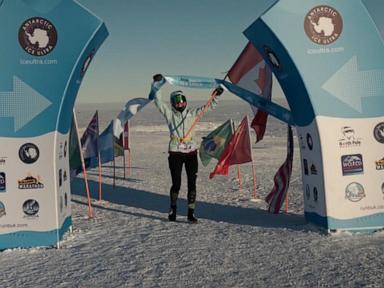
Out on the polar plateau, with eighteen miles left and the wind rising again, that quiet, domestic toughness transforms into something unstoppable. It is not cinematic. There is no swelling orchestral music. It is just one frozen foot placed deliberately ahead of the other, over and over, until the distant orange flags of the base camp finally stop shimmering like a mirage and solidify into canvas and rope.
The Aftermath Nobody Films
The video clips always end at the finish tape. We see the raised arms, the frost-rimed eyelashes, the tears freezing instantly on windburned cheeks, the embrace from the race director.
We rarely see what happens three days later.
We do not see the flight back north across the Drake Passage, the sudden shock of smelling wet earth and diesel exhaust in southern Chile, or the weird, hollow quiet that settles into your bones after achieving something that consumed every waking thought for two years. You cannot stay on the ice forever. Eventually, you have to come down from the mountain, unpack the salt-stained thermal gear, and step back into a life that kept spinning while you were gone.
You walk through your front door. Your kids drop their backpacks, run across the hardwood floor, and throw their arms around your waist—not because you just rewrote polar athletic history, and not because your name is circulating on news feeds around the world, but simply because you are home and dinner needs to be made.
And as you stand there in the kitchen, still nursing black toenails and wind-chapped lips, looking down at the small hands gripping your sweater, you realize the truth that every headline got backward. Running a hundred miles across the frozen end of the earth was never an escape from motherhood. It was the ultimate proof of what motherhood had already built.