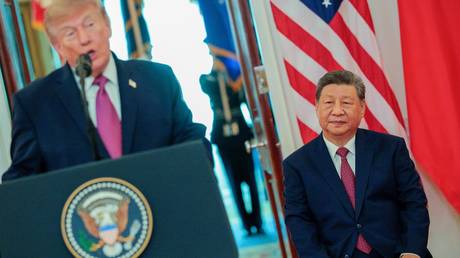
When a former commander-in-chief leans across a diplomatic table and nudges a foreign counterpart to load up on domestic defense hardware, the gesture is rarely about simple procurement. Former President Donald Trump’s reported push for Chinese President Xi Jinping to purchase American military equipment sits at the intersection of transactional diplomacy, industrial base politics, and high-stakes economic coercion. Former ambassadors and trade negotiators recognize this playbook immediately. It is an attempt to weaponize bilateral trade deficits through heavy manufacturing, turning sovereign security items into ordinary bargaining chips in a broader commercial war.
The core premise reported by diplomats centers on a blunt proposition. If Beijing wants relief from aggressive tariffs and trade penalties, one path forward involves absorbing massive quantities of American-made defense technology. To understand why this strategy was deployed, we must examine the mechanics of how superpower friction operates behind closed doors. Trade negotiations rarely rely on abstract concepts like intellectual property protections alone. They require tangible ledgers, numbers that can be flashed on a Washington spreadsheet to prove a point about domestic job creation and export volume.
Washington defense contractors operate within a distinct ecosystem of lobbying, foreign military sales, and strict congressional oversight. Foreign military sales require notification to Congress, intense scrutiny regarding technology transfer, and deep concerns over proprietary secrets falling into strategic competitor hands. Proposing advanced hardware sales to Beijing ignores statutory roadblocks designed precisely to prevent the proliferation of sensitive defense capabilities to primary geopolitical rivals. Trump understood the optics of heavy manufacturing exports, yet the practical realities of selling sophisticated military systems across the Pacific created an immediate paradox.
Beijing understands leverage. When faced with suggestions to acquire American defense inventory, Chinese leadership views the proposal through the lens of national security self-sufficiency and technological independence. China has spent decades and billions of dollars systematically decoupling its military-industrial complex from foreign reliance. Domestic shipyards churn out destroyers, aviation plants refine fifth-generation stealth fighters, and state-backed research laboratories develop indigenous electronic warfare systems. The idea of writing multi-billion-dollar checks to American defense firms for weapon systems stands diametrically opposed to Beijing's grand strategy of self-reliance.
Diplomacy conducted via transactional pressure points often creates strange bedfellows and impossible demands. By framing national security hardware as an export commodity comparable to soybeans or commercial airliners, the administration flattened the distinction between commercial trade and sovereign survival. Weapons are not consumer goods. They embody classified code, proprietary metallurgy, and strategic doctrine. Handing a potential adversary a catalog of advanced munitions and saying "buy American" misunderstands the fundamental nature of modern military power.
Consider the broader historical precedent of economic statecraft. From the grain embargoes of the Cold War to modern semiconductor export controls, nations have consistently attempted to use economic dominance to shape competitor behavior. Yet, forcing a competitor to fund your own defense industrial base through mandatory procurement is an entirely different tier of ambition. It assumes that the target nation values immediate tariff relief above long-term strategic autonomy. History suggests otherwise. Major powers routinely absorb short-term economic pain rather than compromise their core military independence.
The domestic political utility of such demands, however, cannot be ignored. Within the Beltway, appearing tough on trade while simultaneously championing American manufacturing exports plays well to key industrial constituencies. When politicians talk about boosting exports, heavy defense manufacturers represent some of the largest ticket items on the manifest. Even if the proposal itself was a non-starter in Beijing, floating the concept serves a dual purpose. It signals to domestic voters an unwavering commitment to rectifying trade imbalances, while simultaneously signaling to foreign adversaries that every sector remains on the table during negotiations.
Trade negotiations function as a multi-layered chess match where public pronouncements and private demands rarely align. The dialogue surrounding weapon purchases highlights the inherent friction of trying to merge capitalist salesmanship with great power competition. As global supply chains fracture and nations race to secure critical technologies independently, the era of transactional defense diplomacy faces severe limitations. Sovereignty cannot be easily purchased off a catalog, and strategic rivals rarely finance the very weapons designed to keep them in check. The ledger remains unbalanced because some things cannot be bought, and other things should never be sold.