Two and six.
Say those two numbers out loud in the middle of November in Florham Park, New Jersey, and they do not sound like a football record. They sound like a countdown. They sound like the rhythmic, heavy ticking of a clock hanging over the head of a man who spent his entire adult life learning how to survive the violent chaos of the National Football League, only to find himself standing motionless in the eye of a quieter, far more merciless storm.
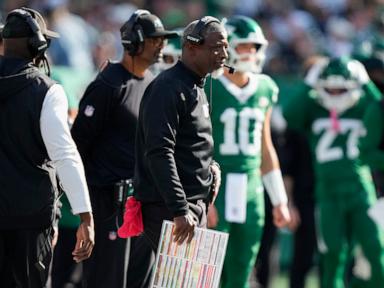
When Aaron Glenn stood at the podium this week, the fluorescent lights of the media room hummed with that distinct, sterile buzz every beaten-down coach knows by heart. Reporters leaned forward, notebooks open, microphones angled like spears. They wanted blood, or at least a confession of panic. They wanted to know if the first-year head coach of the New York Jets was looking over his shoulder, checking the exits, wondering if the seat beneath him had already caught fire.
Glenn did not blink. He did not flinch. He looked out over a sea of expectant faces and told them, plainly and without the theatrical bravado that usually plagues men in desperate positions, that his job security was not on his mind. Fixing a broken 2-6 football team was.
It is easy to dismiss a quote like that as standard coaching boilerplate, the kind of sanitized deflection handed out in media training binders across the league. We have heard it a thousand times before from men who were packing their offices three weeks later. Yet, if you strip away the cynicism that comes with covering or rooting for a franchise that has not tasted the postseason since 2010, something far more human—and far more compelling—emerges from that room.
To understand what Aaron Glenn is actually doing right now, you have to understand the specific, suffocating weight of wearing the Jets headset, and the peculiar psychology of a man who refuses to look at the guillotine while he is still trying to sharpen a blade.
The Architecture of a Collapse
Consider a hypothetical season-ticket holder—let us call him Marcus—who has driven up the New Jersey Turnpike every autumn Sunday for twenty-five years. Marcus remembers when Aaron Glenn was a rookie cornerback drafted twelfth overall by this very franchise in 1994, a compact, ferocious blur of speed and instinct who played with the kind of defiant pride that made losing feel like a personal insult. When the Jets hired Glenn away from Detroit—where he had spent four years helping Dan Campbell haul the Lions out of decades of existential misery—Marcus felt something he had long since trained himself to suppress. He felt hope.
Then September arrived, and reality swung a sledgehammer.
A 2-6 start in New York is not merely a string of losses; it is an environmental hazard. The air inside the facility thickens. Every dropped pass in practice echoes like a gunshot. Every third-down conversion surrendered on Sunday afternoon triggers a Monday morning autopsy on talk radio, where callers demand firings before the players have even finished their cold tubs. By the time a team reaches the halfway mark with six losses, the human brain naturally shifts into self-preservation mode. Assistants start quietly texting agents to see what college jobs might open up in December. Veteran players begin calculating how many snaps they need to protect their bodies for their next contract. Owners start taking quiet phone calls from consultants.
Fear is contagious in a locker room, and it travels fastest from the top down.
Think of a commercial airline pilot flying through severe, unforecasted wind shear at thirty-five thousand feet. If the passengers look through the cockpit door and see the captain frantically reading the emergency bailout manual or checking his life insurance policy, panic becomes absolute. The captain cannot afford the luxury of worrying about whether the airline will fire him after the landing. His entire cognitive bandwidth must be consumed by pitch, yaw, airspeed, and the terrifying physics of keeping the nose level until the storm breaks.
That is the exact psychological tightrope Aaron Glenn is walking right now. When he insists he is not thinking about his job security, he is not offering a polite lie to the press. He is describing a strict survival discipline. The moment a head coach starts coaching to save his job, he stops coaching to win games. He calls plays out of fear of criticism rather than conviction. He benches young players who need reps in favor of safe veterans who will keep a loss respectable by ten points instead of twenty-four. He becomes a politician, and football players—who possess an almost supernatural radar for fraudulence—immediately stop listening.
Ghosts in the Meadowlands
To grasp why this particular moment carries so much invisible tension, you have to look at the graveyard of men who stood at that exact podium before him. The New York Jets have spent the better part of fifteen years trapped in a violent cycle of impatience. Adam Gase. Robert Saleh. Todd Bowles. Rex Ryan. Every regime began with a press conference full of grand promises about culture, accountability, and toughness, and nearly every regime ended in mid-season turmoil, interim tags, and another desperate reset.
History creates a gravitational pull. In Florham Park, failure does not just sit in the record books; it lingers in the hallways like dampness after a November rain.
When a franchise goes more than a decade without a playoff appearance, losing ceases to be an anomaly and becomes a habit—a subtle, insidious expectation that when something goes wrong in the fourth quarter, the roof is going to cave in. You can see it in the body language of a 2-6 team when a drive stalls at the opponent’s thirty-yard line. Shoulders slump a fraction of an inch. Eyes dart toward the scoreboard. The collective internal monologue shifts from How do we break their will? to Here we go again.
Glenn knew this before he ever signed his contract. He lived it as a player in the mid-nineties, enduring the brutal 1-15 nightmare of 1996 under Rich Kotite before Bill Parcells walked through the door and dragged the organization upright by its collar. Glenn saw firsthand what genuine cultural reconstruction actually looks like, and he knows it does not happen on a clean, linear graph. It is ugly. It involves tearing rotted floorboards out of a house while people are still trying to live inside it.
That lived experience is why Glenn’s demeanor at 2-6 looks radically different from the shell-shocked expressions of his predecessors. He has already seen the absolute bottom of professional football, and he survived it. More importantly, he spent four years in Detroit watching a rebuild that looked dead on arrival—starting 3-13-1 in year one, stumbling out to a catastrophic 1-6 start in year two—before the foundation finally hardened and the Lions turned into an NFC powerhouse.
He has seen the blueprint work when everyone outside the building was calling for blood.
What Fixing Actually Looks Like
So when Glenn says he is focused entirely on fixing the Jets, what does that actually mean behind the closed doors where cameras are not allowed? It is not dramatic speeches. Hollywood has ruined our understanding of how football teams turn around; nobody wins an NFL game because a coach delivered a tear-jerking monologue in the tunnel before kickoff.
Fixing a 2-6 team happens in suffocatingly small, unglamorous increments at six o'clock on a Tuesday morning.
It is sitting in a dark film room with a second-year defensive back and rewinding the same four-second clip twenty times until the player understands why his outside foot was six inches too wide at the snap, leaving a sliver of daylight for a slant route on third-and-four. It is an offensive line coach screaming himself hoarse on a practice field in forty-degree drizzle because a guard’s hand placement was lazy on a simulated double-team, knowing that laziness in November becomes a strip-sack in December. It is Glenn walking up to a frustrated star receiver whose targets have dried up and telling him the unvarnished truth to his face before resentment can rot into a locker room whisper campaign.
Accountability in the NFL is exhausting. It requires a head coach to confront grown men—millionaires with massive egos and elite athletic pride—day after day, even when the scoreboard on Sunday refuses to reward the effort.
Consider the alternative. If Glenn were worried about his job security, his focus would drift upward toward ownership and outward toward public perception. He would spend energy managing narratives, leaking excuses about injuries, or subtly shifting blame toward coordinators to buy himself another twelve months of employment. Instead, by locking his eyes strictly on the tape, the practice script, and the eighty-some men in his locker room, he is forcing the entire organization to share his tunnel vision.
There is a quiet, stubborn dignity in that refusal to flinch. Even if the wins do not materialize fast enough to satisfy an impatient fan base, the standard itself is being welded into place. Players notice when a coach refuses to panic. They notice when the message on Wednesday after a brutal loss sounds identical to the message on Wednesday after a victory.
The Verdict Waiting in the Cold
None of this guarantees a fairytale ending. The National Football League is not a sentimentality business; it is a ruthless ledger of wins, losses, and television ratings. In New York, patience is the scarcest natural resource on earth, and a 2-6 hole leaves virtually zero margin for error over the final nine weeks of the season. Ownership has shown before that when the noise from the stadium seats grows loud enough, logic often gets thrown out the window in favor of appeasement.
Glenn knows the math. He knows that in this league, you are always living on borrowed time, and that goodwill evaporates the moment the fourth-quarter clock hits zero with the wrong number on the board.
Yet, there is something strangely liberating about standing at the edge of the cliff and refusing to look down. By stripping away the fear of getting fired, Glenn has reclaimed the only leverage a football coach truly owns: complete command of the present moment. He cannot control what happens in January. He cannot control the headlines on the back pages of the tabloids tomorrow morning. He can only control the next meeting, the next snap, and the relentless demand that his players refuse to surrender their pride just because the standings say they are buried.
Late on Wednesday afternoon, long after the reporters had packed up their tripods and filed out of the media room to write their stories about hot seats and dismal records, the practice lights outside 1 Jets Drive flickered on against the early November dusk. Somewhere out on that damp turf, a whistle blew. A handful of players stayed behind after the horn, working through footwork drills in the gathering cold while a man in a dark sweatshirt stood ten yards away, arms crossed, watching every step like it was the opening drive of the Super Bowl.