Punching an asteroid four years ago looked easy on paper. NASA slammed its 576-kilogram DART spacecraft into Dimorphos at 6.1 kilometers per second in September 2022, cutting the little moonlet's orbit around Didymos by roughly 33 minutes. That proved we can shove a space rock off course. Honestly, though, hitting a target is only half the job if you don't know what broke when it hit.
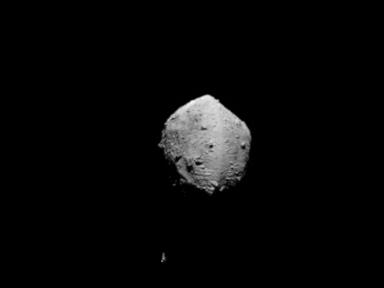
Now the European Space Agency's Hera spacecraft has arrived at the binary system and unveiled its first close-up views. The images are wild. Instead of a neat little dent, DART flattened an entire face of the 151-meter moonlet into a stadium-sized impact crater stretching across the width of that side. Meanwhile, Dimorphos isn't neatly locked facing its bigger partner Didymos anymore. It's tumbling chaotically in space.
And there's more clutter out there than anyone expected. Hera has spotted hundreds of orbiting boulders, each just a few meters across, drifting around the pair. That turns a routine cosmic crime-scene check into a careful navigation puzzle.
Why One Successful Shove Isn't Enough Yet
If you've ever played pool, you know hitting the cue ball is straightforward until you start thinking about spin, cushion bounce, and scattered balls. Deflecting an asteroid works kind of like that, except you don't get a practice rack if a real threat ever shows up.
Earth-based telescopes did a great job timing Dimorphos after DART struck, showing its orbital period shrank from about 11.92 hours to 11.37 hours. That outcome beat pre-impact expectations by a wide margin. Still, measuring a change in orbit doesn't tell you how much momentum came from the spacecraft itself versus how much came from rock blasted backward off the surface.
Hera principal investigator Patrick Michel and ESA mission scientist Michael Kueppers have pointed straight at those core unknowns: how did the collision reshape Dimorphos, what is its true mass, and what physical traits explain why it reacted this way? Until engineers understand the physics behind the recoil, scaling a kinetic impactor up to a much larger or looser asteroid remains an educated guess.
- Momentum transfer is tricky: Ejected debris can push an asteroid harder than the impactor alone, which helps deflection if you predict it accurately and complicates things if you don't.
- Internal structure matters: A solid rock behaves very differently from a loose pile of rubble held together mostly by weak gravity.
- One test isn't a playbook: Getting a 33-minute orbital shift proves feasibility, not precision engineering across every asteroid type.
Stadium Crater Meets Chaotic Tumbling
What makes Hera's findings so striking isn't just one surprise. It's the mix of dramatic local damage and eerie stability right next door.
On the side DART hit, the surface looks heavily reworked, flattened into a crater roughly the span of a sports stadium. Look elsewhere on Dimorphos, though, and boulder fields in those regions still look remarkably similar to what DART's own cameras captured in 2022. Not every part of the moonlet got turned inside out.
Then there's the spin. Before impact, Dimorphos stayed tidally locked to Didymos, keeping roughly the same face pointed toward the larger asteroid, much like our Moon does with Earth. Hera's observations show that neat rhythm is gone. Dimorphos is now tumbling unpredictably along its orbit.
There's a practical upside for planetary defense researchers here. Because Dimorphos isn't stuck showing only one side to Didymos, Hera gets broader views of different faces as the moonlet tumbles. The catch is that modeling a tumbling, rubble-rich body takes way more math than tracking a steady spinner.
Navigating a Cloud of Meter-Sized Boulders
As if a tumbling target weren't enough, Hera is surveying a neighborhood crowded with hundreds of boulders measuring a few meters across in orbit around the system. ESA hasn't pinned down whether every single one of those rocks was kicked loose by DART. Either way, they're out there right now.
Moving a spacecraft closer to an asteroid when meter-scale rocks are circling nearby is no joke. Even a slow-moving boulder can ruin a solar array or knock a camera off alignment if nobody tracks its path. That's why mission teams have to factor those orbiting rocks into every closer pass.
What CubeSats Will Do That Hera Can't
Hera isn't alone out there for long. Following its closer inspection passes over the coming weeks, the mission is set to release two shoebox-sized CubeSats early in 2027—with plans to push the boundaries even further toward surface contact later on.
Sending small CubeSats in close makes total sense. A main spacecraft carries expensive instruments and high-value mission goals you don't want to gamble near jagged terrain or stray boulders. Smaller probes can take tighter, riskier trajectories to probe closer to the surface and gather data that helps pin down mass, structure, and geology.
If you follow space missions closely, you've probably noticed how often "first images" get treated like the finish line. In reality, they're the starting gun for months of careful orbital mechanics, gravity mapping, and hazard checks.
Smart Ways to Track Hera's Inspection Phase
If you want to follow this post-impact investigation without getting lost in hype, focus on what actually changes the science:
- Watch for mass and density estimates: Shape and crater size tell only half the story until scientists combine tracking data with close imaging to nail down how heavy and porous Dimorphos really is.
- Track the boulder hazard assessments: Pay attention to how the team maps those orbiting meter-sized rocks before moving into tightest observation orbits.
- Follow the 2027 CubeSat deployments: The real close-quarters risk-taking ramps up when the miniature spacecraft separate and operate near the asteroid pair.
- Check official mission updates: You can read primary mission dispatches directly from the European Space Agency Hera mission page rather than relying on second-hand summaries.