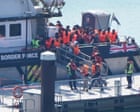
In mid-2026, medical and humanitarian reports emerging from Paris revealed an alarming trend: asylum seekers deported from the United Kingdom under the bilateral "one in, one out" agreement were arriving back on French soil bearing physical injuries, fractures, and severe psychological trauma. Documented by frontline agencies like Samusocial de Paris, these cases exposed the violent reality of administrative removal operations enforced across the Channel, tearing away the bureaucratic veneer of immigration management to reveal bruised bodies and broken minds.
For years, the political discourse surrounding small-boat crossings in the English Channel has been dominated by rhetoric about border security, deterrence, and orderly processing. Yet behind the press releases and diplomatic summits lies a grinding machinery of physical enforcement. When the UK government implemented its controversial removal scheme to send asylum seekers back to France in exchange for pre-screened applicants, officials promised secure and dignified transfers. The reality on the ground in Paris told a starkly different story. Medical evaluations conducted by French health workers cataloged a disturbing catalog of injuries sustained during detention and deportation proceedings in Britain.
The findings forced a reckoning over accountability in immigration enforcement. They raised uncomfortable questions about how private security contractors operate behind closed doors, what level of oversight governs forced removals, and whether political pressure to deliver deportation statistics has created an environment where excessive force goes unchecked. To understand how individuals fleeing war, persecution, and authoritarian states ended up back in France with fractured bones and restraint lacerations, one must examine the mechanics of the removal pipeline from its inception in British detention centers to its chaotic termination on the streets of Paris.
The Mechanics of Removal Behind Closed Doors
Detention centers are designed to be invisible. Tucked away on the outskirts of industrial parks or near major airports, facilities like Brook House, Colnbrook, or Yarl’s Wood operate outside the daily view of the public. Inside these walls, the countdown to removal moves swiftly once an individual’s legal avenues are exhausted or bypassed by emergency policy enactments.
The "one in, one out" arrangement relied on a rapid turnover. Speed was prioritized over thorough welfare checks. When deportation orders are executed against individuals who refuse to board charter flights voluntarily, physical coercion frequently becomes the default tool of compliance. Security guards deployed by private contractors are tasked with ensuring that deportees make it onto the aircraft, regardless of physical resistance or psychological distress.
Witness testimonies and legal filings gathered by human rights monitors depict a harrowing routine. Individuals are often woken in the middle of the night, informed with minimal notice that they are being expelled, and subjected to immediate physical restraint if they question the order or attempt to seek legal counsel. Handcuffs are applied tightly. Limbs are forced into submission. Pressure points are utilized to compel movement down narrow aircraft aisles.
The friction generated by these forced interactions leaves physical evidence. According to documentation compiled by medical personnel in France, many of the returnees presented with diffuse bruising, torn ligaments, and lacerations specifically matching the geometry of handcuffs and restraint holds. These were not injuries sustained during dangerous channel crossings or street altercations in France. They were inflicted inside secure British state-funded facilities by professionals trained in restraint techniques.
Private Contractors on the Front Line
The privatization of immigration enforcement has long created a diffusion of responsibility between corporate entities and government departments. Companies contracted by the Home Office to manage detention estates and escort deportees operate under commercial incentives that prioritize efficiency and contract compliance over human rights safeguards.
When allegations of excessive force surface, a familiar bureaucratic loop activates. The government points to the contractor, asserting that private firms are required to adhere to strict standards of dignity and respect. The contractor points to operational guidelines and the inherent difficulties of managing distressed individuals facing deportation. Meanwhile, independent oversight bodies struggle to gain unhindered access to real-time removal operations, leaving victims with few avenues for immediate recourse.
The financial stakes are high. Billions of pounds flow through the immigration detention and removal sector, creating an industrial complex where human movement is commodified. In this environment, injuries sustained during deportations are frequently categorized as isolated incidents or the unfortunate result of necessary compliance measures rather than systemic failures in training and accountability.
Medical Documentation in Parisian Emergency Rooms
The true physical and psychological toll of the deportation policy only became fully visible when returnees landed in France and encountered an entirely different administrative and medical infrastructure. Stripped of their meager belongings and dumped back into the precarious migrant ecosystem of northern France or Paris, many individuals sought emergency medical attention for symptoms they could no longer ignore.
Samusocial de Paris, an emergency humanitarian and medical aid service operating in the capital, began recording detailed clinical notes of individuals transferred under the Franco-British agreement. The reports paint a grim picture. One case involved a young man arriving in such an acute state of physical and mental collapse that he was immediately diverted from a reception center to hospital emergency department care.
Medical certificates issued by attending physicians noted significant trauma. There were fractured ribs, severe abdominal pain resulting from blunt force impacts, and deep lacerations around the wrists. Beyond the physical trauma, the psychological deterioration was equally profound. Clinicians reported cases of severe depressive episodes, acute post-traumatic stress disorder, disorientation, and suicidal ideation.
For many returnees, the deportation process triggered memories of the very atrocities they had fled in their home countries. Fleeing violence in regions like Sudan, Eritrea, or Afghanistan, these individuals had survived treacherous overland journeys and perilous sea crossings, only to experience state-sanctioned physical violence within the legal architecture of a Western democracy.
Psychiatrists working with these populations described the removal scheme as uniquely destructive to mental stability. The abrupt shattering of legal security, combined with physical manhandling, left patients in states of profound shock. Some suffered from involuntary body tics, mutism, and incoherent speech upon arrival. The medical documentation did not merely record injuries; it established a direct chronological link between the enforcement of the bilateral treaty and the bodily harm suffered by the deportees.
The Diplomatic Friction Between London and Paris
Migrant policy has always functioned as a high-stakes geopolitical chess match, where human lives are routinely leveraged for domestic political leverage. The bilateral agreement between the United Kingdom and France was forged in an atmosphere of mutual frustration over small-boat arrivals across the Channel.
For the British government, the deal was marketed as a crucial mechanism to reassert control over maritime borders and demonstrate decisive action to a restless electorate. For France, cooperation was secured through financial contributions and diplomatic balancing acts, with Paris agreeing to take back individuals who had successfully crossed the maritime boundary.
However, the operational reality strained diplomatic goodwill. French local authorities and humanitarian NGOs found themselves forced to manage the fallout of a policy that returned traumatized, injured people to the streets of Paris without adequate support systems, legal clarity, or long-term housing solutions. Hundreds of individuals removed under the scheme simply vanished into the informal migrant networks, preferring to evade French authorities and attempt another hazardous crossing rather than submit to an asylum system that had already failed to protect them.
Political currents shifted rapidly. Human rights challenges wound their way through British courts, with legal advocacy groups successfully arguing that various aspects of the fast-track removal protocols infringed upon domestic and international obligations. Concurrently, French politicians began voicing sharp opposition to bearing the sole burden of an unworkable bilateral arrangement. Calls grew louder in Paris to scrap the bilateral deal in favor of a comprehensive, EU-wide migration pact that would distribute responsibilities equitably across all twenty-seven member states rather than leaving France to absorb the human wreckage of cross-Channel expulsions.
By late 2026, the cracks in the architecture of the scheme had widened into a full structural collapse. Reports of ongoing deportations weeks after the official cessation of the program highlighted administrative inertia and institutional desperation. Even as policymakers negotiated new frameworks, dozens of individuals remained caught in legal limbo, detained in British facilities or hiding from French police.
The Revolving Door Across the Channel
The human persistence that drives small-boat crossings defies administrative containment. To view unauthorized migration merely as an enforcement puzzle is to misunderstand the desperation of those who undertake the journey. For an Iranian or Syrian refugee who has survived human trafficking rings, extortion in transit countries, and the freezing waters of the Channel, a deportation notice to France is viewed not as a permanent closure, but as a temporary setback in a continuous survival strategy.
Interviews with individuals who were deported to France under the scheme and subsequently managed to return to the UK reveal a striking uniformity of purpose. Safe housing and legal protection remain the primary objectives. If France represented a viable sanctuary, the original crossings would never have occurred. Thrust back into encampments around Calais or Dunkirk, vulnerable to exploitation by predatory smuggling networks who carry knives and weapons in the forests, these individuals face immediate reinviction into the criminal underworld from which they sought escape.
The use of violence during deportations does not deter future crossings; it merely deepens the trauma of a displaced population. When a government relies on physical coercion to enforce administrative removals, it signals that the rule of law has been subordinated to political optics. The injuries documented in Paris emergency rooms stand as a physical indictment of a system that attempted to beat human desperation into submission.
The policy cycles will continue. New ministers will propose new crackdowns, surveillance technologies will expand across Channel beaches, and bilateral pacts will be rewritten under different names. Yet the fundamental dynamic remains unaltered as long as the underlying drivers of forced migration are met with walls, batons, and charter flights. The bruises fade, the fractures heal, but the boats continue to launch into the dark waters of the Channel, propelled by a resilience that no deportation machinery has yet learned how to break.