At 28,000 feet, the human brain begins to die.
Not all at once, of course. It is a slow, creeping erasure. Neurons misfire. Judgment dissolves like sugar in hot tea. The lungs heave against air so thin it feels like breathing through a coffee stirrer, while the wind screams off the Tibetan plateau at sixty miles an hour, carrying ice crystals sharp enough to slice through Gore-Tex. Up here, on the jagged spine of Mount Everest, the margin between life and death is not measured in miles or hours. It is measured in inches and seconds.
Now, picture a different kind of altitude. Picture 14,000 feet, down in the Khumbu Valley, where the air is slightly thicker, yet the stakes are just as lethal.
To understand what really happened when two helicopters collided near the base of the world’s highest peak—leaving one person dead and two others fighting for their lives—you have to look past the dry aviation reports. You have to stop thinking of Everest as a pristine, silent cathedral of snow and ice. You have to see it for what it has quietly become over the last decade: a high-altitude highway with no traffic lights, terrible weather, and too many drivers in a hurry.
The Illusion of the Summit
Consider a hypothetical climber named David. David is forty-four, an executive from Chicago who spent two years training on a StairMaster with a weighted vest and wired seventy-five thousand dollars to an outfitter in Kathmandu. David did not come to Nepal to suffer for three months in a frozen tent, slowly acclimatizing his blood to the punishing lack of oxygen. David has a board meeting on the third Tuesday of next month.
So, David buys the modern Everest experience.
He flies into Lukla, the most dangerous airport on earth, where a pitched, 1,700-foot runway ends in a sheer cliff drop. From there, instead of trekking for ten days through rhododendron forests and across swaying suspension bridges, David steps into a Eurocopter AS350 B3. In fifteen minutes, he is at Base Camp. If his stomach turns sour at Camp Two, or if the summit push leaves his toes blackened with frostbite, he doesn’t rely on a team of six Sherpas dragging him down a glacial moraine on a plastic sled. He calls for a bird.
The helicopter has become the ultimate safety net—and the ultimate shortcut—in the Himalayas.
I remember standing near the edge of the Khumbu Icefall years ago, listening to the sound of the glacier shifting. It sounds like distant artillery, a deep, groaning crack that vibrates in your fillings. Back then, the sky belonged to the lammergeiers, those massive bearded vultures riding the thermal updrafts. When a chopper arrived, everyone stopped and stared. It meant someone was dying. It meant a catastrophe had occurred, and a pilot with nerves of steel was risking everything to pluck a broken body off a vertical wall.
Today, the valley echoes with the constant, rhythmic whop-whop-whop of rotor blades from dawn until the afternoon clouds roll in. They ferry crates of fresh avocados for luxury base camp tents. They haul out bags of human waste. They shuttle wealthy tourists up for a twenty-minute photo op at Kala Patthar, allowing them to post a selfie with Everest looming behind them before they are back in Kathmandu in time for a hot shower and a steak dinner.
Physics Does Not Negotiate
When steel meets steel in the thin air of the Solukhumbu district, the tragedy is rarely a fluke. It is a math problem waiting to go wrong.
To grasp why flying near Everest is so treacherous, think of air not as empty space, but as a fluid. At sea level, that fluid is thick, like water; helicopter blades bite into it easily, generating massive lift. At 14,000 feet, that fluid has thinned out to the consistency of mist. The air density drops by nearly forty percent.
To stay airborne, the engine has to scream at maximum RPMs, and the blades must pitch aggressively just to claw at whatever stray oxygen and nitrogen molecules remain. The aircraft loses its agility. Turning takes wider arcs. Stopping takes longer distances. If a sudden downdraft—known as a katabatic wind—spills off the surrounding 20,000-foot peaks, a pilot cannot simply pull back on the cyclic and climb out of trouble. There is no power left in reserve.
Add to this the visual chaos of the mountains.
In the flatlands, a pilot has a horizon. Up here, there is no horizon. There are only blinding walls of white snow, dark granite cliffs, and shifting banks of freezing fog that can swallow a valley whole in ninety seconds. Depth perception vanishes in what aviators call "flat light," where the ground and the sky blend into a single, featureless expanse of milk.
Now, put multiple helicopters into that narrow, winding canyon at the exact same time, all racing against the clock before the midday winds pick up and ground every flight for the rest of the day.
There is no radar coverage deep inside the Himalayan valleys. The towering walls of rock block the signals. There is no centralized air traffic control tower watching a glowing green screen and barking orders to keep aircraft separated by three miles and a thousand feet. Instead, pilots rely on radio chatter—calling out their positions over shared frequencies, squinting through scratched Plexiglas windshields for a flash of bright red or yellow paint against the blinding snow, and trusting that everyone else is flying the exact line they say they are flying.
The Invisible Pressure Cooker
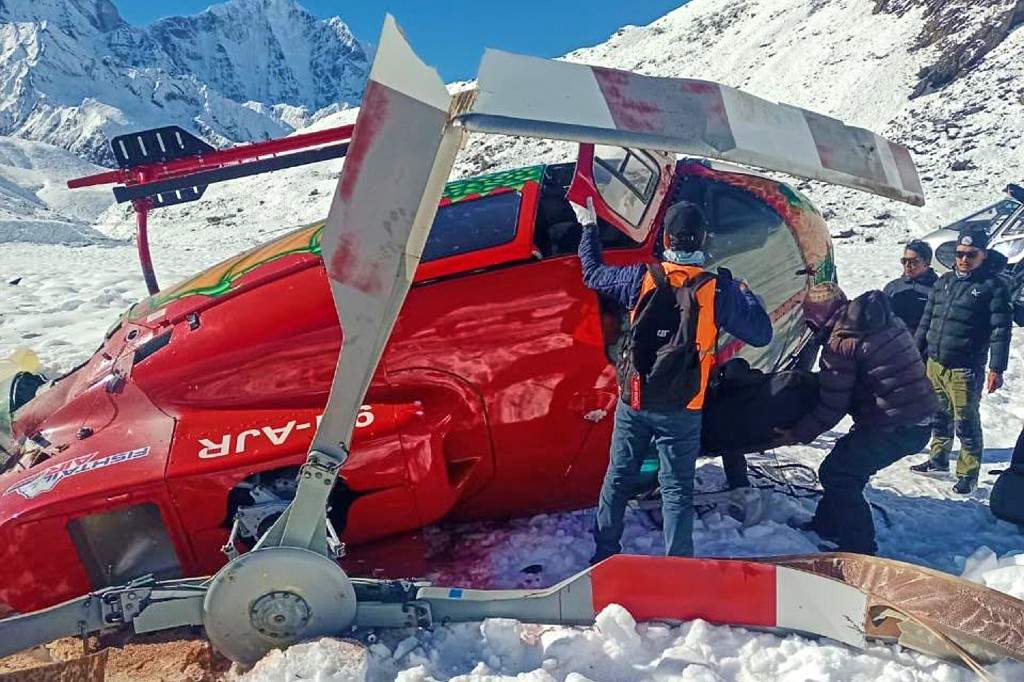
When a crash occurs in this environment, the headlines focus on the immediate wreckage: the twisted fuselage on the rocky moraine, the frantic rescue effort, the single fatality, the two survivors airlifted to hospitals in Kathmandu with critical injuries.
Those are the cold facts. They tell us what happened, but they refuse to tell us why.
The real story lives in the invisible pressure cooker of the Nepali aviation industry. Nepal has a notoriously troubled safety record, a reality that has led the European Union to ban Nepali airlines from its airspace for over a decade. Yet, the problem isn't a lack of skill among the pilots. Many of the men flying these mountain routes are among the most gifted, daring aviators alive, capable of hovering with one skid resting on a snow shelf at 21,000 feet while a sick climber crawls aboard.
The problem is economic gravity.
Nepal is one of the poorest nations in Asia, and mountaineering is its golden goose. Every spring and autumn, tens of millions of dollars flow into Kathmandu, funneled through trekking agencies, gear shops, and helicopter operators. When a commercial expedition company promises a client a "fast-track" climb, or when an insurance company approves a lucrative evacuation flight, the pressure on the pilot to fly—even when the weather is marginal, even when the valley is crowded, even when the machine is pushed to its absolute weight limit—is immense.
If one pilot says no because the cloud ceiling is dropping, another operator might say yes. And in a fiercely competitive market where a single hour of flight time can bring in thousands of dollars, saying no feels like handing money to a rival.
I have sat in the cramped tea houses of Namche Bazaar, watching the clouds boil up from the river gorge below, listening to guides argue over satellite weather reports. You can feel the tension humming in the wooden floorboards. Everyone wants to move. Everyone has a schedule. The mountain, however, does not care about your flight itinerary, your corporate retreat, or your travel insurance policy.
The Human Cost of Convenience
Let’s look at who actually pays the price when the sky gets too crowded.
It is rarely the billionaire adventurer who booked a private charter to skip the walk. More often, it is the local crew. The flight engineers, the ground handlers, the Nepali pilots who grew up looking at these peaks and turned that reverence into a livelihood to support their families back in the lowlands. When a rotor clips a tail boom, or when two aircraft converge on a narrow landing pad in swirling snow, it is these men who absorb the impact.
There is a bitter irony at the heart of modern Himalayan travel. We go to the mountains to escape the noise, the congestion, and the artificial urgency of modern life. We seek out the edge of the map because we want to feel small in the presence of something ancient and indifferent.
Yet, we bring our impatience with us. We demand convenience in a place defined by hardship. We turn a wild, unforgiving frontier into a congested air corridor, packing the sky with metal machines so we can conquer a peak on a tight deadline.
Reclaiming the Margin of Safety
Fixing this does not require banning helicopters from the Himalayas. That would be a death sentence for climbers suffering from high-altitude pulmonary edema or Sherpas caught in an icefall collapse. Helicopters save dozens of lives every single season on Everest; their presence is a genuine blessing when things go terribly wrong on the upper slopes.
What it requires is a brutal honesty about what these machines should—and should not—be used for.
First, the distinction between a rescue flight and a joyride must be carved in stone. Regulatory authorities in Kathmandu have repeatedly tried to limit commercial sightseeing flights and non-essential cargo drops above certain altitudes, only to see those rules bent or quietly abandoned under industry pressure. Enforcing strict flight corridors, mandating GPS-based tracking transponders that allow pilots to see each other on cockpit displays even when the clouds roll in, and capping the number of daily commercial flights into the Khumbu would immediately clear the air.
Second, the culture of expedition tourism has to shift. Outfitters must stop selling Everest as a guaranteed, climate-controlled product where a helicopter is always waiting five minutes away to erase a bad decision or a lack of physical preparation. True mountaineering demands humility. It demands accepting that if you cannot walk up the valley on your own two feet, you have no business standing on the roof of the world.
Think back to that crash site near the base of the mountain.
After the dust settles and the rescue teams pack away their stretchers, the wind returns. It sweeps across the shattered aluminum and the blackened snow, erasing the tracks of the rescuers, indifferent to the grief of the families waiting for phone calls in Kathmandu or halfway across the globe. Up high, the plume of snow still streams off the summit of Everest like a white flag against the cobalt sky, silent and untouched, waiting to see if we will finally learn how to respect the space it takes to survive.