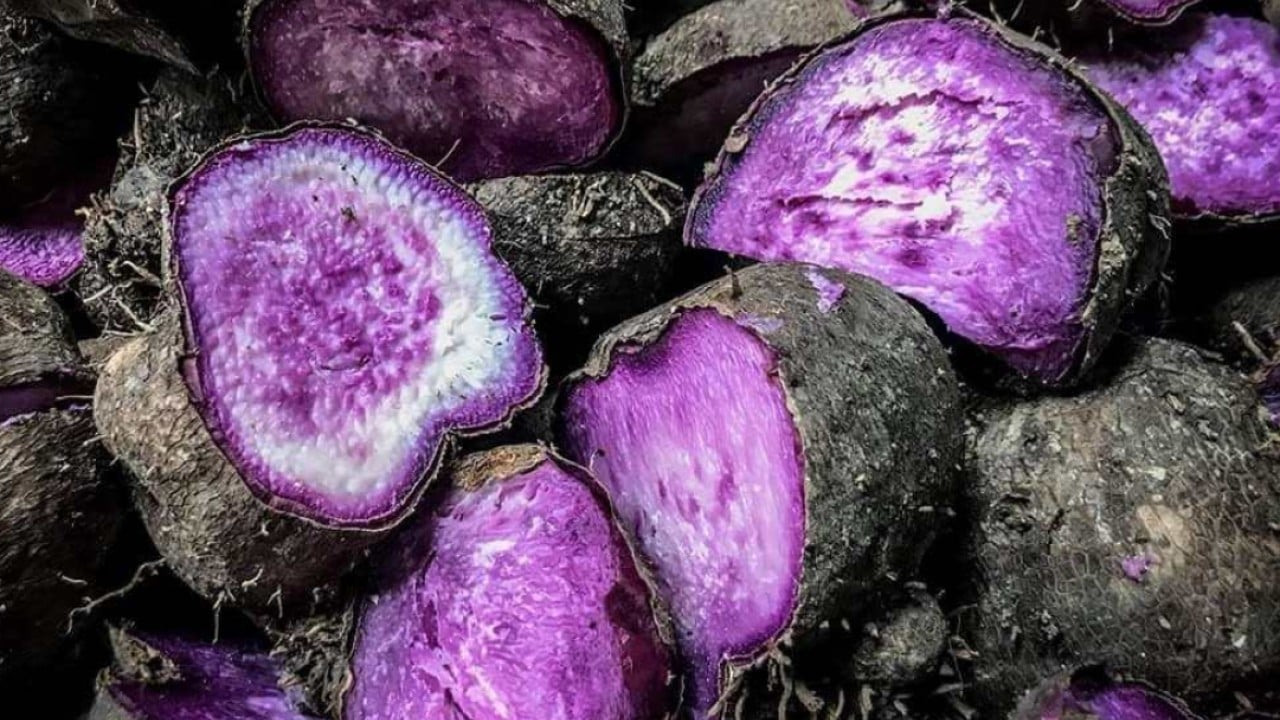
The dirt under a farmer's fingernails in Bohol is usually a standard, forgettable brown. But during the harvest, something strange happens. The soil splits open, and what emerges is a deep, striking violet.
This is ube. You might also find this related coverage interesting: The Frictionless Diplomacy Myth and the Real Math of US India Trade.
To the global culinary scene, the purple yam is an overnight sensation. It is the vibrant centerpiece of multi-dollar lattes in Manhattan, the striking hue of viral ice creams on Instagram, and the darling of high-end bakeries from London to Tokyo. Food critics call it a trend. Investors call it a "purple gold rush."
But if you visit the steep, rain-slicked hillsides of the Central Visayas, you will find a completely different reality. You will find that the people growing the world’s most fashionable root vegetable can barely afford to keep their children in school. As extensively documented in latest coverage by CNBC, the implications are notable.
The international market is starving for authentic Philippine ube, yet the supply chain is fractured, volatile, and dangerously primitive. The gold rush is happening, but the wealth is flowing away from the soil, leaving the traditional guardians of the crop with little more than aching backs and empty pockets.
Understanding why requires looking past the neon-purple desserts and into the dirt.
The Weight of a Single Tubercle
Consider a hypothetical but entirely accurate representation of a smallholder farmer: let's call him Eduardo. Eduardo owns less than one hectare of land in a remote corner of the Philippines. For generations, his family has cultivated the Kinampay variety—the apex variant of ube, prized for its intense aroma and rich, nutty-sweet flavor.
To the Western consumer, ube is a powder, a paste, or an extract that arrives neatly packaged. To Eduardo, it is a test of human endurance.
Ube is not like rice or corn. You cannot plant it with a tractor and walk away. It demands a grueling eight-month cycle of intense physical labor. Farmers must manually dig deep trenches, erect intricate bamboo trellises for the vines to climb, and spend hours under a punishing tropical sun clearing weeds that threaten to choke the crop.
Then comes the real gamble: climate vulnerability.
The Philippines faces an average of twenty typhoons a year. A single severe storm can turn a promising ube patch into a muddy grave of rotting tubers. Because ube grows entirely underground, a farmer cannot see their failure or success until the moment they drive their spade into the earth in December.
When the harvest is good, a single tuber can weigh several kilograms. But this heavy yield brings a bitter irony. Eduardo cannot drive a truck to his farm because there are no paved roads. He must load sacks weighing fifty kilograms onto his own back, or onto a fragile water buffalo, and trek miles down a muddy mountain path to the nearest trading post.
This is where the economic trap snaps shut.
The Disappearing Margin
Because Eduardo is isolated from the ultimate buyers, he relies on middlemen—local traders who wait at the edge of the paved roads with cash in hand. These traders understand a fundamental truth of small-scale farming: the farmer is desperate. Eduardo needs money immediately to pay off debts incurred for seeds and fertilizer during the planting season. He cannot afford to store his crop or negotiate.
The trader buys the raw ube for a pittance, perhaps 40 to 50 Philippine pesos per kilogram.
By the time that exact same ube is cleaned, processed into ube halaya (jam), exported, and spun into a gourmet pastry in Los Angeles, its value has multiplied exponentially. A single slice of ube cake in a boutique Western bakery can sell for twelve dollars—more than Eduardo earns for an entire day of backbreaking labor.
The global demand is skyrocketing, but Philippine production has actually plateaued or dropped in several traditional regions over recent years. Why? Because younger generations are watching their parents break their bodies for pennies. They are fleeing the fields for service jobs in Manila or construction gigs overseas.
The world wants more purple gold, but the people who know how to mine it are walking away.
Fixing the Broken Machine
The tragedy is that this problem is entirely solvable. The bottleneck isn't the soil, and it isn't the soul of the farmers; it is the infrastructure.
To transform ube farming from a survival strategy into a true commercial engine, the approach to agricultural logistics must change completely.
- Direct-to-Processor Contracts: When large food conglomerates bypass local predatory middlemen and sign direct purchasing agreements with farmer cooperatives, the economic dynamic shifts. Farmers gain price stability; corporations secure a reliable supply of authentic Dioscorea alata (the scientific name for the true purple yam) rather than cheap, dyed sweet potato substitutes.
- Localized Processing Hubs: Raw ube is mostly water. Shipping heavy, unpeeled roots across islands is incredibly inefficient. By establishing community-managed processing centers close to the farms, cooperatives can steam, mash, and flash-freeze the ube directly. Shipping processed pulp drastically reduces transportation costs and retains the economic value within the village.
- Micro-Investment in Cultivar Quality: Most smallholders rely on saved tubers from their previous harvest, which can lead to disease accumulation and lower yields over generations. Providing access to clean, tissue-cultured seedlings developed by state agricultural universities can double a farm's output without expanding its physical footprint.
Change is bubbling up, but it is agonizingly slow. In some provinces, agricultural cooperatives are beginning to pool resources to buy shared delivery trucks, effectively cutting out the first layer of exploitative trading. But these initiatives require capital, and rural banks are notoriously hesitant to loan money to someone whose asset is buried under three feet of dirt.
The Soul of the Sweetness
There is a distinct cultural cost to this economic failure. In the Philippines, ube is not a trend; it is memory. It is the sound of a heavy wooden spoon scraping the bottom of a massive iron pot for hours on Christmas Eve as a grandmother prepares ube halaya for the entire neighborhood. It is an anchor of community identity.
When we treat a crop purely as a global commodity to be exploited during a temporary food craze, we strip away its context. We celebrate the color but ignore the hands that brought it out of the earth.
The next time you see that bright, impossibly purple dessert on your screen, look past the aesthetic. Recognize that the vibrant hue represents a delicate, endangered ecosystem of human labor, ancestral knowledge, and systemic struggle. The purple gold rush can either remain a story of corporate extraction, or it can become the catalyst that lifts thousands of rural families out of generational poverty.
The choice does not lie in the boardrooms of international food distributors. It lies in whether we demand a supply chain that values the farmer as much as the flavor. Until then, the sweetest crop in the archipelago will leave a remarkably bitter aftertaste.