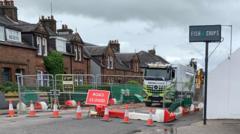
A sudden crater in the asphalt outside a local chip shop does more than divert traffic. It instantly halves the cash flow of a vulnerable small business, exposing a fragile urban infrastructure that leaves independent merchants to bear the financial brunt of municipal neglect. When a sinkhole appears, the immediate response focuses on utility maps and emergency road closures. The prolonged economic strangulation of the surrounding high street is treated as an afterthought. For independent retailers operating on razor-thin margins, a lengthy repair timeline is a commercial death sentence.
The immediate fallout is predictable but devastating. Foot traffic evaporates, delivery drivers bypass the block, and loyal customers seek alternatives. Yet, the core issue is not the geology that caused the void. The real failure lies in the bureaucratic paralysis and shifting liabilities that keep the road closed for weeks, sometimes months, while small business owners watch their livelihoods erode.
The True Cost of Municipal Inertia
When a road collapses outside a business, the ticking clock represents accumulating losses. Municipalities and utility providers routinely engage in a slow-motion game of finger-pointing to determine who owns the broken pipe or unstable substrata. While engineers debate liability, the business owner remains trapped in a regulatory void.
Fixed costs do not pause for infrastructure failures. Rent, commercial rates, insurance, and staff wages remain due every month, regardless of whether customers can physically reach the front door. A fifty percent drop in revenue for a high-street food business removes the entire profit margin and forces the owner to dip into personal savings just to keep the lights on.
Most local authorities have no structural mechanism to compensate businesses for trade lost due to public works or infrastructure failure. The legal burden typically rests on the business owner to prove direct negligence—a costly, uphill battle against government legal teams that can take years to resolve.
Why Standard Insurance Fails the High Street
Business interruption insurance sounds like the definitive antidote to a sudden drop in trade. The reality is far more bureaucratic and punitive. Standard policies are meticulously designed to avoid paying out for off-premises infrastructure failures unless there is direct physical damage to the insured property itself.
- The Physical Damage Trigger: If a sinkhole swallows a shopfront, insurance kicks in. If the sinkhole is two yards outside the door, blocking all access but leaving the building untouched, insurers routinely deny the claim.
- The Non-Damage Business Interruption Loophole: Some premium policies include extensions for "loss of attraction" or "hindrance of access." However, these clauses are heavily restricted, carry exorbitant deductibles, and often require the total closure of the business rather than a severe reduction in trade.
- The Premium Spike: Even in the rare event of a successful claim, the business is flagged as high-risk. The subsequent rise in insurance premiums can permanently alter the company's financial viability.
This leaves small business owners in a perilous economic blind spot. They are forced to navigate a crisis caused by public assets, using private funds that they cannot afford to lose.
The Fractured Anatomy of Modern Road Repairs
To understand why a simple hole in the road takes so long to fix, one must look at the fragmented nature of modern public works. Gone are the days when a single municipal department dispatched a crew to dig, repair, and pave a road in a single shift.
Today, the space beneath the pavement is a crowded labyrinth of privatized assets. Fiber-optic cables, gas mains, water lines, and electricity grids are managed by separate corporate entities. When a collapse occurs, each utility must send its own specialists to assess their specific infrastructure.
The Sequencing Nightmare
Repairing an urban sinkhole requires strict chronological sequencing. If one utility company delays its inspection, the entire project grinds to a halt.
| Phase | Operational Step | Primary Cause of Delay |
|---|---|---|
| 1 | Stabilization and Safety | Assessing structural integrity of surrounding buildings |
| 2 | Utility Identification | Disagreements between privatized companies over asset ownership |
| 3 | Subsurface Repair | Sourcing specialized materials or waiting for concrete curing |
| 4 | Backfilling and Resurfacing | Scheduling municipal contractors around weather windows |
A delay in any single phase cascades down the line. A site can sit empty for days not because workers are lazy, but because the contract for the next specific phase hasn't cleared the necessary bureaucratic hurdles.
The Fiction of Emergency Urgency
Municipalities frequently declare these incidents as emergencies to bypass standard procurement rules. This designation rarely translates to 24-hour physical labor on-site. Noise ordinances, strict shift-length regulations for laborers, and supply chain bottlenecks for specialist backfill materials mean that an "emergency" repair often progresses at the exact same pace as a routine scheduled upgrade.
The Supply Chain and Foot Traffic Cascade
The damage caused by prolonged road closures extends far beyond the immediate storefront. High street ecosystems rely on a delicate web of interdependence. When a anchor business like a popular local eatery sees its volume halved, the economic shockwaves ripple outward through the local economy.
Suppliers of fresh produce, packaging, and local services feel the squeeze immediately. Orders are cut or canceled entirely. Delivery drivers lose shifts because drop-offs to the affected zone are no longer viable or efficient.
Furthermore, consumer habits change permanently during extended disruptions. If a road is closed for six weeks, customers establish new routines. They find another spot for lunch, use a different route home, or switch to online alternatives. Winning those customers back once the asphalt is finally poured requires significant marketing spend—money that the cash-starved business no longer possesses.
A Broken System of Liability and Red Tape
The fundamental flaw in the current model is the complete decoupling of public works timelines from the reality of small business economics. A city department measures a project's success by budget adherence and engineering compliance. They do not measure the bankruptcy rate of the street during construction.
Statutory compensation schemes are desperately outdated. In many jurisdictions, laws governing street works provide zero financial recourse for lost profits unless the utility company exceeds its legally permitted timeline. These permitted timelines are incredibly generous, allowing utilities weeks of leeway before any financial penalties apply. Even when fines are levied, the money goes directly into municipal coffers, not to the merchants whose trade was decimated.
The Blueprint for Survival
Independent operators cannot rely on bureaucratic goodwill or insurance miracles when infrastructure fails outside their door. Survival requires immediate, aggressive adaptation to protect whatever cash flow remains.
Pivot to Digital Diversification
When physical access is compromised, the digital footprint must expand. Businesses must immediately leverage localized digital channels to inform their customer base that they remain open. This means updating mapping services to show alternative pedestrian routes, offering targeted discounts for locals who make the effort to bypass the construction, and expanding curb-side pickup options at the nearest accessible point.
Aggressive Landlord and Vendor Renegotiation
Do not wait for the cash reserves to hit zero before speaking to stakeholders. Landlords should be approached immediately with a formal request for temporary rent abatement or deferment, explicitly citing the government-induced drop in foot traffic. Most landlords prefer a temporary reduction in rent over an empty unit and a bankrupt tenant. Simultaneously, payment terms with key suppliers must be stretched to preserve daily operational liquidity.
The Hard Truth of High Street Vulnerability
The vulnerability of small businesses to infrastructure failure is an institutional choice. Cities choose to privatize utilities without enforcing strict economic penalties for prolonged street disruptions. Governments choose to build complex regulatory frameworks that protect municipal budgets while leaving independent traders completely exposed to the financial fallout of crumbling roads.
Until local authorities integrate small business survival metrics into their public works contracts, the story of the ruined merchant next to a prolonged construction site will repeat itself in every city. A sinkhole is a geological accident, but the destruction of a local business during its repair is a policy failure. Merchants must operate under the assumption that no help is coming from the city hall or the insurance adjuster. Survival depends entirely on swift, defensive financial management and a ruthless pivot to alternative revenue streams before the pavement clears.