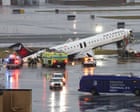
The cockpit of a modern aircraft is a temple of silence, shattered only by the rhythmic clicking of switches and the occasional crackle of the radio. For a pilot, that crackle is the umbilical cord to reality. You trust the voice on the other end. You have to. When you are hurtling down a runway at LaGuardia Airport, surrounded by the gray sprawl of Queens and the unforgiving shimmer of the East River, your world narrows to the few thousand feet of asphalt ahead of you.
Then, a single word cuts through the static.
"Stop."
It is the most primitive command in the English language. It is binary. It is absolute. But in the chaotic geography of a major international airport, a word without a target is just noise.
On a recent morning that started like any other for the Port Authority crews at LaGuardia, that noise nearly became a tragedy. A firefighter, sitting in the heavy belly of a rescue vehicle, heard the command. He felt the phantom pressure of a brake pedal in his mind. He waited for the impact, for the screech of metal, for the fireball that is the constant, unspoken passenger on every flight.
He heard the word. He just didn't know who it was for.
The Ghost in the Frequency
To understand why a five-letter word can fail so spectacularly, you have to understand the invisible web of the National Airspace System. We like to think of air travel as a series of lines on a map, but it is actually a delicate, high-stakes conversation. Every movement—from a fuel truck repositioning to a Boeing 737 rotating for takeoff—is choreographed by voices.
The National Transportation Safety Board (NTSB) recently released a report detailing a near-miss at LaGuardia that reads less like a technical document and more like a psychological thriller. It centers on a moment of profound ambiguity. An air traffic controller saw a conflict developing on the tarmac. The response was instinctive: a command to halt.
But the radio is a shared space. It’s a crowded room where everyone is shouting.
Consider the firefighter. He is a professional trained to run toward the heat. His ears are tuned to the frequency of disaster. When the word "stop" hit his headset, his heart rate spiked. Was there a plane crossing his path? Was he the hazard? Or was he merely a witness to a disaster unfolding elsewhere on the grid?
In that sliver of a second, the human brain performs a frantic calculation. It weighs the cost of action against the cost of hesitation. This is the "processing lag" that safety experts spend decades trying to shave down. At LaGuardia, where the runways are famously short and the margins for error are razor-thin, that lag is where people die.
The Geometry of a Near Miss
The facts are cold, but the implications are sweating. A fire truck was on the move. A commercial jet was in its takeoff roll. The distances involved were not measured in miles, but in heartbeats.
When the controller issued the "stop" command, they were reacting to a visual overlap. In the tower, the world looks like a chessboard. From the ground, it looks like a wall of moving lights. The firefighter reported that the command lacked a "call sign"—the specific identifier that tells a pilot or a driver, Yes, I am talking to you.
Without that name, the word "stop" is an orphan.
It floats in the air, claimed by no one and feared by everyone. It creates a vacuum of leadership. In this specific instance, the firefighter hesitated, searching for context. The pilot, perhaps hearing the same shout, had to decide if the voice was a divine intervention or a distraction.
We rely on technology to bridge these gaps. We have ground radar, transponders, and automated warning systems that can predict a collision before the human eye even registers the two objects are on the same plane. But as this report highlights, the final fail-safe is still a human being with a microphone.
And humans are prone to the "urgency trap."
When we panic, we strip away the details. We lose the call signs. We lose the nuance. We revert to the primal. "Stop." "Look out." "Help."
The problem is that a fire truck cannot "look out" for a jet traveling at 140 knots. The jet is a physical inevitability. Once it reaches a certain speed, it belongs to the air, or it belongs to the wreckage.
The Invisible Stakes of Communication
Safety is not the absence of accidents. It is the presence of systems that survive human error.
Every time you sit in seat 12A, leaning your head against the cool plastic of the window, you are placing an enormous amount of faith in the grammar of air traffic control. You are betting your life that the person in the tower will use the correct prefix. You are betting that the firefighter on the ground is disciplined enough to stay in his lane.
But what happens when the system works exactly as designed, and it’s still not enough?
The NTSB report isn't just about a close call in New York. It’s a warning about the limits of language. We have built machines that move faster than we can speak. We have created environments so complex that a simple command can be a riddle.
Think of the last time you were in a crowded place and someone yelled "Hey!" You turned around. So did ten other people. Now, imagine you are all driving multi-million dollar machines filled with jet fuel.
The "stop" at LaGuardia was a "Hey!" in a storm.
The firefighter’s testimony is haunting because it reflects a universal human experience: the feeling of knowing something is wrong but being powerless to identify your role in it. He sat in his rig, the engine rumbling beneath him, listening to a voice that sounded like the end of the world, wondering if he was the one causing it.
The Cost of the Silent Seconds
There is a specific kind of silence that follows a near-miss. It’s the sound of adrenaline receding, leaving behind a cold, metallic taste in the mouth.
At LaGuardia, the disaster didn't happen. The planes didn't collide. The fire truck didn't become a crumpled heap of yellow steel. On paper, the system "worked" because the outcome was zero casualties. But the report tells a different story. It tells the story of a system that reached its breaking point and held together by a thread of pure luck.
We often talk about "human error" as if it’s a failure of character. It’s not. It’s a failure of design. If a professional firefighter—someone whose entire career is built on situational awareness—doesn't know who a command is for, the command is the failure.
The industry is now looking at ways to automate these warnings, to push text-based "stop" commands directly to heads-up displays, bypassing the vagaries of the human voice and the interference of the radio. They want to turn that orphan word into a targeted strike of information.
But for now, we are left with the image of that firefighter in the cab.
He is all of us, navigating a world that is getting louder and faster every day. He is listening for his name in the static. He is waiting for the one piece of information that will tell him whether to push forward or stand still.
The next time you hear the engines roar and feel the back of your seat press against your spine, remember the voices in the headsets. Remember the firefighter. Remember that "stop" is only a word until someone claims it.
The stakes are invisible until they are unavoidable. We live in the gaps between the words. We survive because, most of the time, the voice on the other end knows exactly who we are.
Until they don't.
And in that silence, before the next word comes, the world holds its breath.