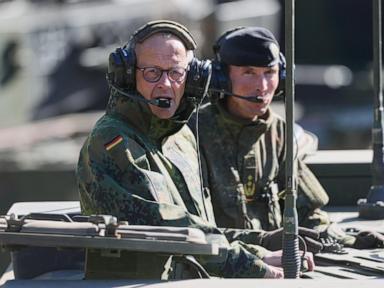
In the quiet, cobblestoned town of Baumholder, the air smells of pine and damp earth. For decades, it also smelled of diesel fumes and American coffee. For the locals, the low rumble of an M1 Abrams tank moving toward the firing range wasn't a nuisance; it was a heartbeat. It meant the bakery would sell out of rolls by 8:00 AM. It meant the local car dealership would stay in business. Most importantly, it meant that the world’s most powerful military was parked in their backyard, ensuring that the ghosts of the twentieth century stayed buried.
That heartbeat is skipping.
Germany is waking up to a silence it isn't prepared for. As Washington pivots its gaze toward the Pacific and internal political pressures in the United States demand a "Main Street first" foreign policy, the American security umbrella—the very thing that allowed Europe to transform from a blood-soaked battlefield into a prosperous shopping mall—is folding up.
This isn't just about troop numbers. It is about a fundamental shift in the psychic geography of the West.
The Ghost of the 2nd Cavalry
Consider a hypothetical sergeant named Marcus. Marcus has spent three tours in Germany. He speaks passable German, his kids go to the local kindergarten in Vilseck, and he spends his weekends hiking the Bavarian Alps. To the Pentagon, Marcus is a data point in a strategic realignment. To the German butcher down the street, Marcus is the difference between a thriving business and a shuttered storefront.
When Marcus receives orders to relocate to a base in South Carolina or a rotational post in Poland, he leaves behind more than an empty housing unit. He leaves a vacuum.
For seventy years, Germany relied on a simple, unspoken bargain: the United States would provide the muscle, and Germany would provide the moral and economic engine of Europe. It worked. It worked so well that Germany eventually forgot what it felt like to be afraid. Defense spending became an afterthought, a rounding error in a budget dedicated to social welfare and green energy transitions.
Now, the bill is coming due.
The threat of a reduced U.S. presence isn't merely about the loss of the 35,000 troops currently stationed on German soil. It is about the "tripwire" effect. If a hostile power moves against a border protected by American soldiers, they aren't just fighting a local army; they are picking a fight with the entire nuclear and conventional might of the United States. Without that tripwire, the deterrent becomes a suggestion.
The Rust on the Leopard
The reality of the German military, the Bundeswehr, is a sobering counterpoint to the country’s industrial reputation. While German engineering produces the finest luxury sedans in the world, its military hardware has often sat languishing in hangars. Reports have surfaced for years of broomsticks used during NATO exercises because of a lack of heavy machine guns, and submarines that cannot submerge.
Berlin recently announced a Zeitenwende—a turning point. They pledged 100 billion euros to fix the military. But money cannot buy time. You can’t manifest a modern air force or a digitally integrated command structure overnight.
Imagine trying to build a fire while the blizzard is already howling at the door. That is the position Germany finds itself in. The American departure accelerates the clock. Every C-17 transport plane that leaves Ramstein Air Base for the final time represents a capability that Germany must now replicate at ten times the cost and with a fraction of the experience.
The shift is also technological. Modern warfare is no longer just about who has the most boots on the ground. It is about satellite arrays, cyber-defense, and high-altitude surveillance. The United States has spent trillions developing these "invisible" layers of protection. Germany, by contrast, is still struggling to digitize its basic radio communications across all units.
If the U.S. pulls back its logistical and intelligence support, Germany isn't just losing soldiers. It is losing its eyes and ears.
The Geopolitical Pivot Point
Why is this happening now? The answer lies across the Atlantic, in a country that is tired.
American voters across the political spectrum are increasingly skeptical of "forever commitments." They look at a prosperous, wealthy Germany and ask why their tax dollars are spent defending a nation that has a higher standard of living than many parts of the American Midwest. This sentiment isn't a fluke; it’s a trend. Whether it manifests as an aggressive "America First" withdrawal or a slow, bureaucratic "rebalancing," the result is the same. The Atlantic is getting wider.
Central and Eastern European nations are watching this tension with growing anxiety. Poland and the Baltic states, who remember the cold touch of occupation more vividly than their Western neighbors, have begun bypass-negotiating directly with Washington. They want the Americans on their soil.
This creates a fracture within Europe itself. If the U.S. moves its primary bases from Germany to Poland, the center of gravity in Europe shifts East. Germany loses its status as the indispensable partner. It becomes a middle-man in a continent that is rapidly re-arming and re-polarizing.
The Human Cost of Strategic Autonomy
Europeans often talk about "strategic autonomy"—the idea that the continent should be able to defend itself without the U.S. It sounds noble. It sounds like adulthood.
But strategic autonomy has a human face. It means a return to conscription. It means young Germans, who grew up in a world of open borders and pacifism, will have to spend years learning how to operate a tank or clear a room. It means the "peace dividend" that funded the German lifestyle for decades is evaporated.
Instead of investing in high-speed rail or climate tech, the nation must invest in artillery shells and missile defense batteries. The trade-off is visceral. Every Euro spent on a Patriot missile battery is a Euro not spent on a school or a hospital.
Germany is facing an identity crisis. It spent the last half-century trying to be a "civilian power," a nation that led through trade and diplomacy. It viewed the military as a relic of a dark past. But the world is proving that trade does not stop tanks, and diplomacy only works when there is a shadow of force behind the table.
The Silence at the Gate
Back in the towns near the bases, the anxiety is more immediate. It’s the landlord who suddenly has ten empty apartments. It’s the local mayor who sees a massive hole in the municipal budget. It’s the sense of being a front-line state that has suddenly been told it’s on its own.
The withdrawal of American forces is the removal of a psychological safety net. For years, Germans could afford to be critical of American foreign policy precisely because they knew the Americans would never actually leave. It was the privilege of the protected to mock the protector.
That privilege is expiring.
The threat isn't a sudden invasion. It’s the slow, grinding realization that the rules of the game have changed. The invisible shield is flickering. Germany must now decide if it will become a true military power—with all the cultural and financial pain that entails—or if it will remain a wealthy, vulnerable giant in an increasingly predatory neighborhood.
The rumble of the tanks is fading. In its place is a quiet, cold wind blowing in from the East, and for the first time in generations, Germany has nothing to block it but its own resolve.
The barracks are emptying, and the lights in the command centers are being flicked off, one by one.