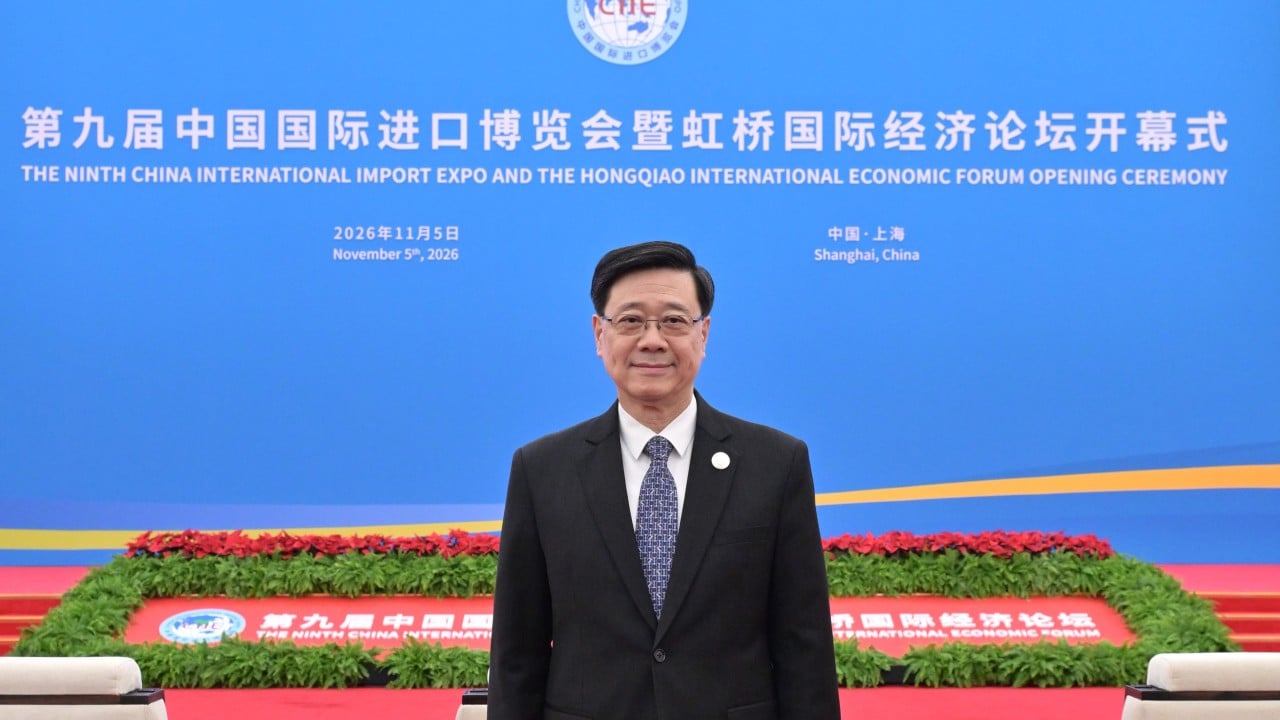
Hong Kong Chief Executive John Lee’s call for "forward-looking" industrial planning is an admission that the city's traditional middleman model is breaking down. For decades, Hong Kong thrived simply by acting as the effortless financial and logistical bridge between Western capital and mainland Chinese factories. Today, global manufacturers are actively rerouting supply chains to Southeast Asia, India, and Mexico to bypass geopolitical friction and tariffs, leaving Hong Kong’s legacy port and trade infrastructure dangerously exposed. To survive, the city is attempting a difficult transition from a passive transit hub into a high-value center for supply chain management, intellectual property, and advanced manufacturing.
The End of the Easy Middleman Era
You can see the structural shift on the docks of Kwai Tsing. Container throughput at Hong Kong’s port—once the undisputed busiest in the world—has been steadily sliding for years, overtaken by neighboring Shenzhen, Ningbo, and Singapore.
The math is brutal. When a factory moves from Guangdong to Vietnam or Malaysia, those goods no longer need to pass through Hong Kong’s harbor. Direct shipping routes from Southeast Asian ports to North America and Europe have matured, stripping away the geographical monopoly Hong Kong enjoyed for half a century.
Lee’s rhetoric about adapting to changes in industrial chains is a direct response to this reality. The government recognizes that waiting for global trade volumes to magically rebound is a losing bet. Instead, officials are pushing a concept they call multinational supply chain management. The pitch is simple, even if the execution is not. If a Chinese manufacturer builds a plant in Thailand to avoid U.S. tariffs, Hong Kong wants to be the place where that company raises capital, insures its cargo, settles its legal disputes, and manages its regional treasury.
What Forward-Looking Planning Actually Means on the Ground
Government slogans rarely move freight. To understand whether Hong Kong can pull off this reinvention, you have to look at where capital and policy are actually being deployed.
First, there is the aggressive push toward new industrialization. For years, Hong Kong’s economy was dangerously lopsided, relying almost entirely on financial services, real estate, trade, and tourism. Manufacturing had withered to roughly one percent of GDP. Now, the administration is pouring billions into microelectronics, biotechnology, and artificial intelligence, anchored by the massive Northern Metropolis development project near the Shenzhen border.
The logic is sound on paper. Hong Kong possesses world-class research universities and strict intellectual property protections, while Shenzhen offers unmatched hardware prototyping and mass-production speed. Combining the two creates a cross-border innovation corridor.
Second, trade finance is getting an overhaul. Traditional supply chain financing relies heavily on physical bills of lading and established banking relationships with massive conglomerates. As supply chains fragment into smaller, more agile networks across ASEAN nations, smaller suppliers struggle to get credit. Hong Kong is pushing fintech adoption and cross-border data sharing—like the Commercial Data Interchange—to allow banks to underwrite loans based on real-time logistics data rather than just brick-and-mortar collateral.
The High Cost of Reinvention
Turning a hyper-dense financial center into an advanced industrial hub runs straight into physical and economic walls.
- Land and Labor Scarcity: Industrial land in Hong Kong remains astronomically expensive compared to regional competitors. Even with government subsidies, setting up a smart manufacturing facility in the New Territories costs a fraction of what it would in Johor or Binh Duong, yet still far exceeds mainland rates.
- The Talent Bottleneck: Hong Kong has spent decades training bankers, lawyers, and accountants. It has a severe shortage of mid-level engineers, lab technicians, and industrial operations managers. Importing talent helps, but housing costs remain a major deterrent for mid-career specialists.
- Regulatory Friction: Moving data, biological samples, and specialized equipment across the Shenzhen-Hong Kong border still involves customs and regulatory hurdles that slow down just-in-time research and development.
The Geopolitical Tightrope Nobody Wants to Mention
Here is the core contradiction at the heart of Hong Kong’s strategy. The city wants to remain a globally trusted, Western-aligned financial and legal jurisdiction while simultaneously integrating deeper into mainland China’s state-led industrial apparatus.
Consider a hypothetical scenario. A Shenzhen-based robotics firm sets up a regional headquarters in Hong Kong to manage its new assembly lines in Indonesia and its sales offices in Germany. To access Western banking rails and avoid secondary sanctions, that firm relies on Hong Kong’s separate customs territory status and common law system. Yet, as Washington tightens export controls on advanced semiconductors and AI hardware, the line separating Hong Kong from the mainland is scrutinized more heavily every month.
Global corporations are acutely aware of this tension. Many Western multinationals have adopted a "China Plus One" strategy specifically to insulate themselves from geopolitical shocks. If Hong Kong is perceived merely as an extension of the mainland regulatory sphere rather than an independent buffer zone, foreign firms will simply route their regional supply chain headquarters through Singapore or Tokyo instead.
Where the Real Opportunity Lies
Despite the headwinds, writing off Hong Kong is a mistake veteran Asia hands rarely make twice. The city’s resilience comes from its unmatched concentration of specialized professional services and deep capital pools.
While container ships may be bypassing Victoria Harbour, the money still flows through Central. Mainland Chinese enterprises are expanding overseas at a blistering pace—not just to evade tariffs, but to capture growing consumer markets in the Middle East, Latin America, and Southeast Asia. These companies desperately need sophisticated offshore corporate structures, foreign exchange hedging, and international legal counsel. They are far more comfortable operating in Hong Kong, where business culture bridges East and West, than starting from scratch in unfamiliar jurisdictions.
Furthermore, green finance and ESG compliance are quietly becoming major drivers of supply chain restructuring. European and North American buyers now demand strict carbon-tracking and ethical sourcing audits down to the raw material level. Hong Kong is positioning itself as the premier certification and green-financing hub for Asian suppliers trying to meet these Western standards. If a textile factory in Cambodia needs a sustainability-linked loan to upgrade to solar power so it can keep selling to European retailers, Hong Kong banks are structured to write that check.
The Execution Gap
John Lee’s diagnosis of the problem is accurate. The global industrial map is being redrawn in real time, and passive transit hubs are going extinct.
Yet diagnosing a structural decline and reversing it are two entirely different disciplines. Bureaucracies are notoriously bad at picking winning industries, and throwing public money at tech parks does not guarantee commercial breakthroughs. Hong Kong’s leadership has spent the past few years focused heavily on political stability and national security; pivoting the entire civil service toward agile, market-driven economic risk-taking requires a fundamentally different mindset.
Success will not be measured by how many ribbon-cutting ceremonies occur at new innovation hubs or how many task forces are formed to study supply chain resilience. It will be measured by whether private, unsubsidized foreign capital chooses to build its regional command centers in Hong Kong over Singapore, Dubai, or Seoul. Until the cost of doing business drops and regulatory predictability is ironclad, the city’s forward-looking plans remain a high-stakes gamble against shifting global currents.