Hong Kong is broken. Or so the western headlines love to claim. For years, overseas pundits have treated the city like a slow-motion corporate tragedy, writing premature obituaries about its financial status and wondering if its international soul has vanished. But if you actually talk to founders operating in Central, look at the capital moving through the Greater Bay Area, or examine the city's newly minted economic roadmap, a very different picture emerges. Hong Kong’s new chapter isn't a terminal decline. It's a painful, necessary pivot away from an outdated model that relied too heavily on passive complacency, astronomical property prices, and easy speculative gains.
Let's look at what is actually happening on the ground. Learn more on a related topic: this related article.
Stripping Away the Western Doomer Narrative
Financial analysts love simple stories. When an economy shifts its focus from traditional real estate speculation and fast-buck trading to deep technology, biotech, and advanced manufacturing, outsiders often mistake structural change for collapse. Former Morgan Stanley Asia chairman Stephen Roach famously declared that old Hong Kong was over. He was right, though probably not in the way he intended. Old Hong Kong—the sleepy, colonial-era entrepôt sustained by easy property fortunes and minimal regulatory friction—is indeed gone.
That death was required. You cannot build a modern innovation powerhouse while trapped in twenty-first-century bottlenecks with twentieth-century mindsets. More analysis by MarketWatch explores related views on this issue.
Instead of collapsing, the local economy fought its way back. After suffering negative growth a few years ago, the city rebounded with solid positive momentum, posting a 5.1 percent year-on-year economic growth rate in the first half of 2026. That marks the strongest half-year performance in almost five years. Total goods exports jumped over 26 percent, and gross domestic product crossed the 3.3 trillion mark. Companies—both local startups and international firms—are registering in record numbers. Median monthly employment earnings have risen by roughly 20 percent over a four-year window.
Yet, critics keep talking about flight and irrelevance. They ignore the data because it ruins a tidy narrative.
The First Five-Year Plan Changes the Rules
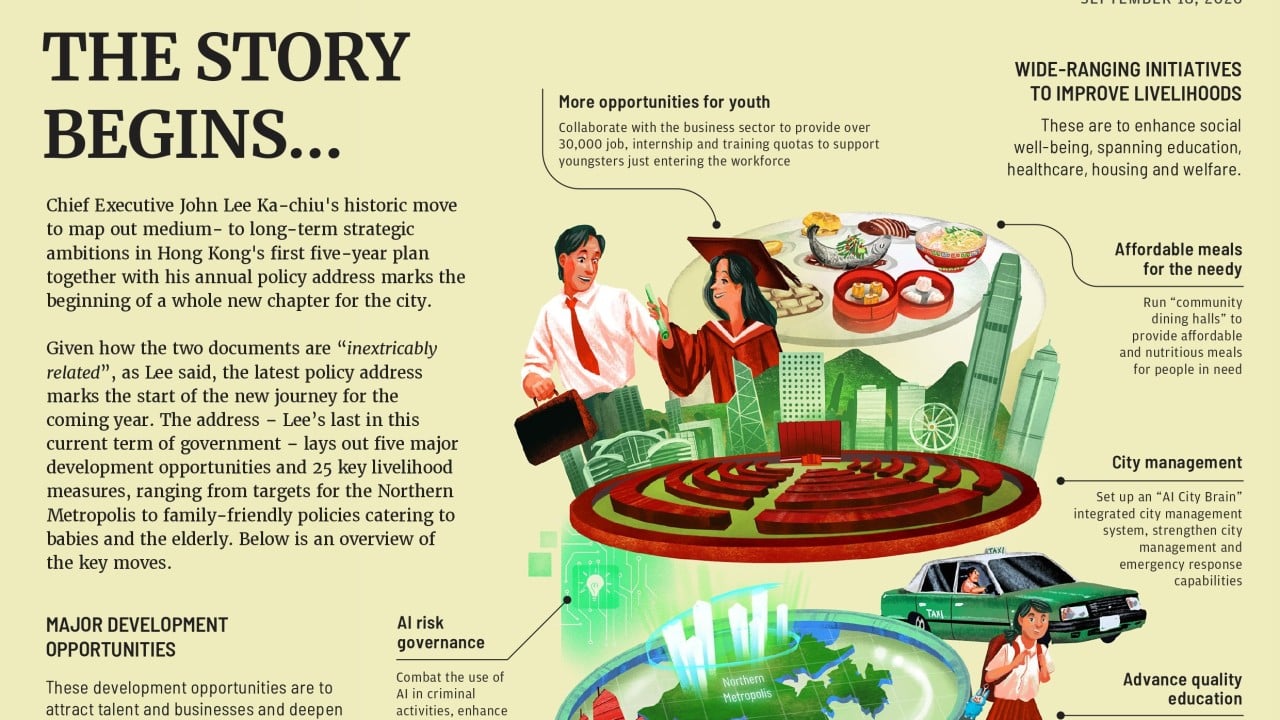
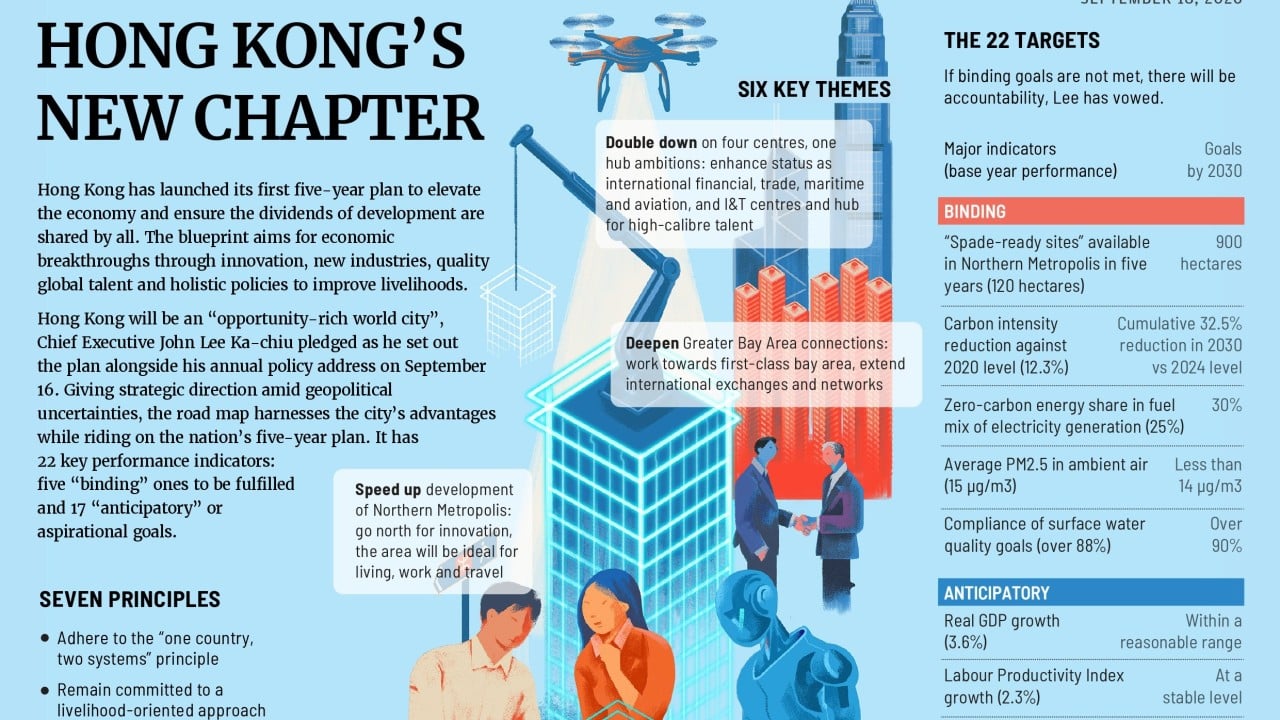
Governments rarely write down exact targets unless they intend to be held accountable. Chief Executive John Lee unveiled Hong Kong's first official five-year plan spanning 2026 to 2030. This blueprint changes everything about how the local government operates. It introduces 22 key performance indicators, split into five binding targets and seventeen anticipatory goals.
If officials fail to meet binding commitments, accountability is baked into the system. That is a massive departure from standard bureaucratic hand-waving.
What are these targets trying to fix? For starters, the city's reliance on property and financial services alone left it dangerously exposed to global interest rate shocks. The new plan targets manufacturing and emerging industries, pushing their value-added contribution to gross domestic product higher over the decade. It aims to scale domestic research and development expenditure significantly, transforming the city from a place where money is traded into a place where intellectual property is created.
Specific financial commitments match the ambition. The government set up a 10 billion dollar Innovation and Technology Industry-Oriented Fund to seed high-potential startups. It introduced targeted tax concessions, such as a half-rate tax for commodity trading, designed to pull trading houses away from competing regional ports. In tourism, the goal is clear: increase flight destinations from 220 to 240, and push the proportion of foreign visitors among overnight tourists to 40 percent.
People worry this means Beijing is turning Hong Kong into a rigid, centrally planned mainland city. That fear misunderstands the architecture of the plan. The capitalist core remains untouched. The free market operates with absolute freedom, currency peg intact, capital flowing without restriction. What the government is doing is supplying the missing ingredient: proactive infrastructure and strategic direction. A market left entirely to its own devices often ignores long-term infrastructure. Hong Kong is correcting that blind spot.
Building North and Rewriting Urban Geography
You cannot talk about Hong Kong without talking about space. Real estate has always choked economic diversification. When office rent in core districts costs more than anywhere else on earth, small hardware startups, robotics labs, and creative agencies simply get priced out.
Enter the Northern Metropolis.
Located right along the boundary with Shenzhen, this massive development zone is designed to house over one hundred thousand residential units in its initial phase and create hundreds of thousands of jobs. It is not just a housing project. It is an innovation corridor. By integrating directly with the tech powerhouse of Shenzhen, Hong Kong businesses gain immediate access to hardware manufacturing supply chains that used to take weeks to cross a border.
Critics call it an expensive gamble. Founders working in robotics and artificial intelligence call it overdue.
When you can step out of a lab in Hong Kong and test your prototype in a factory twenty minutes north across the boundary, the entire product development cycle collapses from months to days. That proximity changes how companies scale. The Northern Metropolis shifts the city's center of gravity away from the traditional financial core of Victoria Harbour toward a twin-engine model. One engine handles global finance and legal dispute resolution; the other handles deep tech, advanced manufacturing, and cross-border commercialization.
At the same time, cultural and entertainment mega-events are reshaping the city's appeal. The mega-event economy received a massive shot in the arm with the opening of the Kai Tak Sports Park, which quickly established itself as a world-class venue for international sports and concerts, complemented by the historic co-hosting of the National Games alongside Guangdong and Macao.
Taming the Talent Crunch and Cost of Living
Growth means nothing if citizens cannot afford to live where they work. For decades, the local government watched housing costs spiral while median wages stagnated. Hong Kong’s new chapter attempts to tackle these chronic sores head-on rather than sweeping them under administrative rugs.
Consider the recent structural labour reforms. The notorious Mandatory Provident Fund offsetting arrangement—which allowed employers to use severance payments from retirement funds—has finally been abolished. Statutory minimum wage reviews changed from a sluggish biennial cycle to an annual check. The continuous contract threshold moved from the rigid old rule to a fairer standard, giving part-time and gig economy workers access to statutory protection.
At the same time, the administration launched aggressive talent attraction schemes. Tens of thousands of global professionals have arrived under various talent programs, bringing families, spending power, and specialized expertise. Critics argue this drives up apartment prices. But the government is pairing talent acquisition with massive public housing supply injections and expedited land reclamation.
Healthcare is getting an overhaul too. Streamlining drug approval processes means patients gain access to advanced cancer treatments and rare disease therapies months or years faster than before. Preparing for a third medical school and expanding chronic disease management programs shows a shift toward preventative public health. Education remains a crown jewel, with five local universities sitting comfortably in the world's top one hundred, pulling in top-tier global students.
The Legal and Financial Moat That Nobody Can Copy
Even with all these domestic shifts, Hong Kong's true superpower remains unchanged: its unique legal system and financial infrastructure.
Foreign investors often ask if common law is dead. The answer sits in the operational reality of the courts. Commercial contracts are still enforced under English common law traditions, judges from other common law jurisdictions still sit on the Court of Final Appeal, and international arbitration cases continue to surge. Global firms do not choose Hong Kong because they love the weather; they choose it because they trust the dispute resolution framework.
On top of that, the city has cemented its position as the world's largest cross-boundary wealth management centre while reclaiming its spot as the third-largest global financial hub. Mainland companies wanting to go global use Hong Kong as their springboard. International firms wanting access to renminbi-denominated assets use Hong Kong as their primary clearing house. No other city in Asia replicates this dual identity. Shanghai is a domestic financial monster, and Singapore is a brilliant regional hub, but neither bridges mainland economic weight with Western legal standards quite the way Hong Kong does.
Operating in Hong Kong Today Without Illusions
Every economic transition comes with friction. Hong Kong faces real headwinds. Geopolitical tensions between the United States and China mean local firms navigate constant compliance crosscurrents. Commercial real estate vacancy rates in prime areas remain elevated as hybrid work takes hold and multinational corporations downsize their sprawling office footprints.
Ignoring these pressures is foolish. But pretending they spell the end of the city is equally ridiculous.
The playbook that worked from the nineteen-eighties through the two-thousands—rely on property sales, stock market trading, and low-tax tourism—is retired. The next era requires grit, engineering talent, cross-border integration, and institutional adaptability.
If you are an entrepreneur, a venture capitalist, or a professional trying to figure out where to place your bets in Asia for the next decade, stop listening to commentators who haven't visited the city in five years. Look at the capital flows, watch the engineering graduates coming out of local universities, and examine the hard infrastructure breaking ground in the north. Hong Kong isn't winding down its story. It is merely writing a much harder, much more interesting chapter.