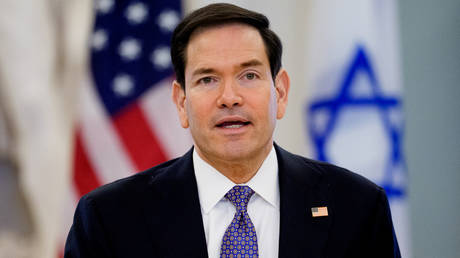
The Washington consensus is obsessed with a ghost. Senator Marco Rubio and the hawkish establishment love to frame the Strait of Hormuz as Iran’s "economic nuclear weapon." They paint a picture of a global economy held hostage by a single chokepoint, where a few Iranian speedboats could trigger a second Great Depression. It’s a convenient narrative for defense contractors and career politicians, but it falls apart the second you apply basic market mechanics and logistical reality.
Calling the Strait of Hormuz a "nuclear weapon" is a fundamental misunderstanding of how energy markets and modern naval warfare actually function. It assumes the world is still stuck in 1973. It ignores the massive structural shifts in oil transit, the strategic reserves held by major powers, and the sheer suicidal math that would dictate any attempt to "close" the waterway. You might also find this connected coverage useful: The Porch Light that Stays Off.
If Iran actually pulled the trigger on this "weapon," they wouldn't just be shooting the West in the foot. They would be blowing their own head off.
The Myth of Total Closure
The primary fallacy in the "economic nuclear weapon" argument is the idea that the Strait can be simply "closed." Maps make it look like a narrow door you can just slam shut. Reality is a 21-mile-wide stretch of water with deep-water shipping lanes that are remarkably difficult to obstruct. As reported in recent reports by The Washington Post, the implications are significant.
To effectively halt traffic, Iran would need to maintain a persistent, high-intensity blockade against the combined naval power of the U.S. Fifth Fleet and its allies. This isn't a game of sinking a few tankers. It’s a full-scale maritime war. Mines can be swept. Speedboats can be turned into scrap metal by Hellfire missiles in minutes.
Most importantly, modern tankers are monsters of steel. During the "Tanker War" of the 1980s, hundreds of ships were hit, yet oil kept flowing. Insurance premiums spiked, sure. But the "weapon" failed to achieve strategic paralysis then, and it’s even less likely to succeed now when satellite surveillance and precision munitions have removed the element of surprise.
The Beijing Factor: Iran’s Real Landlord
The loudest voices screaming about the Hormuz threat tend to ignore the most important player in the room: China.
Iran doesn't sell its oil to the United States. It sells the vast majority of its exports to Chinese "teapots" (independent refineries). If Iran chokes the Strait, they aren't just hurting "the Great Satan." They are cutting off the energy supply of their only remaining superpower patron.
China imports roughly 1.5 million barrels of Iranian oil per day. They aren't going to sit idly by while Tehran nukes the global supply chain and sends the Chinese manufacturing sector into a tailspin. If Iran shuts the Strait, they lose their bank account and their diplomatic shield in the UN Security Council overnight.
An "economic nuclear weapon" that primarily destroys your only customer isn't a weapon. It’s a suicide note.
The Pipeline Pivot the Media Ignores
The "Hormuz is the only way out" talking point is outdated. Regional players have spent the last decade building expensive, high-capacity workarounds specifically because they know Iran likes to rattle the saber.
- Saudi Arabia’s East-West Pipeline: Can move 5 million barrels per day (bpd) to the Red Sea, bypassing Hormuz entirely.
- Abu Dhabi’s ADCOP Pipeline: Bypasses the Strait to deliver oil to the port of Fujairah on the Gulf of Oman.
- Iran’s own Goreh-Jask Pipeline: In a move that highlights their own fear of a Hormuz conflict, Iran built a pipeline to export oil from Jask, which sits outside the Strait.
When even the "aggressor" builds an escape hatch to avoid its own supposed weapon, you know the threat is more theater than strategy. We are looking at a world where roughly 40% of the oil that usually goes through Hormuz could be rerouted within weeks. That’s enough to blunt the "nuclear" impact into a manageable, albeit painful, market correction.
The Price Spike Paradox
Let’s talk about the "economic" part of this weapon. The fear is that oil hits $200 a barrel and the world ends.
In reality, the global economy is far more resilient to price shocks than it was during the Volcker era. The energy intensity of GDP has plummeted in developed nations. Furthermore, a massive price spike triggers two immediate reactions that Iran cannot control:
- US Shale Explosion: At $150+ oil, every capped well in the Permian Basin becomes a gold mine. American production would surge to historic levels, permanently stealing market share from OPEC+ and Iran.
- Demand Destruction: High prices accelerate the transition to renewables and EVs faster than any government subsidy ever could.
If Iran uses their "weapon," they effectively subsidize their competitors and kill the long-term demand for their only export. It is the ultimate "own goal."
The Strategic Reserve Buffer
The U.S. and IEA member countries hold massive Strategic Petroleum Reserves (SPR). While the Biden administration has drawn down the U.S. reserve to its lowest level since the 1980s, there is still enough "black gold" to keep the lights on during a short-term naval conflict.
The goal of a naval engagement in Hormuz wouldn't be a multi-year siege. It would be a "clearing operation." Between the SPR and the sheer speed of modern carrier strike groups, the "economic nuclear" window is likely less than 30 days. That is a market volatility event, not a civilization-ending catastrophe.
Stop Treating Theater Like Strategy
The "Hormuz threat" persists because it serves the interests of everyone involved except the taxpayer.
Iran gets to look powerful and defiant despite a crumbling domestic economy. Politicians get to justify massive defense budgets and "tough on Iran" stances for their constituents. Oil speculators get to bake a "geopolitical risk premium" into every barrel, padding their margins.
It is a symbiotic delusion.
I’ve watched analysts forecast the "imminent closure" of the Strait for twenty years. Every time tensions rise, the same tired maps and the same "20% of global oil" statistics get trotted out. And every time, the Strait stays open. Why? Because the Iranian leadership, for all their rhetoric, isn't interested in being the kings of a radioactive, bankrupt desert. They know that the moment the first sea mine touches a hull, the regime's countdown clock hits zero.
The Real Threat is Internal
If you want to worry about Iran, stop looking at the water. Look at the aging leadership, the 40% inflation rate, and the massive civil unrest. The "economic nuclear weapon" is a distraction from the fact that the Islamic Republic is a failing state trying to maintain relevance through maritime bullying.
The Strait of Hormuz is a vital artery, yes. But it is not a kill switch for the global economy. Treating it as such only gives Tehran the leverage they haven't earned and don't actually possess.
Stop falling for the bluff. Markets are bigger than geography, and self-preservation is a much stronger force than revolutionary zeal. The "weapon" is a prop.
Stop asking what happens if they close the Strait. Start asking why we keep pretending they can.