The satellite imagery doesn't lie, but the analysts reading it certainly do.
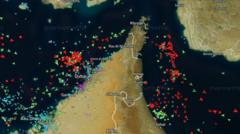
If you’ve looked at the recent timelapse data showing a thinning of shipping traffic through the Strait of Hormuz, you’ve likely heard the standard eulogy for regional relevance. The narrative is lazy: global "de-risking," the rise of the Northern Sea Route, and the inevitable pivot to green energy have supposedly turned the world’s most critical chokepoint into a ghost town.
They say the decline in hull counts signals a loss of Persian Gulf power. They are wrong.
In reality, we are witnessing the professionalization of scarcity. A drop in visible traffic isn't a sign of weakness; it’s a sign of a market that has finally learned how to weaponize efficiency and "dark" logistics. While the desk-bound analysts at major maritime consultancies track Transponder A and Transponder B, they are missing the tectonic shift in how energy actually moves in 2026.
The Volume Vanity Metric
The biggest mistake in maritime analysis is equating ship counts with strategic importance. I spent a decade in commodity floor trading, and the first lesson you learn is that the loudest signal is often the most deceptive.
Most "traffic decline" reports fail to account for the massive increase in Deadweight Tonnage (DWT) per vessel. We aren’t seeing fewer barrels; we are seeing larger, more efficient hauls that consolidate three Medium Range tankers into one Very Large Crude Carrier (VLCC).
- The Math of Stealth: A single VLCC can carry $2,000,000$ barrels of oil.
- The Optical Illusion: On a satellite timelapse, one VLCC looks like a single dot. Three smaller tankers look like a "busy corridor."
When you see a "fall in shipping traffic," you aren't seeing a decline in demand. You are seeing the optimization of the supply chain. The Strait remains the artery for 20% of the world’s liquid petroleum. Whether that 20% moves in 50 ships or 150 ships is irrelevant to the global economy, but it’s a "game-changer" for those who want to sell a narrative of Middle Eastern decline.
The Rise of the Invisible Fleet
Let’s talk about what the cameras don't show. If you think every ship in the Strait of Hormuz is broadcasting its position via AIS (Automatic Identification System), you haven't been paying attention to the "shadow fleet" dynamics.
Sanctions evasion isn't a fringe activity anymore; it’s a sophisticated, multi-billion dollar infrastructure. When the "visible" traffic falls, the "dark" traffic often rises to meet it. Vessels routinely spoof their locations, manipulate their MMSI numbers, or simply "go dark" while transiting sensitive zones.
I’ve seen operations where cargo is transferred ship-to-ship (STS) just outside the monitored zones, effectively halving the number of recorded transits through the chokepoint while the exact same volume of product reaches its destination. To look at a timelapse and claim traffic is down is like looking at a highway at night, seeing no headlights, and assuming no one is driving—completely ignoring the guys running with night-vision goggles.
The Pipeline Pivot Myth
A favorite argument of the "Hormuz is Over" crowd is the expansion of overland pipelines. The UAE’s Habshan-Fujairah line and Saudi Arabia’s Petroline are frequently cited as the reasons why the Strait is losing its grip.
This is a fundamental misunderstanding of maritime flexibility.
Pipelines are static. They are vulnerable to sabotage and limited by fixed capacities. More importantly, they lack the "optionality" that a tanker provides. A ship can be diverted to a higher bidder in mid-ocean; a pipe goes where the steel was laid ten years ago.
The regional powers aren't using pipelines to bypass the Strait because it’s "losing relevance." They are using them as a hedge to ensure that when they do decide to exert pressure on the Strait, they don't bankrupt themselves in the process. The "decline" in traffic is actually the sound of the Gulf states building a safety net that allows them to be more aggressive, not less.
Why the Data is Biased
Most of the entities providing this "fall in traffic" data have a vested interest in cooling the insurance markets.
High traffic density in a contested zone drives up War Risk Premia. When the data shows a "calmer" Strait, insurance rates stabilize. It’s a convenient fiction that benefits Western buyers and shipping conglomerates.
If you look at the Baltic Exchange data or the Lloyd’s List intelligence reports with a critical eye, you’ll notice that while "scheduled" transits might be down, the "ton-mile" demand is at record highs. Ships are traveling further, staying at sea longer, and carrying more.
The Sovereignty of the Chokepoint
Consider the physics of a chokepoint. The Strait of Hormuz is roughly 21 miles wide at its narrowest point, but the shipping lanes are only two miles wide in each direction.
Total $Width = 21$ miles.
Navigable $Lanes = 2$ miles.
It does not matter if 1,000 ships pass through or 10. The geopolitical leverage remains binary: either the lanes are open, or they are closed. A "fall in traffic" doesn't make the Strait easier to defend, nor does it make it less lucrative to block. If anything, fewer, larger ships make for higher stakes targets. Losing one VLCC is a catastrophic environmental and economic event; losing one of ten small tankers is a Tuesday.
The Energy Transition Fallacy
Stop believing the hype that the energy transition has already gutted the oil markets.
In 2026, global oil demand is still hovering near all-time highs. The shift toward electrification in the West is being more than offset by the massive industrialization of the Global South. Those tankers you see "disappearing" from the timelapse? They aren't going to scrap yards. They are heading to Port Klang, to Jamnagar, and to the massive new refinery complexes in East Africa.
The traffic isn't "falling"—it’s redirecting. It’s moving away from the prying eyes of Western-centric data providers and into the opaque corridors of the New Silk Road.
Stop Asking if Traffic is Down
The question isn't "Why is shipping traffic falling?" That’s a flawed premise based on incomplete data.
The real question you should be asking is: "Who benefits from the perception that the Strait of Hormuz is becoming less important?"
The answer is the buyers who want lower insurance rates and the politicians who want to pretend that Middle Eastern stability is no longer a prerequisite for Western prosperity. Both are lying to you.
The Strait is more dangerous and more vital than ever precisely because the traffic is becoming more concentrated. Every ship that passes through now represents a larger share of the global economy. Every "dark" vessel represents a failure of international oversight.
If you’re waiting for the traffic to return to 2010 levels to realize the Strait still matters, you’ve already lost the trade. The smart money isn't watching the number of dots on a map; it's watching the volume of the cargo and the flags of the owners.
Forget the timelapse. Watch the Brent Crude spreads. That’s the only data point that doesn't have an agenda.
The Strait isn't dying. It's just getting harder to track. And in the world of global commodities, what you can't see is exactly what should keep you up at night.
Burn your charts and look at the hulls.