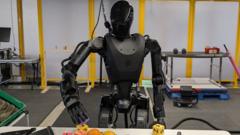
The defense tech sector is currently suffering from a collective delusion. If you read the mainstream defense blogs or listen to the breathless PR coming out of robotics keynotes, you are being sold a specific vision of tomorrow: sleek, bipedal humanoid robots marching into urban combat, replacing flesh-and-blood soldiers, and executing flawless tactical maneuvers.
It is a cinematic fantasy. It is also an engineering absurdity and a tactical nightmare. Recently making headlines lately: The Real Reason Washington is Panicking Over Quantum Computing.
Defense primes and venture-backed startups are burning through hundreds of millions of dollars to force a human shape onto machines meant for war. They argue that because the world is built for humans, warbots must be shaped like humans to navigate it.
They are fundamentally wrong. The "lazy consensus" assumes that the bipedal form is the pinnacle of evolutionary design for combat. In reality, the human body is a fragile, unstable compromise dictated by biology, not ballistic efficiency. Further information regarding the matter are covered by Wired.
By building military robots in our own image, we are spending billions to import human vulnerabilities into machines, while discarding the unique advantages that mechanical platforms actually possess.
The Fatal Flaw of the Two-Legged Warbot
Let’s dismantle the core premise of the humanoid defense narrative: the idea that bipedal locomotion is ideal for the battlefield.
It isn't. Bipedalism is a mechanical liability.
From a physics perspective, standing on two feet means constantly managing a high center of gravity over a dangerously small base of support. Humanoid robots require an immense amount of computational power and battery life just to avoid falling over when shoved. Now, add fifty pounds of armor plating, a muddy trench, an uneven pile of urban rubble, and the kinetic shockwaves of nearby artillery.
Consider the fundamental mechanics of locomotion:
- Static Stability: A four-legged or tracked vehicle is inherently stable. If it loses power, it sits still. If a humanoid robot loses power, or suffers a minor hydraulic failure in a single ankle actuator, it collapses into a hundred-pound heap of useless titanium and shattered sensors.
- Ground Pressure: Two feet concentrate the entire weight of the platform onto two small points. Quadrupedal platforms or continuous tracks distribute weight far better, allowing them to traverse mud, sand, and snow where a heavy humanoid would immediately sink and get stuck.
- Profile and Target Size: The human shape forces a robot to stand tall, presenting a massive, easily identifiable silhouette to enemy marksmen and thermal optics.
I have watched tech firms throw millions of dollars at perfecting a robot's gait on a smooth concrete lab floor. The moment you take that same platform out into a chaotic, unscripted environment filled with loose gravel and wet grass, the illusion shatters. The platform spends more time calculating self-righting algorithms than it does focusing on its mission profile.
We don't build tanks with legs for a reason. We don't build fighter jets with wings that flap like a bird's. Why are we suddenly obsessed with making infantry robots walk like us?
The Tyranny of the Battery
The defense industry loves to talk about autonomy and firepower, but it rarely talks about thermal management and battery density.
A humanoid robot requires dozens of high-torque actuators constantly firing just to maintain balance, look around, and move. The energy cost of simply standing still is staggering. Current lithium-ion technology cannot sustain a heavy, armored bipedal platform for an extended operational window.
Imagine a scenario where a platoon deploys a squad of humanoid autonomous systems for a standard 48-hour long-range patrol.
- The Logistics Nightmare: Each robot requires its own heavy, proprietary charging packs or swap-out batteries. The weight of the replacement batteries quickly exceeds the weight of the ammunition and supplies a human soldier would carry.
- The Thermal Signature: Keeping dozens of electric motors or hydraulic pumps cool while encased in ballistic armor requires active cooling. This transforms the robot into a screaming bright beacon for enemy thermal imaging systems.
A tracked, low-profile unmanned ground vehicle (UGV) can use a highly efficient hybrid-diesel engine, idle quietly for days, and cover hundreds of kilometers of brutal terrain without breaking a sweat. The humanoid form factor forces engineers to compromise on battery capacity because the upper torso cannot handle the top-heavy weight distribution. It is a design trap.
Dismantling the "People Also Ask" Mythos
When you look at what military planners and civilians ask about this technology, the questions themselves betray a deep misunderstanding of how real-world combat functions.
"Can humanoid robots replace human soldiers in urban combat?"
This question assumes that urban combat is just about walking through doors and climbing stairs. It isn't. Urban combat is about occupying space, interacting with civilian populations, and adapting to unpredictable, structural structural collapses. A humanoid robot cannot squeeze into a tiny crawlspace, easily crawl prone under low wire for hundreds of meters, or blend into a local crowd. More importantly, using a multi-million-dollar humanoid robot to clear a room is an incredibly inefficient use of capital. A cheap, expendable, explosive-laden drone flown through a window achieves the same tactical outcome at a fraction of the cost.
"Will humanoid robots reduce military casualties?"
Only if you assume they can survive long enough to take a human's place. Because they are complex, high-maintenance machines with hundreds of moving parts, their mean time between failures on a real battlefield will be devastatingly short. When they break down or get stuck—and they will—flesh-and-blood soldiers will have to risk their lives under fire to retrieve or destroy the classified technology inside them to prevent it from falling into enemy hands.
The Real Future of Autonomous Warfare (And It Isn't Human)
The true innovators in defense technology aren't trying to build C-3PO with an assault rifle. They are leaning into the strengths of non-human morphology.
If you want to understand where autonomous ground warfare is actually going, look away from Silicon Valley's humanoid hype and look at the brutal pragmatism of modern electronic warfare and drone deployment.
| Platform Type | Mobility Efficiency | Production Cost | Tactical Silhouette | Payload Capacity |
|---|---|---|---|---|
| Humanoid Biped | Extremely Low | Exorbitantly High | Tall / High Visibility | Limited / Top-Heavy |
| Quadruped (Robodog) | Medium-High | Moderate | Low / Adaptable | Moderate |
| Tracked Micro-UGV | High | Low | Micro / Ground-Level | High |
The future belongs to swarms of specialized, low-cost systems. A swarm of twenty small, tracked units armed with anti-tank guided missiles can distribute themselves across a square kilometer, hide in the brush, and survive a kinetic strike. A single humanoid robot costing the same amount is just an expensive target waiting to be taken out by a $500 hobby drone carrying a shaped charge.
I admit there is an argument to be made for humanoid forms in highly controlled, rear-enclosure logistics roles—loading cargo containers on a flat tarmac or moving crates inside a well-mapped warehouse. But the moment you cross the line of departure into active combat, the humanoid form factor becomes a liability.
Stop trying to force machines to mimic human biology. The most lethal systems on the next battlefield will look nothing like us. They will be low, ugly, fast, and entirely optimized for the cold calculus of survival and fire dominance. Everything else is just a VC-funded science project.