The Parasite Lie
Popular science loves a clean narrative. Mainstream entomology writers pitch you a comfortable myth: out of roughly 4,600 cockroach species on Earth, a tiny, reckless fraction—maybe less than 1%—"chose" to abandon the forest floor to invade human homes. They paint these pests as opportunistic freeloaders who stumbled into our kitchens and decided to stay.
That narrative is completely wrong.
Cockroaches did not choose us. We engineered an environment that systematically eradicated their natural competitors and left open thousands of square feet of climate-controlled, predator-free real estate. The German cockroach (Blattella germanica) and the American cockroach (Periplaneta americana) are not wild animals that drifted indoors. They are products of human architecture.
If you think you are fighting an invasive wild pest, your pest management strategy will fail. You are actually fighting an organism that you designed your living spaces to breed.
The Co-Evolution Trap
Let us dismantle the standard line. mainstream outlets point out that species like Blattella germanica are nowhere to be found in the wild. They cite this as a quirky biological mystery.
It is not a mystery. It is co-evolution in real time.
When urban developers seal a building to maximize HVAC efficiency, they create high-humidity microclimates behind drywall and around plumbing chases. When architects run thermal conduits through multi-family housing, they construct sub-wall superhighways.
Consider the mechanics:
- Thermal Stability: Wild cockroaches face freezing temperatures, seasonal rain, and severe dehydration. Indoor environments maintain a constant 70°F to 78°F year-round.
- Predator Vacuum: In a garden, a cockroach faces centipedes, birds, spiders, and amphibians. Inside a modern apartment building, those natural checks are aggressively exterminated by tenants or pest control officers.
- Nutritional Concentration: High-density human housing creates concentrated piles of lipids, proteins, and simple carbohydrates within inches of moisture sources.
I have spent years analyzing pest control protocols for commercial properties. Property managers routinely burn thousands of dollars on monthly chemical sprays, completely oblivious to the structural reality: the building itself is an incubator. You can dump a barrel of synthetic pyrethroids into a kitchen, but if your building envelope maintains 60% humidity and provides warm drywall voids, you are merely running a selective breeding program for pesticide resistance.
Why 4,590 Species Avoid You
The conventional wisdom asks: Why do so few species live with us?
The real question is: Why would any self-respecting organism want to?
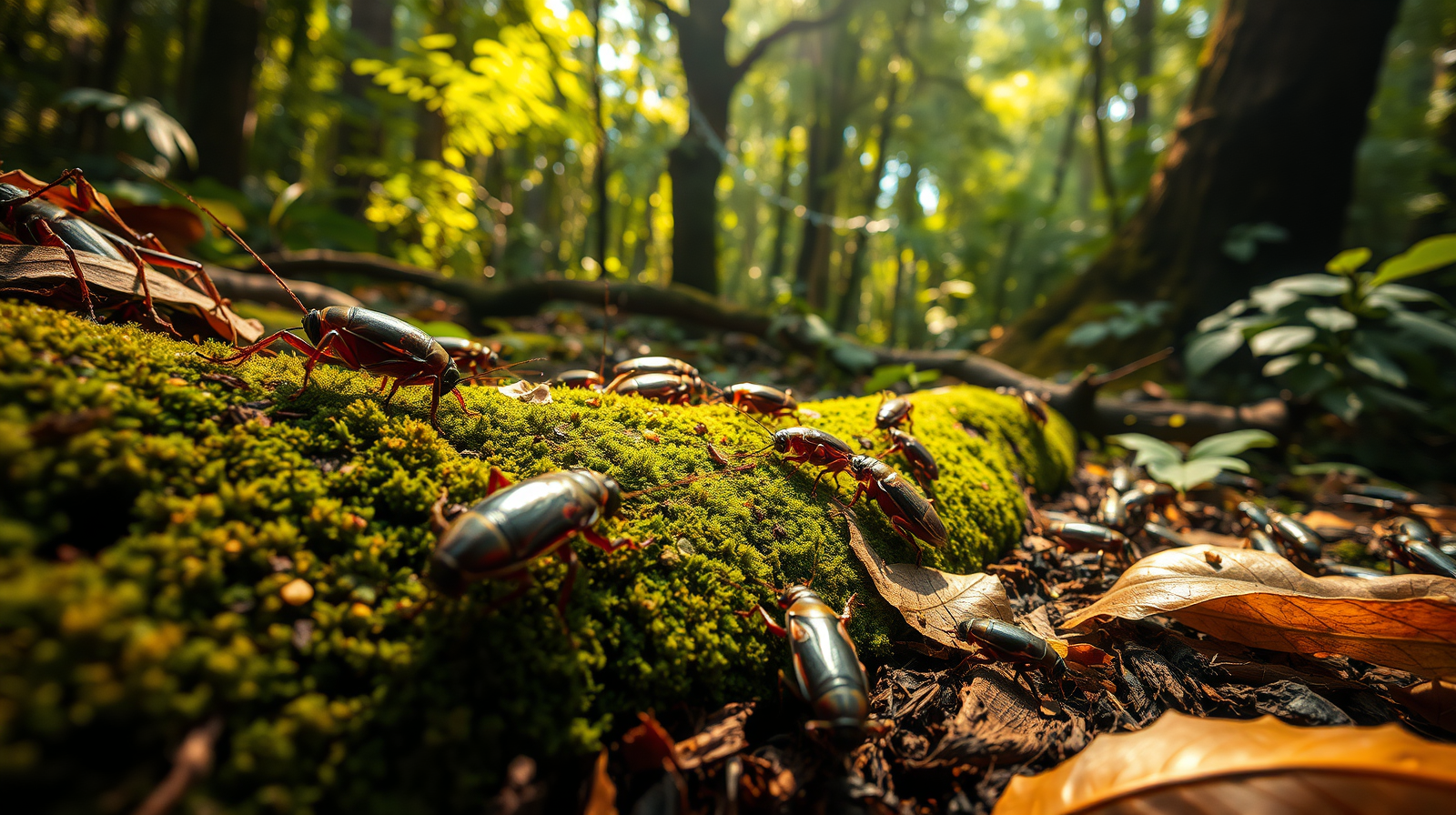
The vast majority of the world's 4,600 cockroach species are specialized detritivores. They need decaying leaf litter, specialized soil fungi, or specific timber density to survive. They are crucial ecosystem engineers breaking down plant matter in tropical rainforests and temperate woodlands.
They stay outside because our homes are biological deserts to them. Your kitchen counter offers zero rotting oak bark. Your bathroom floor lacks the soil microbiome required for their digestive tracts.
The handful of synanthropic species—the ones living alongside us—are not "adaptive geniuses." They are biological generalists with two hyper-specific traits:
- Extreme Thigmotaxis: A physical drive to squeeze into narrow crevices where their back and belly touch opposing surfaces simultaneously. Our construction materials (drywall gaps, baseboard seams, cabinet backing) offer infinite thigmotactic real estate.
- Omnivorous Enzymatic Machinery: An absolute lack of dietary sophistication. They possess an expanded suite of cytochrome P450 enzymes that allow them to neutralize toxins and digest everything from cardboard adhesive to hair follicles.
We did not attract pests; we built a niche so narrow and extreme that only a few hyper-specialized monstrosities could occupy it.
The Chemical Illusion
People love asking simple questions: What is the best spray to get rid of roaches fast?
That question contains a fundamental flaw. Chemical sprays are a short-term band-aid on a structural hemorrhage.
When you spray a aerosol pesticide at a line of German cockroaches, you kill the weak ones. The survivors digest the chemical, metabolize it, and pass metabolic resistance down to the next egg case (otheca). Within three generations, your off-the-shelf spray acts as little more than an inconvenience.
Entomologist Jules Silverman demonstrated decades ago that German cockroach populations quickly evolved a behavioral aversion to glucose—the very sugar manufacturers used to bait them. The roaches literally altered their taste receptors to perceive glucose as bitter, rendering standard bait stations useless overnight.
If you rely purely on chemical warfare, you lose. Every time.
The Trade-Offs of Modern Remediation
To fix a systemic infestation, you have to abandon the idea of an easy fix. Real control requires structural modification, and structural modification is expensive, tedious, and inconvenient.
| Method | The Promise | The Reality | The Failure Point |
|---|---|---|---|
| Pesticide Sprays | Instant knockdown of visible insects. | Drives populations deeper into wall voids; accelerates chemical resistance. | High resistance rates; toxic residue in living areas. |
| Gel Baits | Target eradication through social feeding. | Requires complete removal of competing food sources. | Behavioral glucose aversion; improper placement. |
| Exclusion & Humidity Control | Permanent disruption of the indoor habitat. | High labor costs; requires structural repairs and tenant discipline. | Micro-leaks in plumbing; unsealed utility penetrations. |
The hard truth? The only long-term solution is to ruin their habitat. That means dropping indoor humidity below 50%, stripping out utility penetrations with expanding foam and copper mesh, and eliminating every micro-source of standing water. It is unsexy, physical labor.
Stop Fighting the Bug. Dismantle the Habitat.
If you are dealing with an entrenched infestation, stop looking for a magic chemical. Start thinking like a structural engineer.
First, kill the water source. A German cockroach can survive weeks without food, but it dies in days without moisture. Fix the hairline drip under the sink that you have ignored for six months. Dry out the condensation pan under the refrigerator.
Second, seal the highways. Pull back the stove. Look at where the gas line enters the drywall. If there is a quarter-inch gap around that pipe, you have an open turnpike connecting every unit in the building. Seal it with copper mesh and silicone sealant.
Third, change the bait strategy. Switch to non-sugar-based matrix baits containing insect growth regulators (IGRs) like hydroprene or pyriproxyfen. IGRs do not kill the adult roach immediately; they disrupt the chitin synthesis in nymphs, rendering them sterile adults that cannot reproduce. It takes weeks, but it collapses the entire demographic pyramid of the colony.
We built this indoor ecosystem brick by brick. If we want the pests gone, we have to stop building it for them.