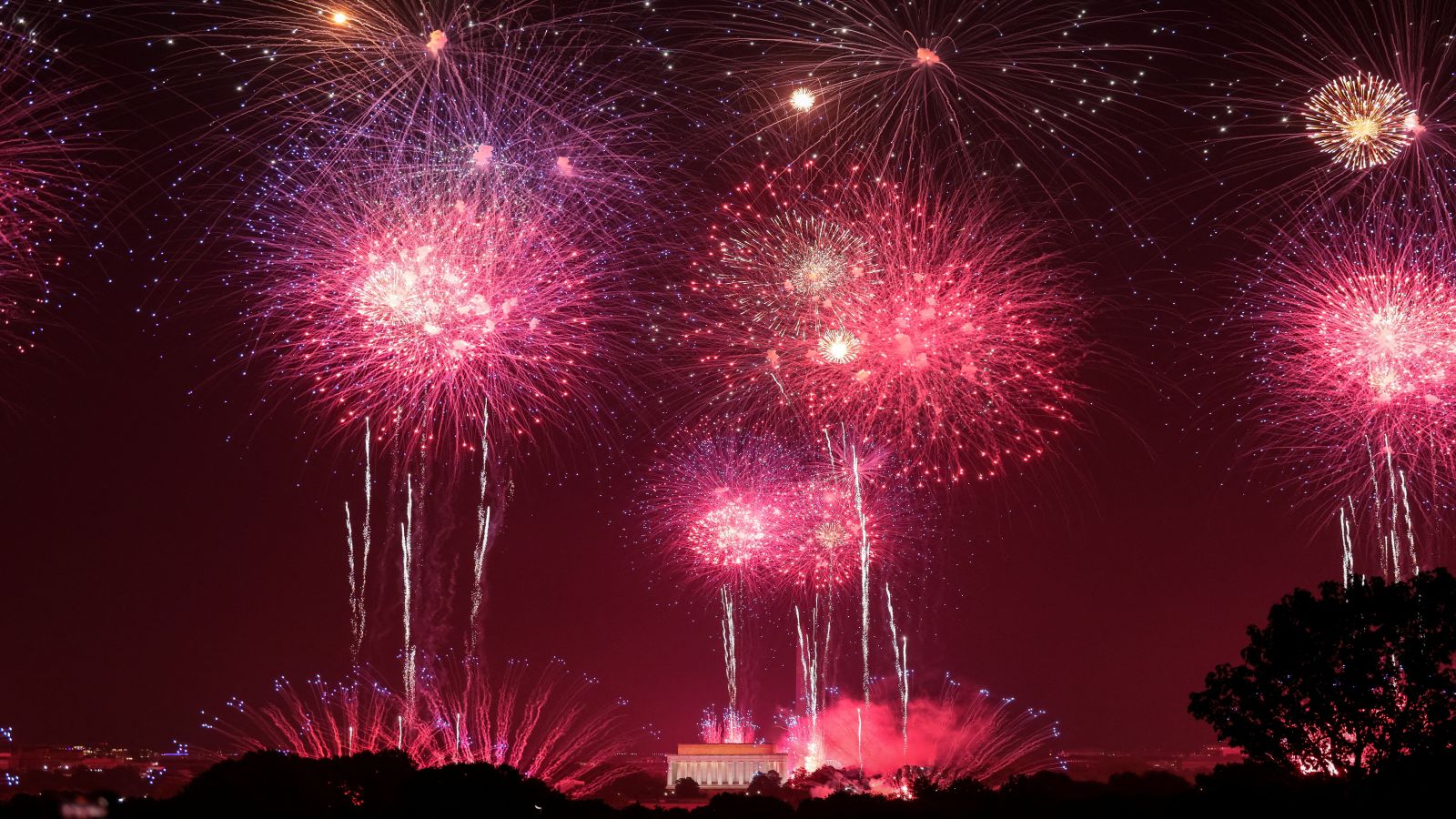
The sky above the National Mall split open with 851,000 bursts of light, a calculated sensory overload engineered to break a world record and mask a fractured reality. On July 4, 2026, the United States marked its 250th anniversary of independence under a stifling 100-degree heatwave and the shadow of severe summer storms. President Donald Trump stood before a rain-slicked, evacuated, and then reconstituted crowd to declare the dawn of a new golden age. Yet beneath the roar of military flyovers and the smoke of a forty-minute pyrotechnic display, the event functioned less as a traditional national milestone and more as a high-stakes exercise in political branding.
The semiquincentennial was designed to be a definitive moment of global spectacle. What the public witnessed, however, was a deep institutional tension between raw patriotism and partisan muscle.
The Architecture of a Public Private Spectacle
To understand the scale of the Washington festivities, one must look at the machinery behind the "Freedom 250" Task Force. This was not the standard, Bureau-led holiday of years past. Instead, it operated as a heavily capitalized public-private partnership, combining $150 million in congressional funding with massive corporate and private backstops.
The footprint was undeniable. A master-planned state fair structure transformed the National Mall into an array of pavilions representing every state and territory. On paper, it was an inclusive tribute to the American experiment. In practice, the scheduling and execution bore the distinct, unmistakable signature of the Trump administration's cultural playbook.
Consider the events leading up to the holiday. The White House lawn was converted into a sports arena to host a professional Ultimate Fighting Championship event. While organizers noted that the athletic organization covered the costs, the integration of a commercial combat sport into the official anniversary matrix of the republic signaled a massive departure from historic civic norms. The event served a dual purpose, blending the nation's milestone with a celebration of the president's recent 80th birthday, complete with a crowd-led rendition of "Happy Birthday" on the executive mansion's lawn.
High Heat Storms and Selective Mobilization
Nature did not cooperate with the script. The weekend was plagued by a brutal heatwave that pushed temperatures past 106 degrees in parts of the mid-Atlantic, forcing the cancellation of the National Park Service’s official Independence Day Parade. By Saturday evening, severe thunderstorms forced authorities to clear the National Mall entirely, halting security screenings and scattering thousands of tourists.
The standard institutional response would be a postponement or a pivot to indoor, televised broadcast. Instead, the administration used the disruption to craft a narrative of defiance.
"I'm not going to let some rain stop our 250th," Trump posted on social media.
💡 You might also like: Structural Mechanics of Turkish Firearm Reform and the School Safety Mandate
When the gates reopened two hours late, a dedicated, highly partisan contingent returned to the wet grass. The resulting environment changed the fundamental nature of the audience. The casual tourists, families with young children, and international visitors largely sought shelter elsewhere. Those who waited out the storm were the core loyalists, transforming a civic commemoration into an arena-style political rally.
The Speech and the Strategic Shift
When the president finally took the stage close to 10:00 PM, the rhetoric immediately shifted from historical reflection to current political warfare. The address balanced necessary tributes to American longevity with specific, sharp jabs aimed at domestic opponents.
Trump honored eleven Gold Star families, praised a 107-year-old D-Day veteran, and highlighted the crew of the upcoming Artemis II lunar mission. These moments aligned with traditional presidential duties during a milestone anniversary. However, the pivot to active policy debates was immediate. Within the same broadcast, the president advocated for the passage of the SAVE America Act, mounted a defense of the Second Amendment, and launched familiar broadsides against what he termed domestic radicals and communist influences.
This juxtaposition exposes the central friction of the modern American dynamic. The state uses the symbols of 1776—the sacrifice of the Founding Fathers, the technological triumphs of the space race, the blood spilled at Normandy—to legitimize a highly specific, contemporary political agenda. For the audience on the Mall, the message was seamless. For the millions watching at home, the divide grew wider.
The Reality of a Divided Public
The numbers behind the celebration show a nation deeply unsure of its own endurance. While a recent Reuters/Ipsos poll indicated that roughly 80 percent of Americans planned to mark the holiday in some fashion, the underlying data reveals a stark ideological split. Over 91 percent of Republicans expressed intent to celebrate, compared to 76 percent of Democrats and 74 percent of independents.
More telling is the long-term outlook of the populace. The same data revealed that 38 percent of respondents believe it is unlikely the United States will exist as a single, unified nation another 250 years from now. This widespread skepticism underscores the artificial nature of the display in Washington. The administration deployed a record-setting 851,000 fireworks precisely to project an image of absolute permanence and power to the rest of the world. Yet, more than a third of the domestic population views the entire structure as fragile.
The massive display by Pyrotecnico met its explicit directive to surpass previous global records, filling the sky until midnight. The air grew thick with sulfur, the noise echoed across the Potomac, and the administration claimed victory over both the weather and its critics. But when the smoke cleared, the systemic fractures of the country remained unchanged. The record-breaking noise of the semiquincentennial did not resolve the American crisis; it simply drowned it out for forty minutes.