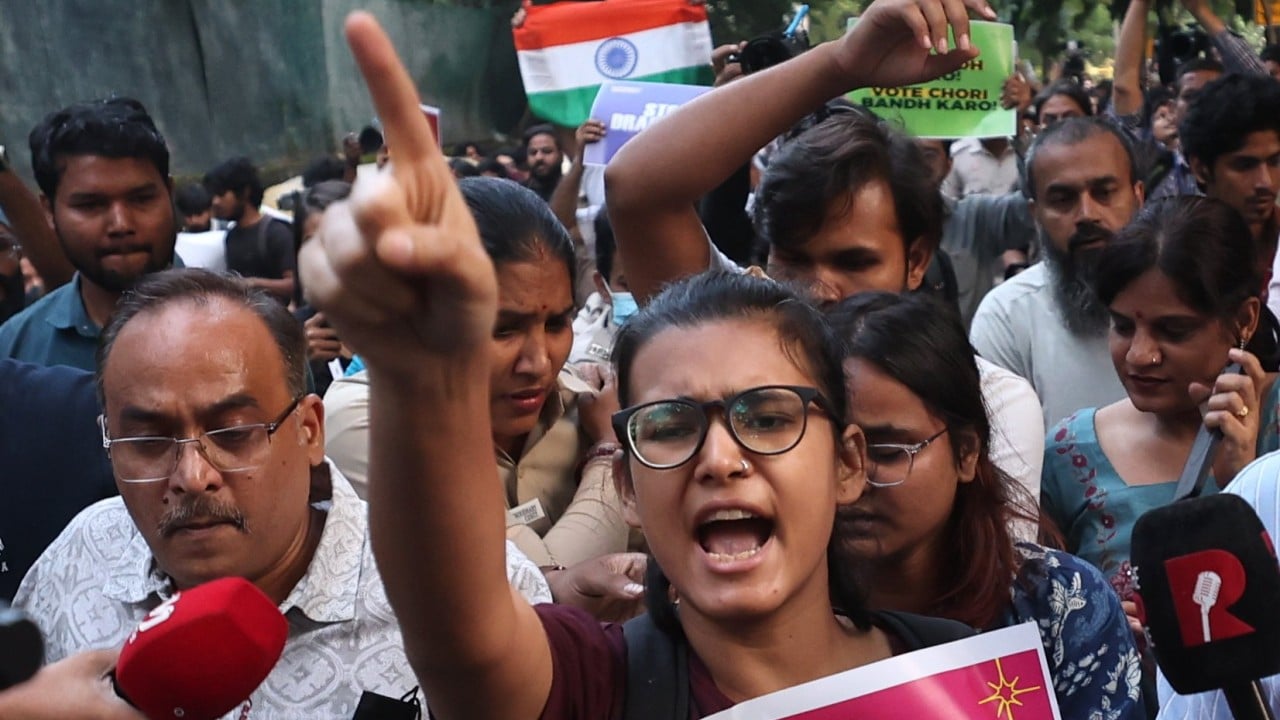
Every time street demonstrations flare up in India, lazy commentators reach for the same dusty script. A prime minister is cornered. A decade-long political streak is cracking. The young are rising up to topple the establishment.
It makes for great television. It is terrible analysis.
The conventional story treats youth protests in India as a simple referendum on Narendra Modi’s survival. When students march over exam cancellations, coaching hubs, or hiring delays, pundits treat every placard as an anti-incumbency ballot. That reading misses the deeper mechanics of Indian politics, Indian demographics, and the exact friction points created by rapid state-led modernization.
Protests are not automatically a sign of collapse. Often, they are the noise made by a system scaling faster than its older administrative plumbing can handle.
The Lazy Consensus About Indian Youth Anger
Start with the premise that a surge in youth protests equals a mortal threat to Modi. Political history in democracies—and certainly in India—does not move in straight lines from street anger to regime change. Protests spike for many reasons. Some topple governments. Most vent specific grievances, force tactical concessions, and leave core voter coalitions intact.
To understand why the "Modi under pressure" narrative is too simple, you have to separate acute grievance from structural alignment. A young graduate furious about a leaked recruitment paper or a botched entrance test is angry at a specific failure of execution. That anger is real. It is loud. It floods social media feeds and draws sympathetic coverage from foreign outlets looking for drama.
Yet anger over administrative bottlenecks is not the same thing as rejecting an entire political project. Many young Indians who protest over exam delays or job competition still support national infrastructure pushes, welfare delivery, cultural assertion, or strong leadership. Treating every protest march as ideological defection confuses a bad day with a divorce.
I have spent years watching political campaigns, policy rollouts, and public communications across high-growth markets misread street noise. I have seen seasoned strategists blow millions chasing a "youth wave" that existed mainly in newsroom group chats while ignoring what voters actually prioritized at the booth. When analysts mistake visible protests for hidden majorities, they get blindsided every single election cycle.
Demographics Is Not a Single Bloc
Another lazy assumption in coverage of India’s youth protests is treating "youth" as one monolithic voting block with one shared grievance. India has one of the largest young populations in the world, which means its young people span every economic tier, caste dynamic, linguistic belt, and aspiration level imaginable.
An urban engineering student scrolling X in Bengaluru does not live in the same economic reality as a rural secondary-school graduate in Uttar Pradesh or a first-generation college student in Bihar. One group worries about global tech hiring and startup funding. Another worries about state public-service exams, regional quotas, and local livelihood stability.
When commentators lump all of them together under a single banner of "India’s youth," they flatten real conflicts of interest among young people themselves. Even on jobs and education, different groups compete for scarce seats and slots. What looks like a unified generational rebellion from afar often turns out to be a patchwork of distinct pressures colliding in public space.
Why Growth and Friction Arrive Together
Here is the counter-intuitive reality that critics of Modi’s economic model rarely want to admit: rising expectations look like instability.
When an economy stagnates quietly, fewer people mobilize around ambitious career ladders because expectations are already depressed. When a country pushes rapid formalization, digital infrastructure, mass university enrollment, and state-backed development programs, millions of young people suddenly enter the race at once. More applicants chase exams. More graduates expect white-collar credentials. More citizens notice when an old state bureaucracy moves too slowly.
Political scientists and development economists—from Samuel Huntington writing on political order in modernizing societies to contemporary observers of Indian state capacity—have long pointed out a basic tension: modernization creates new demands faster than institutions can immediately absorb them. That tension is not proof that development failed. It is proof that millions more people are actively trying to climb into the middle class.
Imagine a scenario where a state doubles university access and digital connectivity in a decade while leaving legacy exam boards and municipal hiring rules half-reformed. You would not get quiet obedience. You would get loud, organized, media-savvy protests from ambitious young citizens demanding competence right now. That is friction from expansion, not rigor mortis.
The Exam and Credential Trap
Nothing captures this friction better than India’s obsession with government jobs and standardized exams. For generations, public-sector employment offered security, social prestige, and predictable benefits in an economy where private formal jobs were harder to find.
When exam schedules slip, question papers leak, or results stall, the outrage is intense because the stakes feel existential to families who pooled savings for coaching classes. Calling those protests a sign of a decade-high crisis for Modi misses who owns the machinery on the ground. Much of exam administration, policing, and local governance in India is shared across state governments run by different parties, not just New Delhi.
Blaming or crediting a single central leader for every administrative hiccup across a federal system is convenient shorthand. It is also lazy political science.
Answering the Questions People Actually Search
If you look past the headlines, people asking about India’s youth protests usually want straight answers to a few recurring questions. Most of those questions start from a shaky premise.
Are youth protests in India really at a decade high?
Headlines love superlatives like "highest level in a decade" because they imply an unbroken arc of calm followed by a sudden explosion. In reality, India has seen major youth and student mobilizations repeatedly over the past ten years—over farm laws, citizenship legislation, railway recruitment rules, university fees, and regional issues.
Recency bias makes the latest wave feel unprecedented. Look closely at the past decade and protest cycles come in waves rather than a single linear surge. Calling the current moment a ten-year peak often depends on which protests you count, how you define "youth," and which news cycle you are staring at.
Why are young Indians protesting if the economy is growing?
Macroeconomic growth rates and everyday household opportunity do not move in lockstep on the same day. A country can post strong headline GDP growth driven by investment, services, or infrastructure while job creation in specific white-collar or entry-level brackets lags behind graduate supply.
Skills mismatches make the gap sharper. Degrees do not automatically equal market-ready skills, and aspirational families often prefer waiting for a perceived "good" job over taking lower-paid informal work. Protest happens in the gap between aspiration and immediate absorption.
Does youth unrest mean Modi’s political dominance is ending?
No single protest cycle ends a dominant political coalition on its own. Dominance in Indian politics rests on organizational depth, welfare delivery, local alliances, cultural resonance, and opposition fragmentation—not just mood swings among college students or urban protesters.
Protests can force policy tweaks, embarrass officials, and dent support in specific pockets. They rarely rewrite an entire electoral map unless opposition parties turn street energy into disciplined ground organization and a credible alternative program. Most protest movements in India burn bright, extract concessions or attention, and struggle to convert into lasting electoral machinery.
Where This Contrarian View Can Go Wrong
Being contrarian is easy when you just wave away bad news. Being credible means admitting where your own argument can fail.
If I am overstating the resilience of Modi’s model, here is how that mistake happens: underestimating compound frustration. A single delayed exam is a headache. Five years of delayed exams, rising living costs, and stagnant real wages for entry-level workers becomes a bitter personal story told at every family dinner table.
Even strong political brands erode if core economic promises feel out of reach for too long. Youth discontent does not have to look like a French-style revolution to matter. Quiet disillusionment, lower turnout among disillusioned cohorts, or gradual erosion in key swing states can hurt just as much over time. Dismissing protests completely because "protests always happen" is just the mirror image of panicking over every march.
What Smart Leaders and Observers Should Do Instead
If you are an investor, policy analyst, founder, or political strategist watching India, stop reading youth protests like a soap opera and start reading them like a diagnostic tool.
- Disaggregate the protest by state and sector. Do not treat a campus rally in one city as a national mood ring. Look at which specific exams, industries, or state administrations triggered it.
- Track administrative throughput, not just slogans. Watch how fast authorities fix exam security, clear backlogs, or expand vocational and apprenticeship pathways. Execution fixes anger; speeches rarely do.
- Separate voter loyalty from service complaints. Ask people what they think of long-term direction separately from how they rate current service delivery. You will often get two very different answers in the same household.
- Watch the opposition’s ground game, not the crowd size. Crowd size measures grievance. Organization measures political threat. Until rivals build durable local muscle around these issues, street anger remains raw material rather than a finished weapon.
Youth protests in India are not proof that Modi’s era is collapsing. They are proof that a massive, impatient generation is colliding with an imperfect system while trying to rise. Ignore the street and you miss real warnings; panic over the street and you miss how power actually works.


