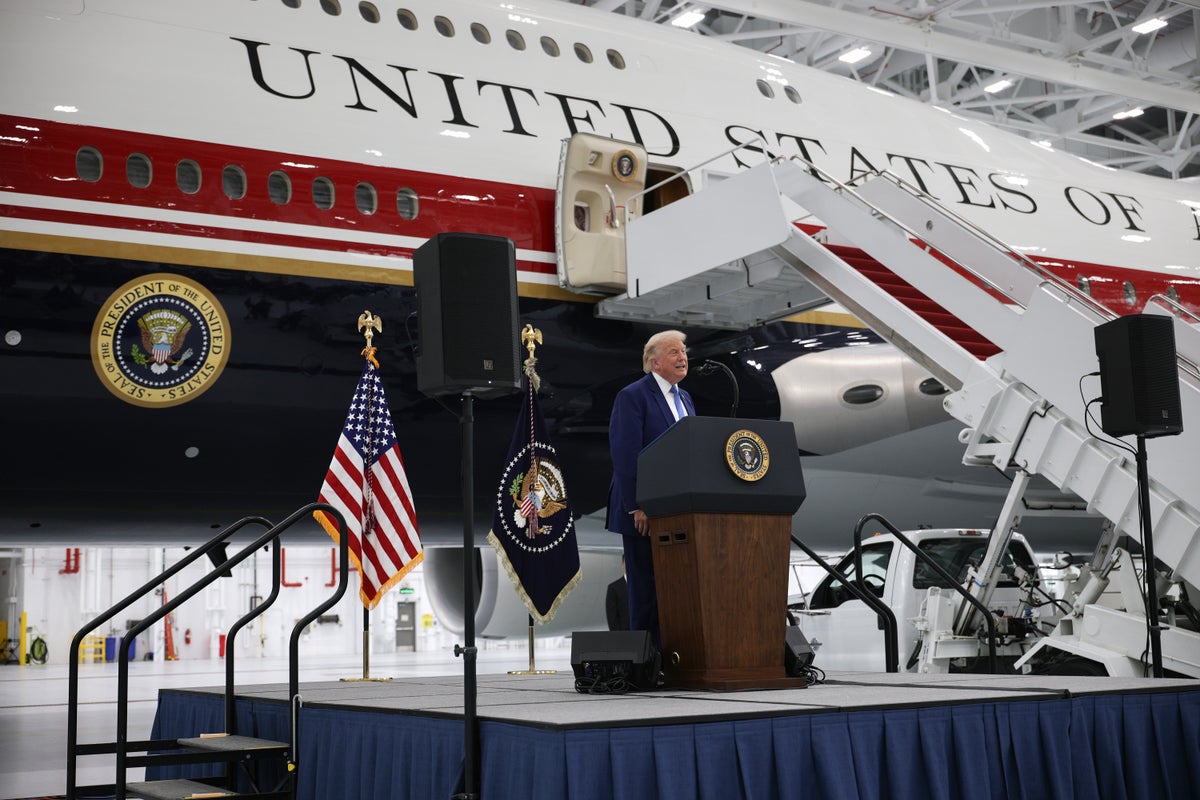
The United States military has officially inducted a formerly foreign-owned jumbo jet into the presidential fleet, bypassing normal procurement channels to solve a mounting logistical crisis. President Donald Trump unveiled the modified Boeing 747-8 at Joint Base Andrews on June 19, 2026, confirming the aircraft will serve as a "bridge" to replace the aging, 35-year-old VC-25A fleet. Valued at $400 million, the aircraft was handed over by the government of Qatar. While the administration frames the acquisition as a massive victory for American taxpayers, the reality reveals a complex web of industrial delays, defense modifications, and significant geopolitical friction.
The Breaking Point in Executive Airlift
The story of the new aircraft is not one of sudden generosity, but of an industrial bottleneck at Boeing. Under a contract initiated during Trump's first term, Boeing was tasked with converting two commercial 747-8 airframes into heavily fortified flying command posts, designated as the VC-25B program.
That program has been crippled by cascading delays, supply chain failures, and workforce shortages. Originally scheduled to debut years ago, the official replacements are now stalled until at least 2028.
Facing the prospect of flying an increasingly unreliable 1980s-era VC-25A through the remainder of his second term, Trump sought an immediate alternative. The solution came via a direct negotiation with the Emir of Qatar, bypassing the standard defense acquisition framework to secure a Boeing Business Jet that previously flew the House of Thani.
The Sovereignty Dilemma of a Gifted Hangar
Accepting a multi-million-dollar piece of hardware from a foreign state violates decades of American diplomatic norms and protocol. To navigate the legal minefield, White House counsel David Warrington and Attorney General Pam Bondi engineered a unique loophole. The plane was technically accepted on the condition that its ultimate title will transfer to Trump’s future presidential library foundation.
National security experts raise serious questions regarding the precedent this sets. Qatar frequently acts as a diplomatic intermediary between Western nations and groups like Hamas, maintaining a highly delicate geopolitical stance. Accepting a massive financial asset from Doha complicates Washington's ability to act as an objective broker in Middle Eastern affairs.
To clear Qatar of future legal liabilities under American law, Defense Secretary Pete Hegseth signed a formal memorandum of understanding in July 2025.
Stripping the Gold and Installing the Armor
While Trump frequently touts the unparalleled luxury of the plane's interior, the Pentagon faced a grueling engineering challenge. A standard VIP transport is fundamentally unequipped to handle the rigors of a nuclear crisis.
Defense contractor L3Harris was quietly tapped to oversee the conversion process under the "VC-25B Bridge" designation. While the Air Force conceded that the interior layout remained minimally changed to expedite deployment, massive structural overhauls occurred beneath the glossy wood paneling and tan leather lounges.
- Hardened Avionics: Technicians installed military-grade, electromagnetic pulse (EMP) shielding to protect the aircraft's flight systems from the atmospheric shockwaves of a nuclear detonation.
- Secured Communications: The civilian satellite arrays were replaced with a localized command node, linking the plane directly to the Pentagon’s secure satellite network.
- Defensive Countermeasures: The airframe was retrofitted with automated flare and chaff dispensers, alongside laser-guided missile defense systems designed to blind incoming heat-seeking ordnance.
The decision to leave the Qatari royal family's luxury finishings largely intact means the aircraft lacks the extensive built-in medical facilities and mobile briefing war rooms native to standard Air Force One specifications. The Air Force chose immediate operational readiness over deep structural re-configuration.
The Battle of the Livery
Beyond the mechanical overhauls, the plane represents a definitive break from American aesthetic history. For over sixty years, U.S. presidential aircraft wore the iconic robin’s egg blue livery designed by Raymond Loewy during the Kennedy administration.
Trump actively discarded that design tradition. The new hull features a deep navy blue underbelly, a sharp red stripe slicing along the fuselage, and prominent gold accents. The left boarding door bears the presidential seal, while the tail is dominated by a sweeping American flag.
[Traditional Loewy Livery] -> Light Blue / White / Silver (Focus on Diplomatic Neutrality)
[New Presidential Livery]  -> Navy Blue / Dark Red / Gold (Focus on Executive Power)
The darker color scheme previously faced stiff resistance from the Pentagon. Engineering assessments during the Biden administration indicated that painting the underside of a large aircraft dark blue could absorb excessive solar radiation. Engineers warned this heat absorption might exceed the qualification limits of sensitive internal electronics during extended tarmac holds in hot climates. The current administration brushed aside those concerns, prioritizing a visual statement of national strength ahead of the scheduled July 4 flyover marking the nation's 250th anniversary.
The Hidden Costs of Free
The claim that the aircraft costs American taxpayers nothing is a financial misdirection. While the airframe itself arrived without a direct purchase invoice, the secondary expenses are substantial.
The Pentagon was forced to build a highly specialized, climate-controlled hangar at Joint Base Andrews simply to fit the 747-8's massive frame, which is significantly larger than the older VC-25A models.
Furthermore, the Air Force had to lease a separate commercial 747-8 and buy a retired airframe from Lufthansa solely to run training simulations for pilots and maintenance crews. Millions more were funneled into building a three-dimensional, full-scale physical mockup of the interior so flight crews could learn the specific geography of the Qatari layout before the real jet arrived.
The plane is currently entering its final commissioning flights, a grueling series of operational stress tests managed by the Presidential Airlift Group to certify the plane before it carries the commander-in-chief to the upcoming NATO summit in Ankara, Turkey. The aircraft is no longer a Qatari asset, but the operational, diplomatic, and long-term maintenance costs of this shortcut will challenge the Pentagon for years to come.