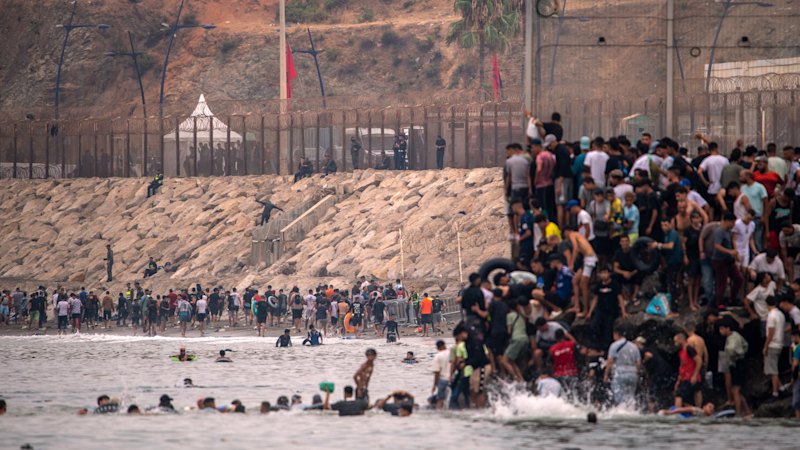
When more than seventy thousand people abruptly surged across the Moroccan border into the Spanish North African enclave of Ceuta, the immediate casualty was orderly statecraft. The subsequent narrative battle over why that unprecedented July rush occurred has exposed a darker mechanism of modern digital manipulation. Spanish Prime Minister Pedro Sánchez pointed directly to coordinated digital interference orchestrated across Russian and Israeli networks, amplifying fraudulent legal claims via platforms like TikTok and Instagram.
This is not a story about simple rumors. It is an examination of how foreign policy flashpoints weaponize human migration as a psychological pressure valve.
The Anatomy of a Digital Fabrication
Borders do not collapse purely because of physical force. They often fracture first in the digital imagination. During the final days of July, short-form video loops began flooding feeds targeted at vulnerable populations across North Africa. The core fabrication was deceptively simple: a distortion of a Spanish domestic court ruling, twisted by criminal human trafficking syndicates and amplified by foreign nodes, claiming that anyone who successfully swam into Ceuta gained permanent sanctuary.
It was entirely false. Yet, momentum on social platforms relies on emotional resonance, not legal accuracy.
Intelligence evaluations cited by Madrid indicate that networks linked to both Moscow and Jerusalem utilized the friction points to target Spain. The strategic logic is transparent to anyone who has watched modern hybrid warfare evolve. Spain’s vocal stance on international conflicts—ranging from its opposition to Russian actions in Ukraine to its sharp criticism of Israeli military campaigns in Gaza—has made Madrid a prime target for retaliatory reputational damage. By pouring fuel onto Europe's most sensitive political nerve—migration—external actors found an efficient vehicle to destabilize domestic Spanish politics and divide the European Union.
The Geopolitical Fallout
Blaming foreign disinformation is often the refuge of politicians cornered by domestic policy failures. Opposition leaders in Madrid and regional critics inside Ceuta argue that shifting focus to Russian and Israeli bot networks is a smokescreen designed to dodge accountability for structural border vulnerabilities.
Yet, dismissing the premier's assertions ignores the documented playbook of modern influence operations. State-backed actors do not need to create a migrant crisis from scratch to exploit it. They simply need to amplify existing despair, grease the wheels of criminal smuggling networks with targeted messaging, and watch the political shockwaves ripple through Brussels.
When the dust settled over the crowded beaches of Ceuta, thousands of migrants remained stranded in legal limbo, local municipal infrastructure buckled under the strain, and twenty-two European Union member states were openly bickering over whether Spain's reception models acted as a dangerous pull factor.
The Mechanics of Attrition
The convergence of far-right international movements, state-level intelligence objectives, and transnational criminal smuggling rings represents a new frontier in border destabilization. Migration policy is no longer just managed through bilateral diplomatic channels or fence reinforcement. It is contested in real-time recommendation algorithms designed to maximize outrage and cross-border movement.
Spain has pledged millions in emergency economic aid to stabilize Ceuta, and European diplomatic services continue to map the digital footprints that triggered the rush. But the underlying vulnerability remains unpatched. As long as digital platforms can be cheaply subverted to manufacture phantom legal realities for desperate populations, physical borders will remain dangerously porous to ghost stories.