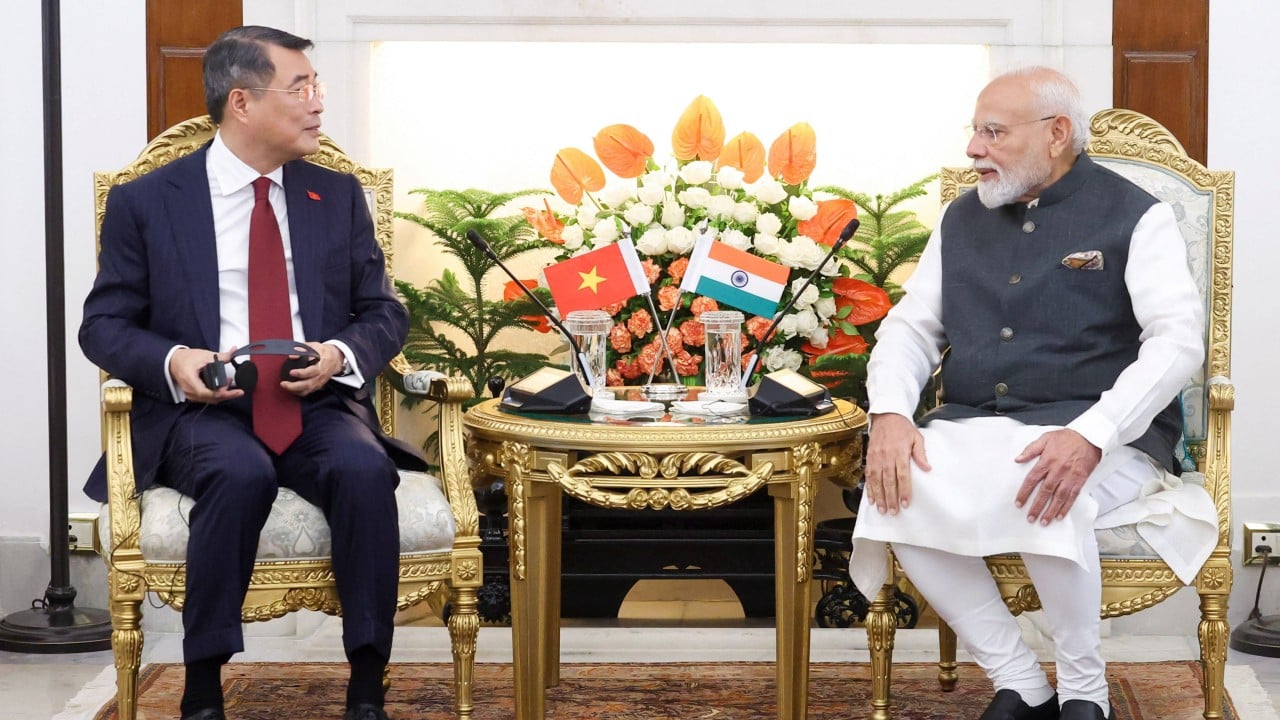
India and Vietnam are both chasing the exact same prize in the China plus one shift, and only one of them actually has the factory floor muscle to keep the orders once tariffs settle. Boardrooms love the clean story of multinationals splitting supply chains to dodge geopolitical headaches. On the ground, Hanoi and New Delhi are fighting a knife fight for anchor tenants in electronics, footwear, and industrial components, often trying to convert temporary risk hedging into permanent export growth.
Walk past the glossy investor summits and you see two very different bets. Vietnam operates like a precision assembly machine built for speed and export discipline. India operates like a continental market trying to bend global manufacturers to its domestic scale while patching physical and bureaucratic potholes in real time. Neither country has a monopoly on the China plus one wave, and neither is guaranteed to hold onto volume if Beijing adjusts pricing or Washington rewrites rules of origin. You might also find this connected article insightful: China Does Not Have A Youth Unemployment Crisis It Has A Credential Inflation Scam.
Why China Plus One Stopped Being a Slide Deck
For years, supply chain diversification lived in corporate risk committees as a PowerPoint exercise. Executives talked about resilience while keeping 80 percent of tooling, mold-making, and component sourcing anchored in Guangdong or Jiangsu. That math broke when tariff regimes hardened, shipping lanes choked, and industrial policy turned factory locations into foreign policy signals.
Still, shifting production out of China does not mean factories magically appear in Southeast Asia or South Asia. A finished smartphone or athletic shoe is not a single item; it is a web of sub-assemblies, chemical inputs, and specialized fasteners. Move final assembly without moving the upstream suppliers and you trade tariff exposure for freight delays and quality drift. As extensively documented in detailed reports by Harvard Business Review, the implications are notable.
Both Vietnam and India understood early that they could not simply wait for orders to drift south or west. They courted anchor names, offered tax holidays, and pitched themselves as indispensable nodes in the China plus one realignment. Yet the mechanics of how each country converts that pitch into durable trade gains work on completely different clocks.
Vietnam Built an Export Runway
Vietnam’s advantage is focus. For more than two decades, policymakers treated export manufacturing as a national survival project rather than one ministry’s pet initiative. Ports sit close to industrial zones, customs clearance rewards predictable schedules, and provincial officials compete hard to clear land for foreign tenants.
Look at how electronics and apparel brands actually run their plants in Bac Ninh, Thai Nguyen, or Dong Nai. Labor is trainable, absenteeism is manageable compared with many emerging markets, and local subcontractors have spent years learning how to meet Tier-1 audit standards. When a brand wants to shift a line out of southern China, Vietnam often feels like a shorter commute across the same supply ecosystem.
That proximity is also Vietnam’s trap. Because so many components still cross the northern border from China, customs scrutiny over rules of origin has grown sharper. A box labeled Made in Vietnam that contains mostly Chinese value-added invites scrutiny from Western regulators and buyers alike. Turning China plus one into lasting trade gains requires Vietnam to deepen domestic value capture without slowing down the customs speed that made it attractive in the first place.
The Labor and Power Ceiling
Success has a habit of eating its own advantages. Industrial provinces in Vietnam have run into tight labor pools during peak production quarters, pushing wages up and forcing factories to recruit from farther provinces. Power reliability has also drawn scrutiny after summer grid strains hit northern manufacturing hubs.
None of this kills Vietnam’s momentum. Factories adapt with automation, shift scheduling, and captive solar or gas arrangements where rules allow. It does mean the easy gains from cheap labor and frictionless expansion are fading, and Hanoi has to compete on productivity rather than low baseline costs.
India Plays a Bigger, Messier Game
India approaches the China plus one race with a completely different leverage point. A company moving to Vietnam is mostly buying an export platform. A company committing billions to India is buying access to more than a billion consumers alongside an export base.
New Delhi’s production-linked incentive schemes changed the tone of conversations with electronics and hardware executives. Instead of asking multinationals to trust vague promises of future infrastructure, the government tied cash payouts to verified incremental manufacturing and local value addition. For categories like mobile phones, components, and solar modules, those incentives moved real capital off the sidelines.
Yet every step forward in Indian manufacturing comes with friction that would make a Vietnamese plant manager wince. Land acquisition still drags. State-level regulations vary wildly. Logistics costs eat a higher share of unit economics before a container even reaches Nhava Sheva or Mundra.
A factory in India can hit world-class assembly quality inside twelve months, while the road connecting its supplier park to the port takes three years of court filings and utility coordination.
That gap between shop-floor capability and macro logistics defines India’s trade battle. Global brands tolerate the friction when subsidies offset initial losses or when domestic demand absorbs early output. Sustaining exports once subsidies taper requires lower component import duties, faster port turnaround, and a deeper pool of mid-sized domestic suppliers who can hit tight tolerances without constant hand-holding.
Where the Two Rivals Actually Clash
On paper, India and Vietnam look complementary. Vietnam dominates consumer electronics assembly, textiles, and footwear; India pushes hard into mobile devices, industrial machinery, chemicals, and auto components. In practice, they collide whenever a global brand decides how many secondary hubs it can afford to manage.
Managing three or four manufacturing countries is expensive. Every extra country adds compliance teams, duplicate tooling, separate vendor audits, and inventory buffers. Most supply chain heads prefer one primary China alternative and one backup, not an evenly split map across half a dozen capitals.
When executives compare notes, the trade-offs are blunt:
- Speed to scale: Vietnam usually gets lines running faster because industrial parks and worker pipelines are already warm.
- Market cushion: India absorbs mistakes better because domestic sales can cushion export dips.
- Component depth: Vietnam leans heavily on regional Asian supply chains, while India is trying to build domestic ecosystems from scratch under tariff walls.
- Policy predictability: Vietnam’s export rules feel narrower and more transactional; India’s industrial policy is ambitious, loud, and frequently revised.
Consider a hypothetical electronics brand weighing where to place a new router assembly line. Suppose the company already buys enclosures and printed circuit boards from suppliers with plants in Shenzhen and northern Vietnam. Moving assembly to Vietnam lets the brand keep existing tooling relationships intact and train supervisors quickly. Moving to India means qualifying new local plastic molders, negotiating customs bonds for imported sub-parts, and accepting higher working capital tied up in transit. Unless Indian incentives or local sales volume close that cost gap, Vietnam wins the order on pure operational arithmetic.
Now flip the example. Suppose the same company is building power supplies or telecom gear where government procurement rules, local content mandates, or long-term domestic infrastructure spending matter. Suddenly Vietnam’s export-only math looks thin, and India’s scale becomes hard to ignore.
The Hidden Bottlenecks Neither Country Can Subsidize Away
Trade ministers love announcing memorandum-of-understanding totals. Plant engineers care about three unglamorous bottlenecks that decide whether China plus one stays put or drifts back.
First is mid-tier supplier depth. Big anchor brands bring their own Tier-1 partners, or force them to build new plants. What both India and Vietnam still lack in sufficient numbers are agile Tier-2 and Tier-3 shops that can machine precision parts, mix specialty resins, or deliver small replacement batches overnight. Without those local workshops, factories still fly parts in from East Asia, eroding the cost and resilience gains of moving in the first place.
Second is port-to-plant choreography. Supply chain resilience fails in customs queues and congested feeder roads. Even modest delays turn just-in-time production into expensive warehouse storage. Vietnam has spent years tightening port workflows, while India has poured capital into dedicated freight corridors and multimodal hubs, yet both still lose margin to border and terminal friction.
Third is human capital below the executive suite. Engineers who can debug automated lines, quality inspectors who catch microscopic defects before shipping, and mid-level logistics planners cannot be conjured by a tax decree. Technical institutes and on-the-job apprenticeships take years to mature, and poaching talent between rival plants only inflates payrolls.
What Happens When China Pushes Back
One flaw in much of the China plus one commentary is treating China as a passive donor of market share. Chinese manufacturers are not sitting still while orders migrate. Many have opened plants in Vietnam, Thailand, Malaysia, and increasingly look at joint ventures or licensing structures in India.
When a Chinese component maker sets up shop in Vietnam, Hanoi records investment and export activity, yet part of the margin and intellectual property still stays with the parent group. When New Delhi restricts Chinese equity or visas to protect domestic industry, it slows down technology transfer and forces Indian firms to source slower, costlier alternatives elsewhere.
Neither Hanoi nor New Delhi controls the broader tariff chessboard in Washington or Brussels. If trade rules tighten around transshipment, or if retaliatory duties hit intermediate goods, the winners will be the countries that actually built local value rather than those that merely re-badged imported modules.
Turning Temporary Hedging Into Permanent Trade Gains
For India and Vietnam, the real test of the China plus one era is not how many groundbreaking ceremonies happen this year. It is what happens five years after the ribbon-cutting, when initial tax breaks expire and procurement teams judge factories purely on landed cost, defect rates, and lead times.
Vietnam has to prove it can move up the value chain—cultivating domestic component makers, upgrading grid and port capacity, and keeping customs clean—without losing the speed that made it a favorite staging ground. India has to prove its industrial subsidies can graduate into self-sustaining competitiveness, cutting logistics drag and letting domestic suppliers stand without permanent tariff walls.
Geography gave both nations a historic opening. Keeping those trade gains requires grinding through the unglamorous work of supplier development, power stability, and customs discipline long after the headlines move on.