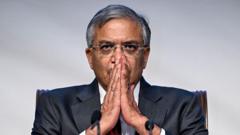
India's Election Commission is facing a severe legitimacy crisis driven by opaque appointment laws, delayed voter turnout data, and perceived bias in enforcing the Model Code of Conduct. For decades, Nirvachan Sadan stood as the unassailable bedrock of the world's largest democracy, a rare institution trusted equally by the ruling party and the opposition. That consensus has shattered. What we are witnessing today is not a isolated administrative hiccup, nor is it merely routine political posturing by sore losers. It is a structural erosion of institutional independence that threatens the perceived fairness of Indian elections before a single ballot is even counted.
To understand why the Election Commission of India (ECI) is perpetually in the eye of the storm, you have to look past the daily press conferences and examine the legislative plumbing beneath it. Meanwhile, you can read related events here: The Structural Failures of Commercial Aviation Security Protocols.
How the Appointment Law Changed Everything
The turning point arrived with the passage of the Chief Election Commissioner and Other Election Commissioners (Appointment, Conditions of Service and Term of Office) Act, 2023. For seventy years, India operated without a specific law governing how its top election officials were chosen, relying instead on the President appointing them on the advice of the Prime Minister. In March 2023, a five-judge Constitution Bench of the Supreme Court stepped into this vacuum. Recognizing the inherent danger of the executive branch handpicking its own referee, the court ruled that appointments must be made by a three-member committee comprising the Prime Minister, the Leader of the Opposition, and the Chief Justice of India.
It was a brief moment of institutional insulation. It lasted less than nine months. To see the bigger picture, we recommend the detailed report by TIME.
The central government introduced new legislation that effectively neutralized the Supreme Court's directive by replacing the Chief Justice of India with a Union Cabinet Minister nominated by the Prime Minister. The math is brutally simple. In a three-member selection panel where two seats belong to the ruling executive—the Prime Minister and a Cabinet Minister—the Leader of the Opposition is permanently outvoted two-to-one.
Critics argue this law institutionalized executive dominance over the poll body. Defenders of the legislation point out that Parliament possesses the constitutional authority to pass laws under Article 324, and that prior to 2023, the executive held absolute sway without any opposition input at all. Both points are factually accurate. Yet the political reality remains unchanged: when the rules are rewritten specifically to remove judicial oversight from the selection of referees, every subsequent call made on the field is viewed through a lens of suspicion.
The sudden resignation of Election Commissioner Arun Goel in March 2024, just days before the general election schedule was announced, poured gasoline on these embers. No official reason was ever provided beyond "personal grounds." Within days, two new commissioners were appointed under the new executive-dominated panel. The opacity of the exit, combined with the speed of the replacements, reinforced a damaging narrative that dissent within Nirvachan Sadan had become untenable.
The Voter Turnout Data Controversy
Trust in an election does not evaporate all at once; it bleeds out through small, unexplained delays. During the multi-phase elections, the ECI found itself embroiled in an unprecedented controversy over the publication of absolute voter turnout numbers.
Historically, the Commission released provisional voting percentages on the evening of polling day, followed swiftly by precise, constituency-wise absolute figures. When the ECI delayed releasing the absolute numbers of votes polled for several days—and when the final figures showed a noticeable upward revision of five to six percentage points compared to initial estimates—opposition parties and civil society groups sounded the alarm.
The Commission's explanation was rooted in logistics. Officials stated that polling parties in remote areas take time to return, that Form 17C (the statutory record of votes polled at each booth) is compiled manually, and that initial percentages are merely estimates based on sporadic updates from presiding officers.
Why Form 17C Became a Flashpoint
To grasp why the delay triggered such intense backlash, you have to understand the mechanics of Form 17C. At the close of polling at every single booth across India, the presiding officer records the total number of votes cast in the Electronic Voting Machine (EVM) on this sheet. Authenticated copies are handed over to the polling agents of every candidate present at that booth before the machines are sealed.
Because agents already possess the booth-level numbers, transparency advocates argued there was no technical barrier preventing the ECI from uploading scanned copies of Form 17C directly onto its website within hours of polling. The Commission refused, citing potential misuse, mischief, and the lack of a strict legal mandate to publish the forms publicly online. The Supreme Court declined to intervene mid-election, citing practical difficulties, which solved the immediate legal challenge for the ECI without resolving the underlying public doubt.
When an institution possesses the data that could immediately quiet conspiracy theories, yet chooses to withhold it on procedural technicalities, it surrenders the moral high ground.
Selective Enforcement of the Model Code of Conduct
If appointment laws govern the structure of the ECI and data delays hurt its transparency, the enforcement of the Model Code of Conduct (MCC) is where the public sees the referee in action. The MCC is a set of guidelines agreed upon by political parties to ensure a level playing field once elections are announced. It prohibits hate speech, appeals to caste and communal sentiments, and the misuse of state machinery.
The problem is that the MCC has no statutory backing; it relies entirely on the moral authority and swift, even-handed intervention of the Commission. Over the past several election cycles, the perception of asymmetry in how this code is applied has grown impossible to ignore.
Consider the mechanics of how complaints are handled:
- Velocity of Action: When opposition leaders cross the line, notices are frequently issued within twenty-four hours, often accompanied by temporary bans on campaigning.
- Institutional Hesitation: When top leaders of the ruling dispensation make speeches that critics flag as overtly communal or divisive, the Commission has repeatedly taken weeks to respond—or addressed the notices to the party president rather than the individual speaker.
- Inconsistent Benchmarks: Statements that draw severe reprimands in one state assembly election are occasionally dismissed as routine political rhetoric in another, leaving campaigns without a clear standard of what is permissible.
Former Chief Election Commissioners like T.N. Seshan built the modern reputation of the ECI in the 1990s precisely because they were feared equally by every political party. Seshan routinely postponed elections, grounded state aircraft, and reprimanded powerful cabinet ministers without blinking. Today's Commission operates with far more advanced technology and vastly superior logistical capabilities, yet it often appears paralyzed when confronting the highest echelons of political power.
The EVM Debate and the Burden of Proof
No analysis of the Election Commission's recurring storms is complete without addressing Electronic Voting Machines. Every major election cycle in India brings a fresh wave of allegations regarding EVM tampering, hacking, or manipulation.
Here, the ECI actually stands on solid technical ground. Indian EVMs are standalone, one-time programmable machines. They have no wireless connectivity, no Bluetooth, no internet interface, and no external ports that can receive outside signals. Furthermore, the introduction of Voter Verified Paper Audit Trails (VVPATs) allows voters to see a printed slip of their vote for seven seconds before it drops into a sealed box.
Yet the Commission consistently mishandles the politics of the EVM debate. Instead of treating skeptics as citizens seeking reassurance, the ECI has often adopted a defensive, dismissive posture. When opposition parties and independent technologists demanded a 100% count of VVPAT slips—or at least an increase from the current random verification of five booths per assembly segment—the Commission argued it would delay results by days and reintroduce human error.
The Supreme Court eventually rejected petitions for 100% VVPAT verification, upholding the integrity of the current system. While the ECI won the legal battle, its combative tone alienated neutral observers. In a democracy, an election authority cannot simply demand blind faith in its hardware. Trust requires continuous, patient demonstration, even when the questions feel repetitive or politically motivated.
The Invisible Hand of Administrative Transfers and Finances
Beyond the headlines about speeches and voting machines lies a quieter battleground: bureaucratic control and campaign finance. Once elections are announced, the ECI assumes disciplinary control over the civil servants and police officers conducting the polls.
Transferring state police chiefs and district magistrates is a standard tool used by the Commission to break local nexuses between bureaucrats and incumbent politicians. However, the pattern of these transfers has increasingly drawn scrutiny. In several state elections, massive bureaucratic reshuffles have occurred in opposition-ruled states following complaints from the central ruling party, while similar complaints regarding officers in states governed by the ruling party met with noticeably lighter intervention.
Simultaneously, the ECI's silence during the Electoral Bonds saga damaged its standing as a guardian of clean elections. Before the Supreme Court struck down the anonymous political funding scheme as unconstitutional in early 2024, the ECI had initially warned the Law Ministry in 2017 that the scheme was a "retrograde step" that would compromise transparency. Later, when the matter reached the apex court, the Commission softened its stance considerably, telling the court it took no position on the policy itself and only sought transparency in disclosures. That pivot looked less like institutional neutrality and more like a retreat under pressure.
The Cost of Diminished Authority
A weakened Election Commission does not just hurt the opposition; it ultimately undermines the mandate of the winner. The genius of India's democratic framework has always been the peaceful transfer of power, made possible because the losing side accepted the legitimacy of the process even when they hated the outcome.
When the referee is viewed as a partisan actor, every close election becomes a potential flashpoint for civil unrest. Losing candidates no longer concede defeat gracefully; they blame the machinery. Winning candidates find their legitimacy constantly questioned, forcing them to spend political capital defending their mandate rather than governing.
Restoring the credibility of Nirvachan Sadan does not require reinventing Indian democracy. It requires reversing the legislative overreach that placed the appointment of commissioners squarely in the hands of the executive, restoring a genuinely independent selection mechanism that includes the judiciary. It demands transparent, automated publication of Form 17C data on polling night so that numbers never look like they are being adjusted behind closed doors. Above all, it requires the courage to apply the Model Code of Conduct without looking at the party symbol of the offender.
Institutions rarely collapse from a single dramatic blow; they hollow out slowly when the people entrusted to run them confuse compliance with neutrality, and until India's election watchdogs rediscover their willingness to say no to power, the storms surrounding them will only grow fiercer.


