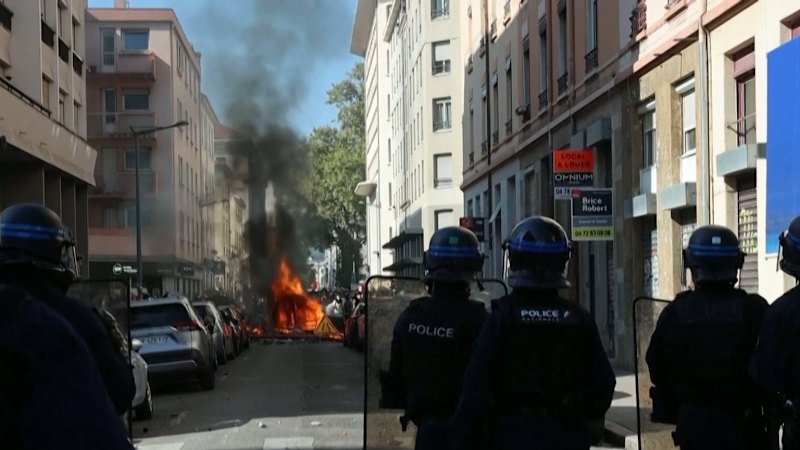
French President Emmanuel Macron called remarks by U.S. President Donald Trump and other foreign leaders on France's October 2026 riots "unacceptable and stupid" after Trump blamed migrants and border policy for nationwide unrest sparked by cost-of-living pressures. Speaking from Qatar on October 21, 2026, Macron pushed back against claims that immigration drove the demonstrations and accused outside politicians of exploiting French street violence for domestic political gain.
The exchange looks like a standard clash of personalities on the surface. It is not. What played out between Doha, Washington, and burning French streets reveals a deeper collision over who gets to define domestic crises in an era of synthetic media, strained supply chains, and populist foreign policy.
Why Street Anger Became a Foreign Campaign Prop
Protests across France in mid-October 2026 began around concrete economic grievances. High inflation, rising living costs, and pressure on public services brought hundreds of thousands of people into the streets, with estimates ranging from 550,000 according to the French interior ministry to 800,000 according to the CGT union. Gilets jaunes activists sought to revive their 2018 movement over living expenses and eroding services, while student groups pushed for greater investment in education.
Some demonstrations tipped into looting, arson, and clashes with security forces. In Limoges, the city hall was destroyed by fire. Elsewhere, authorities imposed curfews and prepared sweeping police deployments ahead of further weekend protests.
Yet almost as quickly as the smoke rose, foreign commentary flattened a messy, multi-layered domestic eruption into a single ideological talking point. Trump argued that concerns over education or household costs were secondary and insisted the unrest was about immigration, urging Macron to close borders and asserting that Paris was heading toward becoming a "Muslim city". In Europe, figures such as Hungarian Prime Minister Peter Magyar similarly tied the turmoil to immigration policy without providing evidence, while broader far-right networks seized on the disorder to push harder anti-immigration arguments.
The Mechanics of Imported Narratives
Foreign leaders rarely comment on another nation's street unrest out of disinterested concern. They speak to audiences back home.
When a foreign president frames a cost-of-living revolt in France as proof of border failure, he is sending a signal to domestic voters worried about migration, crime, and cultural shift. France becomes a convenient mirror. Every burned car or smashed storefront serves as ready-made evidence for a domestic argument already underway in Washington or Budapest.
That dynamic is frustrating for any incumbent leader trying to manage both street disorder and economic anxiety. Macron was in Qatar negotiating energy supplies—securing commitments for monthly diesel deliveries from the Gulf—precisely because fuel and living costs were biting at home. Having foreign leaders rewrite the cause of the crisis from a thousand miles away complicates diplomacy and inflames domestic polarization at the exact moment a government wants clarity.
Synthetic Images and the Information Fog
Macron did not just object to political spin. He pointed to information manipulation and false AI-generated images circulating online that depicted scenes in France that never happened.
In real-world riots, truth already struggles to keep pace with speed. A single real fire in one town can be paired online with fabricated photos from another era or synthetic visuals generated from scratch, making the whole country look consumed by a single storyline. Once those images enter partisan feeds, facts lose ground fast. People react to the visual shock before checking whether the scene occurred on a real French boulevard or inside a rendering engine.
Still, Macron's rebuttal carries its own tension. While he rightly called out fabricated visuals and false claims of an Islamist or migrant "invasion," dismissing foreign criticism outright can also look defensive when French authorities themselves are struggling with curfews, fast-tracked prosecutions, and repeated waves of street violence. A leader facing a burnt town hall has to walk a narrow line: refute distortions without pretending there is no genuine crisis on the streets.
To see how distortion distorts judgment, consider a hypothetical example. Suppose a viral post pairs a real video of a shattered shop window in Lyon with a fabricated image of armed crowds outside a government building, captioned as proof of total state collapse. A reader abroad who already fears migration or urban decay may treat the pair as one unified reality, even if the second image is completely fake and the underlying protest began over bus fares and grocery bills.
What This Clash Exposes About Modern Statecraft
Calling a rival leader's remarks "stupid" breaks the polite choreography usually prized in traditional diplomacy. Yet bluntness has become a predictable reflex when leaders treat international news cycles as extensions of domestic politics.
- Economic pain fuels volatile streets: Cost-of-living pressure and frustration with public services give protests broad reach before fringe actors or rioters hijack the headlines.
- Border rhetoric travels faster than nuance: Simple cultural or migration claims travel across borders far more easily than debates over diesel pricing, municipal budgets, or school funding.
- Visual fakes harden existing priors: AI-generated imagery rarely converts skeptics on its own, but it gives partisans dramatic "proof" to share with allies.
- Alliances strain under public score-settling: Publicly trading insults over domestic turmoil erodes trust even among countries that still need one another on trade, security, and energy.
None of this means immigration or integration debates in Europe are imaginary, nor does it mean Trump's rhetoric is the sole source of France's troubles. France has real fiscal, social, and security pressures that predate any single speech. What makes the October 2026 clash revealing is how quickly raw street anger gets pulled into two competing political playbooks—one fighting to keep control of a volatile domestic narrative, and another eager to turn someone else's crisis into ammunition at home.
Watch closely not just at the next weekend protest, but at whose version of the footage travels fastest across borders before the facts are verified.
Macron condemns "unacceptable, stupid" comments from Trump
This video directly captures Macron's public pushback against foreign leaders' remarks on the French unrest, giving helpful context to the tone and framing behind the clash.