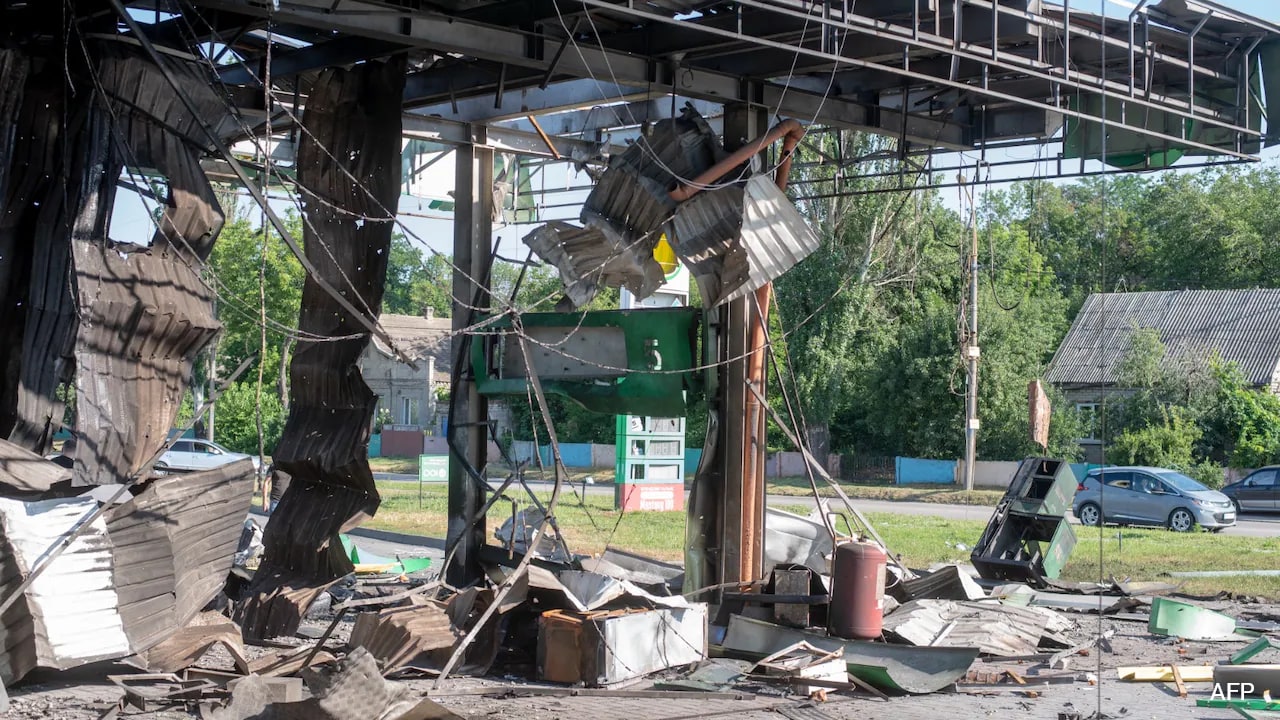
The physical map of the Ukraine war is written in smoke over filling stations and roadside depots. Over recent months, Russian forces have quietly shifted aerial vectors away from purely deep-state military command nodes toward civilian energy supply points, severely damaging more than two hundred filling stations across frontline sectors and primary transit corridors. While broad headlines often focus on massive drone swarms hitting distant Russian refineries, a parallel and much closer-to-home attritional campaign is unfolding on local fueling forecourts. This systematic targeting of retail networks from Kharkiv to Poltava and closer toward the capital represents a calculated effort to choke transport arteries, complicate civilian survival, and fray the administrative nerves of a nation holding the line.
Understanding this shift requires tracking how frontline logistics adapt under constant pressure. When major oil depots were hit in the initial years of the invasion, petroleum companies decentralized fuel storage into thousands of smaller, modular surface nodes. Gas stations transformed from simple commercial transaction points into distributed lifelines. They house independent diesel generators, warmth during rolling blackouts, water filtration points, and secure emergency communication hubs. Striking these scattered forecourts is no longer just about stopping an armored column from fueling up. It is a direct assault on the localized micro-logistics that allow normal civic function to persist under fire.
The military calculus behind these specific strikes also points to an escalatory tit-for-tat. Ukrainian long-range strikes against domestic Russian refinery capacity have pinched fuel availability inside Russia itself, creating domestic price pressure and forcing administrative export caps. Moscow's expanding drone and missile raids targeting Ukrainian fuel complexes act as a blunt counter-measure designed to degrade distribution parity. The mechanics of these attacks rely heavily on loitering munitions and high-speed precision glide weapons. They are timed to strike not just empty storage tanks, but active forecourts during operational hours, compounding human casualties and maximizing psychological terror among the civilian workforce.
Despite the heavy visible damage across regional hubs, structural failure in the national fuel market has not materialized. Industry analysts point to the extraordinary resilience of private commercial networks like OKKO, WOG, and BRSM, which rapidly reroute supply chains, patch damaged pumping equipment, and import alternative fuel volumes from Western partners via rail and road corridors. Supply lines are elastic, bending under acute kinetic pressure rather than snapping entirely. Yet the human cost remains steep, with drivers, station attendants, and humanitarian volunteers regularly caught in the blast radius of these routine civil targets.
As the conflict grinds deeper into its attrition phase, the battlefield boundary between soldier and civilian has dissolved completely into the concrete and steel of roadside commerce. Every functional fuel pump on a major transit route functions as a contested node of resilience, holding together the fragile economic architecture of a society refusing to stop moving.