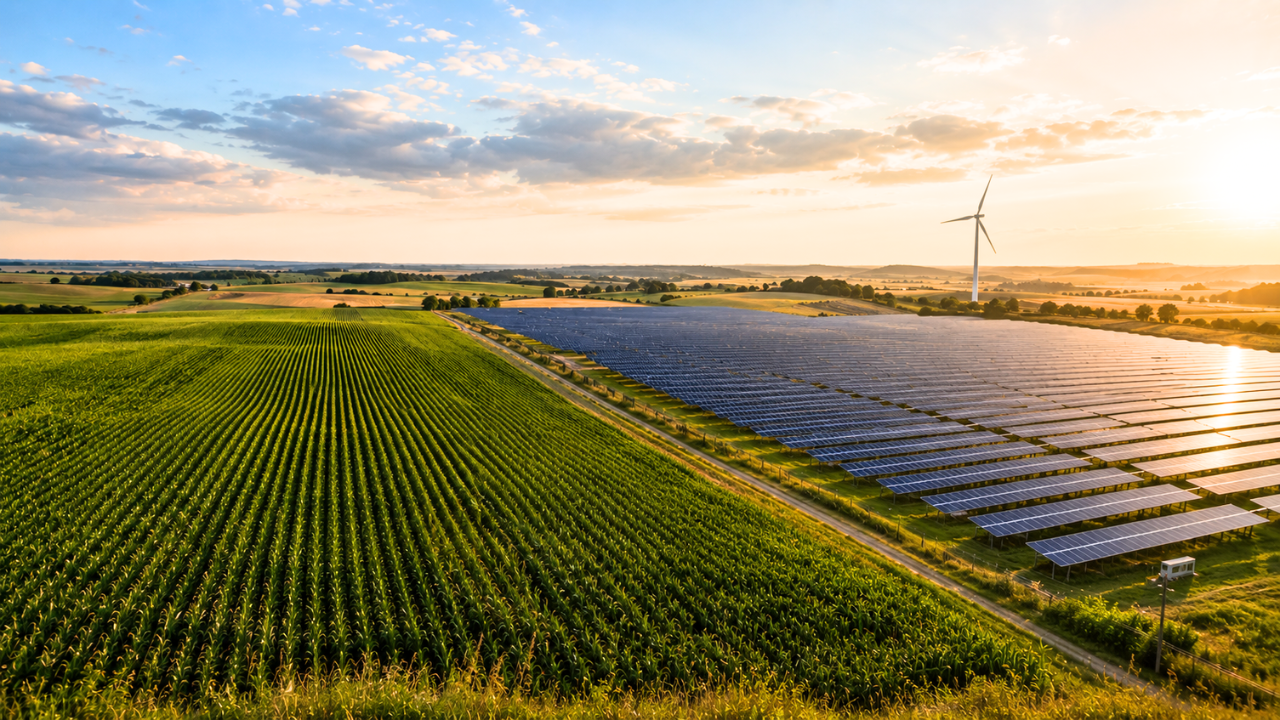
Across the flat stretches of central Illinois, solar developers are pitching agricultural landowners an astonishing proposition. Rent out 100 acres of prime dirt, park solar arrays on the soil, and pocket up to $2,000 per acre every year without touching a tractor. For a century-old family farm wrestling with volatile grain markets and soaring operational costs, a guaranteed six-figure check looks like an unconditional financial lifeline. Yet behind these multi-million-dollar developer promises lies a complex web of grid delays, legal liabilities, zoning clashes, and tax reclassifications that can quiet long-term agricultural profits into frozen contracts and unexpected financial traps.
The initial pitch sounds bulletproof. Traditional corn and soybean operations routinely battle razor-thin profit margins, fluctuating global trade policies, and volatile weather. In a typical year, net returns on Illinois corn might swing between $50 and $200 per acre after accounting for seed, fertilizer, fuel, and equipment overhead. Solar companies step onto the porch offering guaranteed fixed annual lease payments ranging from $1,000 to $2,000 per acre, often tied to small annual escalation clauses. On a 100-acre project, that translates to $100,000 to $200,000 in passive annual income for 25 to 40 years.
It is easy to see why landowners jump at the opportunity. They sign option agreements, believing they have instantly secured their family estate for the next two generations.
+--------------------------------------------------------------------------------+
|                        ANNUAL NET INCOME COMPARISON                            |
+------------------------------------+-------------------------------------------+
| Crop / Land Use                    | Average Net Revenue (Per Acre / Year)     |
+------------------------------------+-------------------------------------------+
| Corn Production                    | $50 to $200 (Subject to commodity risks)  |
| Soybean Production                 | $30 to $150 (Subject to weather/input)    |
| Utility-Scale Solar Land Lease     | $1,000 to $2,000 (Fixed contractual rate) |
+------------------------------------+-------------------------------------------+
The reality on the ground, however, rarely moves as fast as the sales presentation.
The Option Period Trap and Grid Interconnection Stalls
signing a lease does not mean the checks start rolling in tomorrow.
Before a single solar panel breaks ground, developers require an option period that typically lasts anywhere from three to seven years. During this phase, the developer holds exclusive rights to encumber the land while evaluating soil conditions, securing local zoning permits, and applying for grid connection. Landowners frequently discover that during this multi-year waiting period, they are not receiving the headline $2,000 per acre. Instead, they receive a nominal option payment—sometimes as low as $25 to $50 per acre annually—while their land remains locked in legal limbo.
If the developer fails to secure a spot on the electric grid, they can walk away from the deal entirely without ever building the project.
This outcome happens far more often than landowners anticipate. Illinois sits at the crossroads of two major regional transmission organizations, MISO in the central and southern regions and PJM in the north. Both regional power grids are choked with massive backlogs of interconnection requests. Thousands of renewable projects remain stuck in bureaucratic queues, waiting for grid operators to complete complex engineering studies and assign the costs of transmission line upgrades.
When grid operators determine that a local substation requires tens of millions of dollars in unexpected infrastructure upgrades to absorb new solar power, developers often abandon the project overnight.
+--------------------------------------------------------------------------------+
|                    THE SOLAR LEASE TIMELINE REALITY                            |
+--------------------------------------------------------------------------------+
| PHASE 1: Option Period (Years 1 - 7)                                           |
| - Land tied up exclusively by developer                                        |
| - Low compensation ($25 - $100 / acre)                                         |
| - Developer runs interconnection studies with MISO / PJM                       |
|                                                                                |
| PHASE 2: Construction Phase (6 - 18 Months)                                    |
| - Heavy machinery traffic, soil compaction, site grading                       |
| - Full lease payments begin ($1,000 - $2,000 / acre)                           |
|                                                                                |
| PHASE 3: Operational Phase (Years 25 - 40)                                     |
| - Passive income with annual escalation clauses (if negotiated)                |
| - Zero farming on project footprint                                            |
|                                                                                |
| PHASE 4: Decommissioning Phase                                                 |
| - Mandatory equipment removal and soil restoration                             |
| - High exposure to inflation if bond reserves are underfunded                  |
+--------------------------------------------------------------------------------+
A landowner who spent five years anticipating a $200,000 annual payday can suddenly find themselves left with zero rental income, years of lost farm planning, and a contract that simply expired.
Tax Reclassification and Property Tax Escalations
Another significant oversight in early lease negotiations involves state and local tax assessments.
When productive agricultural land is converted into an energy-generating facility, local tax assessors change its classification from agricultural land to commercial property. In Illinois, agricultural land enjoys favorable tax valuations based on soil productivity ratings rather than raw market value. Commercial property, by contrast, is taxed at substantially higher rates based on the assessed value of the commercial improvements and infrastructure constructed on the site.
If a contract is not drafted meticulously, that sudden tax jump falls directly onto the property owner.
For instance, a 100-acre parcel that previously incurred a few thousand dollars in annual agricultural property taxes can see its annual tax bill surge dramatically once classified as a commercial solar installation. If the developer agreement does not explicitly state that the solar company is responsible for 100 percent of all property tax increases resulting from the project, the landowner can watch a huge chunk of their lease check disappear into local tax coffers.
Smart contracts must include clear tax indemnity clauses. These provisions force the solar entity to pay any differential between the historical agricultural assessment and the new commercial valuation directly to the county treasurer.
Local Zoning Wars and Political Friction
The expansion of utility-scale solar has turned quiet county board meetings into tense political battlegrounds.
Rural neighbors often voice concerns over changing community character, potential drops in adjacent property values, and the loss of prime agricultural soils. In response to mounting local opposition across rural counties, Illinois passed legislation in early 2023 that limited county governments from enacting outright bans on wind and solar projects. The law set standardized statewide limits on setbacks, noise restrictions, and building heights to streamline clean energy deployment.
Despite statewide preemption, local friction has not vanished; it has merely shifted into legal and administrative tactical disputes.
County boards and local zoning boards still control drainage approvals, road use agreements, and special use permit conditions. A developer forced to navigate hostile local boards faces lengthened timelines and increased legal costs, which in turn elevates the risk that the project becomes financially unviable before construction ever starts.
Landowners who sign solar leases can also find themselves alienated within their own rural communities, caught between long-time farming neighbors who view industrial development as a threat and developers eager to protect their capital investment.
The End of Life Decommissioning Liability
What happens when the 30-year lease ends, or if the operating solar company goes bankrupt?
This question represents the single largest long-term risk for landowners. A utility-scale solar facility involves thousands of steel racking posts driven deep into the ground, miles of underground copper and aluminum wiring, concrete inverter pads, and heavy transformer equipment. Restoring that land back to tillable agricultural soil requires extensive excavation, removal of deep foundations, and careful subsoil remediation to undo severe soil compaction caused by heavy equipment.
Removing steel piles, clearing concrete pads, and repairing subsurface tile drainage systems across a 100-acre footprint can cost hundreds of thousands of dollars.
If a developer transfers the lease to a smaller holding company that later files for bankruptcy, the financial burden of land restoration falls entirely on the property owner. Illinois law requires developers to submit decommissioning plans and post financial assurance, such as surety bonds or letters of credit, to cover the cost of site removal. However, landowners must scrutinize how those bonds are calculated and updated over time.
A surety bond set today based on present-day labor and machinery costs will fall far short of covering real restoration expenses 30 years down the road if it fails to account for compounding inflation.
+--------------------------------------------------------------------------------+
|                CRITICAL CONTRACT PROVISIONS FOR LANDOWNERS                     |
+-------------------------------------+------------------------------------------+
| Provision                           | What to Demand in the Contract           |
+-------------------------------------+------------------------------------------+
| Project Acres vs Total Acres        | Pay rent on all encumbered property,     |
|                                     | including buffers and access roads.      |
+-------------------------------------+------------------------------------------+
| Inflation Escalation Clause         | Minimum 2% to 3% annual compound lease   |
|                                     | increase or CPI adjustment.              |
+-------------------------------------+------------------------------------------+
| Property Tax Indemnity              | Developer pays 100% of commercial tax    |
|                                     | reclassification increases.              |
+-------------------------------------+------------------------------------------+
| Decommissioning Security            | Fully funded inflation-adjusted bond     |
|                                     | held in escrow starting by Year 10.      |
+-------------------------------------+------------------------------------------+
| Assignment Restrictions             | Right to review and approve lease        |
|                                     | transfers to secondary investors.        |
+-------------------------------------+------------------------------------------+
To protect their equity, agricultural landowners must work alongside experienced energy attorneys to negotiate stringent safeguards before signing any land agreement.
Key Protections to Negotiate in Every Contract
- Distinguish project acreage from encumbered acreage: Developers often try to pay the top $2,000 per acre rate only for the exact ground covered by solar panels. Landowners should insist on being paid for all land restricted by the lease, including required setback zones, access roads, and security fencing.
- Require aggressive escalation rates: A fixed payment of $1,500 per acre might look lucrative today, but over a 30-year span, inflation will erode its real purchasing power. Leases should include a mandatory annual compound escalation clause of 2.5 to 3.5 percent.
- Secure ironclad decommissioning terms: Ensure the developer posts an independent, inflation-adjusted bond or cash escrow account covering 100 percent of estimated removal costs, with mandatory updates every five years.
- Structure clear option period limits: Cap the pre-construction option phase at three years maximum and demand escalating annual option payments if the developer requests extensions.
The financial upside of leasing Illinois farmland to solar developers is undeniable, offering guaranteed income that traditional farming can rarely match year after year. But treat the initial contract as an opening bid rather than a finished offer. Landowners who sign standard boilerplate contracts risk locking their property into long-term grid delays, unexpected tax bills, and costly post-project cleanup hazards. Realizing the full value of a solar lease requires reading the fine print, demanding rigorous financial protections, and knowing precisely what happens when the panels stop producing power.