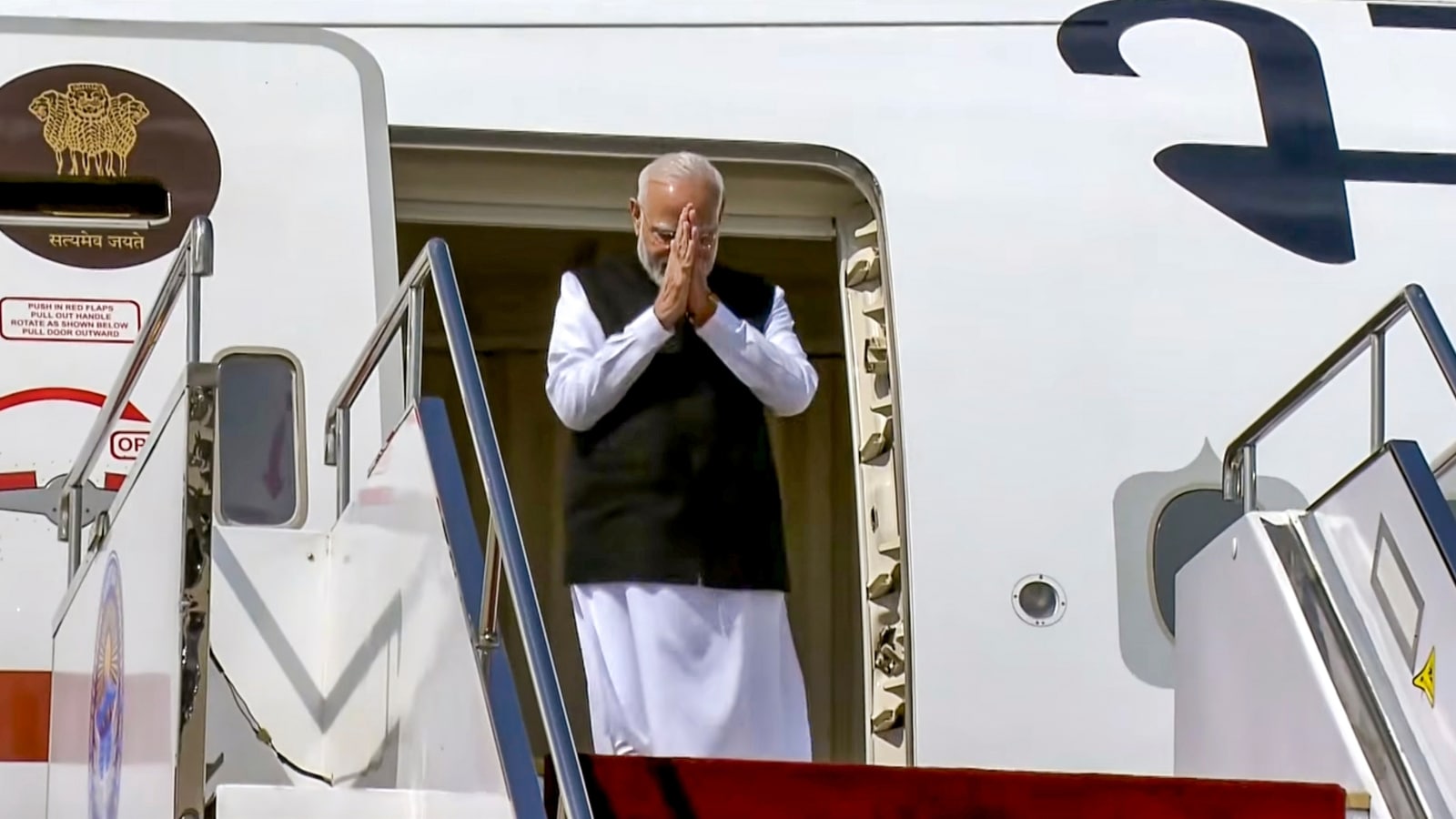
Statecraft rarely hinges on traditional weaponry or economic sanctions alone. Often, the real architecture of international relations is built in quiet rooms through objects carrying deep symbolic freight. When Prime Minister Narendra Modi traveled to Central Asia to meet the leadership of Uzbekistan and Kyrgyzstan, the accompanying gifts bypassed standard diplomatic boilerplate. Instead of generic crystal or commemorative plaques, New Delhi deployed a calculated mixture of high-end sports memorabilia, ancient philosophical texts, and hand-crafted instruments. At the center of this diplomatic choreography was a handwritten chess scoresheet and a ten-volume epic, items designed to speak directly to the intellectual and cultural identity of two nations positioned at the crossroads of modern geopolitical competition.
To understand the weight of these offerings, one must examine the specific memento handed to Uzbek President Shavkat Mirziyoyev: the original handwritten scoresheet from Grandmaster Javokhir Sindarov’s victory at the 2025 FIDE World Cup in Goa. Sindarov, who secured the title by overcoming China's Wei Yi, represents the meteoric rise of Central Asian intellectual prowess on the global sporting stage. By gifting a piece of paper recording actual moves played on Indian soil, Modi bypassed standard economic messaging to tap into something far more permanent: shared sporting glory and mutual respect for intellectual dominance. It is chess diplomacy in its purest form, converting a transient athletic triumph into an enduring artifact of bilateral goodwill.
The subtext of this gesture reveals a fierce, quiet contest for influence across Central Asia. Traditional superpowers and regional actors constantly vie for strategic real estate in Tashkent and Bishkek, leveraging infrastructure loans and energy pacts. Yet, hard-edged transactional diplomacy often breeds fatigue. By highlighting a young Uzbek prodigy's triumph in an Indian venue, New Delhi shifts the narrative away from transactional trade and toward cultural alignment. Chess is deeply woven into the intellectual fabric of Central Asia, tracing a lineage back centuries through the Silk Road. Handing over the scoresheet acknowledges that lineage, signaling that India views Uzbekistan not merely as a market or a transit corridor, but as a peer in intellectual heritage.
Meanwhile, northward in Bishkek, the choice of gift took a different historical turn. President Sadyr Japarov received a ten-volume English translation of the Mahabharata, rendered by economist and scholar Bibek Debroy. On the surface, presenting an ancient Indian epic to a Central Asian head of state might appear standard, almost predictable cultural outreach. Look closer, however, and the strategic selection comes into sharp focus. The Mahabharata is more than a religious text; it is an exhaustive manual on statecraft, duty, ethics, and political survival. Furthermore, it shares profound structural and thematic resonances with the Epic of Manas, Kyrgyzstan’s monumental oral tradition that preserves the collective memory and values of the Kyrgyz people across generations.
Statecraft relies heavily on finding structural mirrors between disparate civilizations. By placing the Mahabharata into the hands of Kyrgyzstan's leadership, Indian diplomats invoked a shared reverence for epic narrative traditions that define national identity against external pressures. The gift silently communicates that both nations understand the heavy burden of sovereignty, governance, and moral duty articulated through foundational literature. It is an appeal to shared civilizational depth at a time when smaller nations find themselves squeezed between larger geopolitical gravitational pulls.
Beyond chess and epics, the diplomatic cargo included tangible artifacts of Indian artisan craftsmanship designed to reinforce personal and institutional warmth. Uzbekistan's president also received a sandalwood Shata Tantri Veena, commonly known as the santoor, bridging North Indian classical musical traditions with Central Asian acoustic sensibilities. Additional items included premium Kangra tea in carved wooden boxes, marble inlay caskets holding Banarasi silk stoles, and fine silver jewelry presented to family members. For the Kyrgyz Prime Minister Adylbek Kasymaliev, the choice was a Dokra artwork depicting traditional Indian musicians, alongside traditional wool textiles. Every item avoided mass-produced banality, anchoring the visit in localized, labor-intensive artisanal traditions that represent India's soft power base.
Skeptics frequently dismiss such exchanges as empty theatre, ritualistic performances devoid of material consequence. That view misunderstands how modern alliances are cemented. Treaties outline trade tariffs and military cooperation, but leaders sign them only when mutual trust has been established. Cultural diplomacy operates as the foundational lubricant for these high-stakes negotiations. When an Uzbek president looks at a framed scoresheet of a national hero winning in Goa, or a Kyrgyz leader traces the philosophical dilemmas encoded in ancient Sanskrit verses, the psychological distance between New Delhi, Tashkent, and Bishkek shrinks perceptibly.
The timing of these gestures is equally telling. Central Asia is currently navigating a delicate balancing act, managing relations with Moscow, Beijing, and Western capitals while seeking alternative partnerships to ensure strategic autonomy. India offers a welcome counterweight—a major economic player with no historical baggage of regional hegemony in the immediate neighborhood. By framing diplomatic engagement around shared intellectual pursuits, historical literature, and sporting achievements, New Delhi creates a diplomatic lane that economic powerhouses struggle to replicate.
Ultimately, these gifts will find their place in presidential archives or display cases, categorized by protocol officers as tokens of state visits. Yet their true function has already been fulfilled. They have reframed the bilateral dialogue from a ledger of trade deficits and energy imports into an ongoing conversation between ancient civilizations navigating a volatile contemporary order. In the high-stakes arena of modern international relations, a carefully chosen chess move or an ancient verse often travels much further than an official communique.