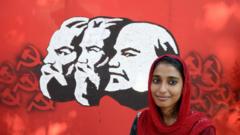
India’s organized communist movement, which once governed over a hundred million people across critical border states and held the balance of power in New Delhi, has collapsed into electoral near-extinction. This month's assembly election results delivered the final blow, as the Communist Party of India (Marxist), or CPI(M), was decisively swept from power in Kerala by the Congress-led United Democratic Front. For the first time in fifty years, not a single Indian state is governed by the Left. While party veterans blame corporate media, right-wing polarization, and massive campaign spending by rivals, the true cause of this historic wipeout is an internal, multi-decade failure to adapt to a changing Indian electorate.
The collapse did not happen overnight. It is the result of rigid ideological fossilization, catastrophic economic miscalculations, and an inability to appeal to an aspirational, young demographic that views the hammer and sickle not as a symbol of liberation, but as a relic of industrial stagnation.
The Fatal Shift from Class to Identity
For decades, Indian communists built their formidable electoral machinery on the foundation of class struggle and radical land reform. In West Bengal, where the Left Front ruled uninterrupted for thirty-four years from 1977 to 2011, rural redistribution initially transformed millions of landless peasants into a fiercely loyal voting bloc.
The strategy worked until the economy evolved. Once land was redistributed, the immediate material needs of the peasantry shifted from survival to ambition. Smallholders wanted better schools, paved roads, steady electricity, and private-sector jobs for their educated children. The Left had no answers. Instead of modern industrial policy, it offered continued agrarian rhetoric and militant trade unionism that actively drove private capital out of their strongholds.
When the industrial sector dried up, politics adjusted. In the absence of viable economic upward mobility, voters increasingly drifted toward parties that mobilized along ethnic, caste, and religious lines. The Right offered a muscular cultural identity coupled with welfare capitalism. The regional parties offered targeted patronage. The Left, trapped in an orthodox Marxist framework that treats caste and religion as mere sub-elements of economic class, completely misjudged the enduring power of identity politics in modern India.
The Hypocrisy of Capital
Nowhere was this ideological confusion more apparent than in the tragic end of the Left Front’s reign in West Bengal. By the mid-2000s, top party leadership recognized that their resistance to private enterprise had turned the state into an industrial graveyard.
Their solution was a desperate, top-down embrace of corporate capitalism that violated their own core tenets. In Singur and Nandigram, the communist state government used colonial-era land acquisition laws to forcibly seize fertile agricultural land from the very peasants who formed their base, handing it over to major private corporations for industrial projects.
The backlash was swift and devastating. The state machinery deployed brutal police force against protesting farmers, shattering the party's moral authority. It exposed a glaring contradiction: a movement built on protecting the proletariat was now acting as the enforcing agent for corporate conglomerates. The Left lost West Bengal in 2011 and has failed to win a single legislative seat in the state for over a decade, with voters shifting allegiance to regional populists and the Hindu nationalist Right.
The Kerala Exception That Wasn't
Until this year, Kerala remained the solitary red bastion. The state’s unique "Kerala Model"—characterized by high literacy, exceptional healthcare metrics, and robust social safety nets—was hailed globally as proof that socialist governance could deliver human development.
But the economic foundation of this model was highly fragile. Kerala’s high standard of living was not funded by internal industrial production or state-run enterprises. It was sustained by billions of dollars in remittances sent home by millions of non-resident Keralites working in the Persian Gulf.
Kerala Economic Paradox:
High Social Spending + Low Local Industrial Output = Total Reliance on Gulf Remittances
This reliance created a unique economic paradox. The state government taxed the consumption funded by foreign remittances to pay for its extensive welfare programs, while local militant unionism and bureaucratic red tape kept private manufacturing investment at a minimum. When global economic shifts and changing labor laws in the Gulf slowed the flow of remittance money, the fiscal deficit widened dramatically. The final years of the Left Democratic Front administration were marred by severe fiscal strain, delayed pensions, and mounting public debt, alienating a middle class that grew tired of stagnating local job opportunities.
A Gerontocracy in an Aspirational Nation
The demographic reality of modern India has turned decisively against the communist old guard. India has one of the youngest populations in the world, with more than half of its citizens under the age of twenty-five. This generation has no memory of the anti-feudal struggles of the 1960s or the pro-poor rhetoric of early post-independence politics. They are digital natives who value entrepreneurship, global connectivity, and rapid economic advancement.
Against this backdrop, the leadership of the major communist parties resembles a closed gerontocracy. The decision-making bodies, such as the CPI(M) Polit Bureau, are heavily dominated by septuagenarians and octogenarians whose political worldviews were formed during the Cold War. Their official pronouncements remain saturated with dense, twentieth-century bureaucratic jargon that completely fails to resonate with twenty-one-year-old gig-economy workers or tech professionals.
| Metric | Communist Party Vanguard (Top Leadership) | Average Indian Electorate |
|---|---|---|
| Average Age | 70+ years old | Under 30 years old |
| Core Ideology | Strict state-led distribution, anti-imperialism | Individual upward mobility, welfare capitalism |
| Primary Medium | Party pamphlets, formal party congresses | Social media, short-form digital content |
This disconnect is magnified by organizational rigidity. The system of "democratic centralism" ensures that power flows exclusively from the top down. Dissent is labeled as anti-party activity, and independent grassroots youth leaders are systematically sidelined if they challenge the established orthodoxy. By strangling internal democracy, the parties have cut off the pipeline for fresh leadership and innovative ideas.
The Path to Complete Irrelevance
The Indian Left now faces an existential choice. If it continues to operate as a dogmatic, election-oriented machine without a clear, modern ideological framework, it will complete its slide into total electoral irrelevance, functioning merely as a minor parliamentary pressure group dependent on alliances with larger regional parties.
A viable future requires a complete structural transformation. The movement must abandon its rigid twentieth-century dogmas and look toward successful modern center-left and social-democratic models. It must build a platform that directly addresses the realities of the gig economy, massive urban underemployment, climate vulnerability, and widening income inequality, without falling back on outdated anti-market rhetoric. The leadership must step aside to allow a new generation of leaders to reshape the movement from the ground up. Without these radical changes, the hammer and sickle will permanently vanish from the Indian political landscape.