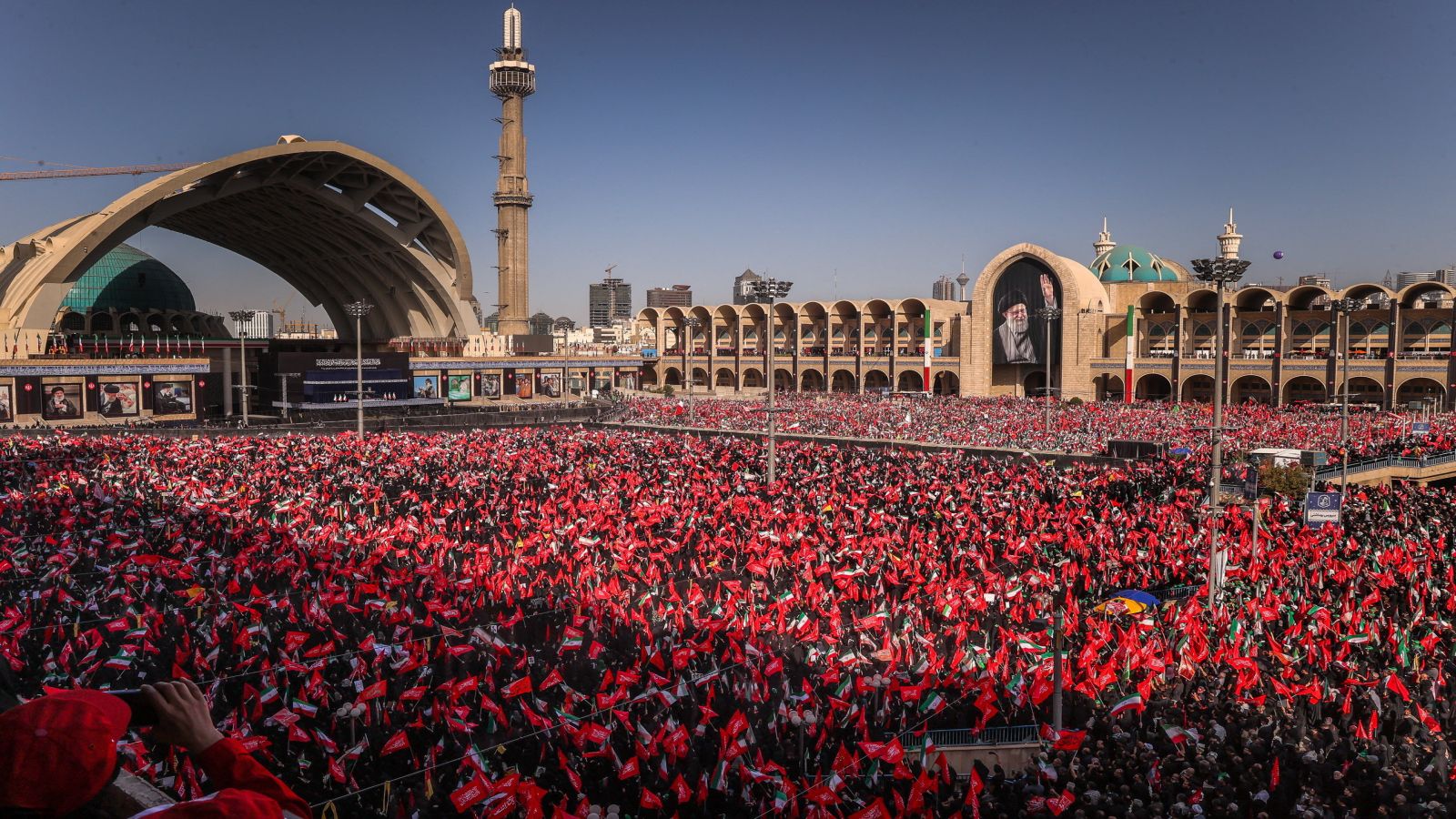
The sea of black-clad mourners choking the streets around Tehran’s Grand Mosalla religious complex looks like an absolute display of total state control. Hundreds of thousands of people are beating their chests, weeping over the glass-cased coffin of Ayatollah Ali Khamenei, and chanting coordinated demands for blood revenge against Washington and Tel Aviv. On paper, and on the television screens managed by the Islamic Republic of Iran Broadcasting, this massive state funeral is supposed to signal to the world that the regime remains unbroken after the devastating strikes that killed its long-serving Supreme Leader on February 28.
The carefully curated images hide a far more dangerous reality. Behind the wall of grief and military pageantry, Iran is grappling with an unprecedented succession crisis that threatens the survival of the theocracy. The supreme authority has passed to Khamenei’s fifty-six-year-old son, Mojtaba Khamenei, yet the new leader is completely missing from his own father’s multi-day funeral rituals. His empty chair speaks louder than the loud state propaganda.
Foreign intelligence agencies and domestic opposition networks are watching a leadership structure operating in deep paranoia. The regime is attempting to projection power while its new commander-in-chief remains hidden in an underground bunker, terrified of the same Western intelligence apparatus that tracked and terminated his predecessor. What is being sold as a moment of national unity is actually a desperate gamble to buy time for a vulnerable, fractured leadership.
The Empty Chair at the Grand Mosalla
The timing of the funeral ceremonies was calculated to maximize geopolitical spite. By opening the public mourning on July 4, the exact day of the American 250th anniversary, the regime sought to turn a moment of profound national vulnerability into a counter-theater of defiance. The streets are plastered with billboards juxtaposing images of the late leader alongside his son, Mojtaba, trying to force an impression of continuous, uninterrupted authority.
The illusion breaks the moment one looks at the VIP prayer carpets.
Three of Khamenei’s sons—Masoud, Meysam, and Mostafa—stood prominently during the public funeral prayers led by the ninety-seven-year-old Shiite cleric Ayatollah Jafar Sobhani. Their presence was meant to validate the family’s enduring stature. But Mojtaba, the only son who matters for the political future of the country, was nowhere to be seen.
The official line from government handlers suggests that the new Supreme Leader is managing critical national security affairs away from public view. The truth is far less dignified. Intelligence leaks indicate Mojtaba was wounded in the initial February airstrikes that claimed his father’s life at their Tehran residence. Even if his physical injuries have healed, the psychological reality is clear. Israel and the United States have made it explicitly clear that Mojtaba is a legitimate military target, and his absence proves that Iran's security apparatus can no longer guarantee the safety of its top official even in the heart of its own capital.
A Hidden Blueprint for Mass Casualties
State media broadcasts endless footage of volunteers spraying cooling water on crowds enduring ninety-degree summer heat, presenting an image of a benevolent state caring for its loyal flock. They do not mention the extreme risk calculations happening behind closed doors.
A classified municipal document leaked from the highest levels of Tehran's city administration reveals that authorities explicitly prepared for the week-long funeral ceremonies to result in between 1,500 and 3,000 civilian deaths.
The internal report outlines logistical nightmares ranging from heatstroke epidemics to uncontrollable crowd crushes in the narrow corridors leading to the Grand Mosalla. Instead of scaling back the multi-city tour—which will move the caskets through Qom and Iraqi holy sites before a final burial at the Imam Reza shrine in Mashhad—the Islamic Revolutionary Guard Corps pushed ahead.
For the ruling elite, human life is an acceptable currency to pay for the visual proof of public support. The regime requires millions of bodies in the streets to mask the fact that its domestic legitimacy has been hollowed out.
The Internal Volcano Under the Black Banners
The massive crowds in Tehran are real, but they are not representative of a unified nation. The regime has spent decades mastering the art of state-mobilized grief, busing in government employees, rural supporters, and families dependent on state welfare. They are providing free transportation, food, and lodging to hundreds of thousands of regional participants.
This artificial display of loyalty exists alongside a deep, simmering domestic fury.
Just months before the February airstrikes, Iran was rocked by massive internal unrest. A brutal state crackdown on nationwide anti-government protests resulted in the slaughter of thousands of Iranian citizens by the IRGC. For a vast portion of the population, the death of the Supreme Leader was not a tragedy, but an unfulfilled promise of liberation that was quickly snuffed out by a wartime state of emergency.
Interviews with ordinary citizens who manage to bypass the state’s internet blocks reveal a profound sense of exhaustion. While the state displays weeping partisans, millions of Iranians are quietly struggling with a devastated economy, hyperinflation, and the terrifying prospect of prolonged war. The enforcement of public mourning has closed down the Tehran Grand Bazaar and basic businesses, strangling the livelihoods of working-class families who have no investment in the regime's regional ambitions.
The Fragile Truce in the Gulf
While the public chants for immediate military revenge, Iran’s remaining diplomatic and military leaders are operating under a temporary, fragile reality. A one-week de-escalation agreement in the Strait of Hormuz was quietly brokered to allow the funeral processions to take place without immediate fears of further airstrikes.
This pause has temporarily halted the intense negotiations that have been taking place regarding a permanent end to the war. High-level Iranian negotiators like Foreign Minister Abbas Araghchi have been forced to balance aggressive public statements with desperate backdoor diplomacy.
The regime’s current strategy is to use the funeral to build leverage. By showing that they can still mobilize hundreds of thousands of people, they hope to convince Western powers that the Islamic Republic cannot be easily toppled from within. This is a weak negotiating position. The major regional powers know that Iran’s primary proxy networks are severely degraded, and its economy cannot sustain a prolonged conflict.
The Succession Gamble
The decision to elevate Mojtaba Khamenei to the supreme position was finalized by the Assembly of Experts shortly after the February assassination. It was a choice born of panic rather than consensus. For years, the prospect of a hereditary succession was criticized even within conservative circles as a betrayal of the anti-monarchical foundations of the 1979 revolution.
By placing the late leader's son on the throne, the IRGC has effectively secured total control over the state apparatus. Mojtaba is deeply tied to the security and intelligence branches of the Guard, far more so than his father ever was. This makes him an ideal figurehead for a military junta that intends to rule Iran through naked force rather than religious charisma.
A leader who cannot show his face to his followers cannot maintain authority forever. The Shiite religious establishment in Qom is privately furious over the lack of traditional consultation in Mojtaba’s selection. Many senior clerics view the new leader as a military puppet lacking the necessary theological credentials to hold the title of Supreme Leader.
The state funeral will eventually end, the caskets will be buried in Mashhad, and the crowds will go home. When the dust settles, the basic structural flaws of the Iranian regime will remain completely exposed. They are led by a phantom ruler, surrounded by a population that remembers the state-sponsored massacres of the previous year, and locked in a war they cannot win. The black banners hanging across Tehran are supposed to mark the passing of a single man, but they look increasingly like the funeral shroud for the system he spent nearly four decades building.
The regime has gambled everything on a display of strength that its hidden leader is too terrified to attend.