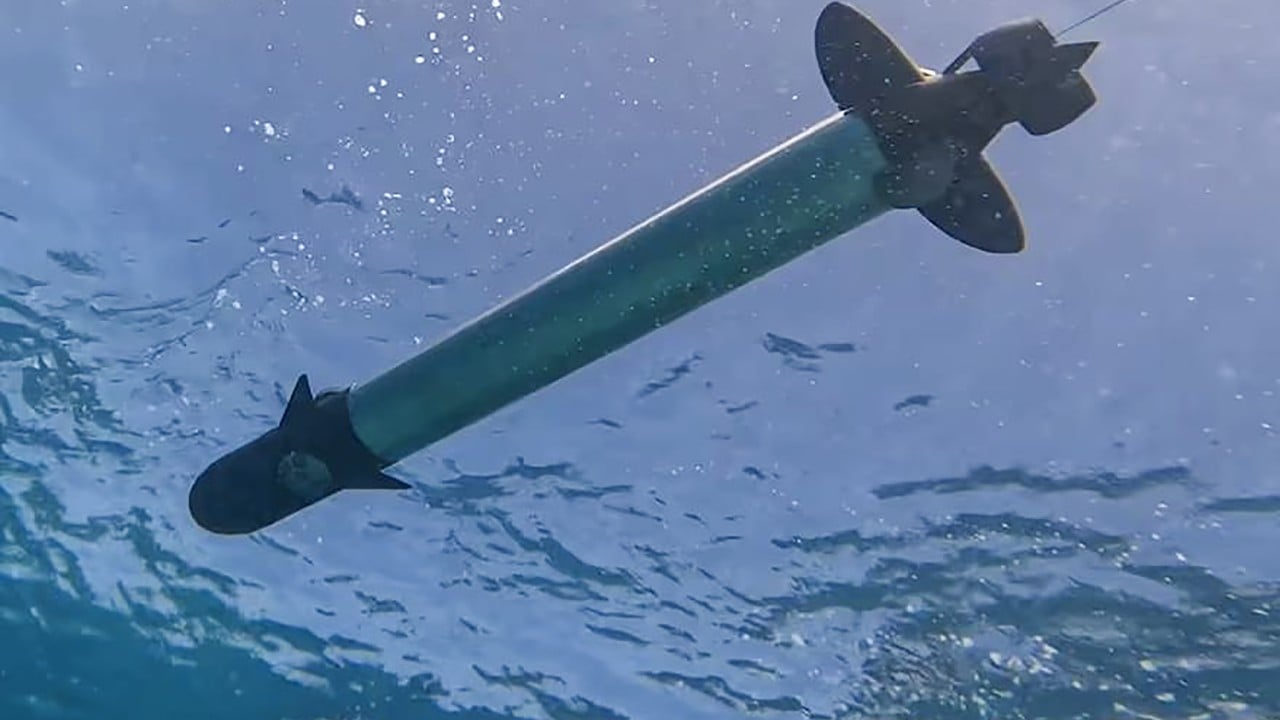
Taiwan and a United States technology startup are quietly finalizing an operational framework to deploy autonomous underwater drones across the Taiwan Strait, shifting the island's defense strategy from traditional heavy assets to distributed maritime deterrence. This industrial and military alignment addresses a persistent vulnerability in the Western Pacific: the sheer cost and visibility of conventional surface warships facing a massive missile-armed adversary. By integrating low-cost, uncrewed underwater vehicles into the defense architecture, Taipei and its foreign contractors aim to complicate any amphibious assault through persistent, hidden surveillance and kinetic interception.
Covert manufacturing runs and restricted software integrations are already underway. Yet beneath the public briefings and optimistic defense press releases lies a grinding industrial reality. Building cheap underwater drones that can survive electronic warfare, high salinity, and active counter-surveillance is an engineering nightmare. Washington and Taipei are discovering that designing the hardware is merely the easy phase. The actual challenge involves scaling production without compromising cryptographic security, establishing decentralized command links that survive localized jamming, and convincing traditional military bureaucracies to trust uncrewed systems with lethal authority.
The Strategic Shift From Steel to Silicon
For decades, the defense of Taiwan relied on major legacy platforms. Frigates, fighter jets, and diesel-electric submarines formed the backbone of a force designed to contest air and sea supremacy directly across the strait. That math no longer works. The sheer volume of mainland anti-ship ballistic missiles and shore-based sensors means any traditional surface ship operating within range of the coast faces an unacceptably high risk of destruction within the opening hours of a conflict.
Defense planners call this the anti-access and area-denial trap. Walking into it with multi-billion-dollar hulls is institutional suicide.
Hence the pivot toward uncrewed underwater drones. These systems operate on a fundamentally different economic and operational principle. Instead of concentrating naval power into a few heavily defended platforms, military strategists are dispersing hundreds of small, autonomous nodes across the shallow waters of the strait.
- Cost asymmetry: A single high-end frigate costs over a billion dollars and requires hundreds of trained sailors. A capable autonomous underwater drone can be produced for a fraction of that cost, allowing naval commands to absorb heavy attrition without collapsing operational capacity.
- Acoustic concealment: The shallow, noisy waters of the Taiwan Strait are notoriously difficult for traditional sonar to map cleanly, providing an ideal operational environment for small, quiet uncrewed vessels running on silent electric propulsion.
- Persistent presence: Human crews require rotation, resupply, and rest. Autonomous drones can loiter on the seabed or drift quietly along thermoclines for weeks, waiting for designated acoustic signatures.
The Silicon Valley and Taipei Industrial Pipeline
The partnership between Taiwan and the American startup ecosystem represents a departure from traditional defense procurement. For generations, heavy military hardware came exclusively from legacy defense primes. These massive defense contractors excel at building customized, gold-plated platforms over decades, but they stumble when tasked with rapid iteration and commercial off-the-shelf component integration.
The new approach mirrors software development cycles. Drones are built using commercial microcontrollers, off-the-shelf batteries, and modular sensor payloads that can be swapped out in hours rather than refitted in dry docks over months.
Commercial Tech Stack -> Modular Payload Integration -> Field Deployment -> Rapid Software Patch
This agile manufacturing model brings distinct vulnerabilities. Commercial components often lack the hardening required to withstand military-grade electromagnetic pulses or intense cyber attacks. If a startup relies on global supply chains for microchips, battery management systems, or acoustic transducers, a sudden geopolitical crisis or supply disruption halts production lines instantly.
Taiwanese manufacturing capabilities offer a partial solution. As the global epicenter for semiconductor fabrication, the island possesses unmatched proficiency in precision electronics. Integrating domestic silicon manufacturing with agile American software design creates a powerful industrial synthesis, provided export controls, intellectual property disputes, and bureaucratic inertia do not choke the pipeline before mass production begins.
The Technical Reality of Underwater Autonomy
Controlling uncrewed vehicles underwater is fundamentally different from managing aerial drones. Radio frequency signals do not propagate through water. GPS signals vanish mere centimeters beneath the surface. Operating an autonomous underwater drone requires sophisticated local computing power, precise inertial navigation systems, and acoustic modems that transmit data at painfully slow speeds over short distances.
An aerial drone can stream high-definition video back to an operator thousands of miles away via satellite links. An underwater drone must think for itself.
Navigation Challenges
Without constant GPS updates, underwater drones suffer from navigational drift. Inertial measurement units calculate position based on acceleration and rotation, but errors accumulate over time. To correct this, drones must periodically surface or rise to periscope depth to take celestial fixes or lock onto commercial navigation constellations—exposing them to visual and radar detection by enemy patrols.
Acoustic Environments
The Taiwan Strait is one of the busiest maritime corridors on earth. Commercial container ships, fishing vessels, and industrial traffic generate a deafening wall of underwater noise. Programming an artificial intelligence model to filter out the acoustic signature of a regional trawler while isolating the distinct cavitating propeller noise of a modern amphibious assault ship requires massive training datasets and edge-computing power that can fit inside a narrow hull.
Overcoming Bureaucratic Inertia
Technology is rarely the primary bottleneck in military transformation. Culture is.
Navies are traditionally conservative institutions led by officers who earned their rank commanding surface combatants or submarines. Handing operational control of lethal underwater assets to algorithms and junior officers managing fleets of unmanned systems challenges deeply entrenched traditions of command and hierarchy.
- Risk aversion: Senior commanders are reluctant to delegate engagement authority to autonomous systems due to the catastrophic potential of a false positive or civilian casualty incident in crowded regional waters.
- Maintenance culture: Traditional military logistics chains are structured around centralized depots and specialized technicians. Distributed fleets of low-cost drones require an entirely different maintenance paradigm, akin to consumer electronics repair or field-swappable modular components.
- Procurement rules: Defense acquisition laws in both the United States and Taiwan are designed for multi-year programs of record, not fast-moving tech startups that iterate product lines every six months.
Bridging this gap requires administrative waivers, flexible contracting vehicles, and political will from leadership willing to accept failure during early prototyping phases. Without these structural adjustments, the partnership risks producing impressive demonstration models that never transition to frontline operational units.
The Broader Geopolitical Ripple Effect
The deployment of autonomous underwater systems in the Taiwan Strait carries implications that extend far beyond immediate regional defense. It serves as a live-fire testbed for distributed maritime warfare, a concept that will define naval conflict for the remainder of the century.
Major military powers are watching closely. If a coalition of agile startups and a targeted island democracy can successfully deter a heavily armed superpower using thousands of low-cost autonomous nodes, the utility of traditional capital ships will face a permanent existential challenge. Defense budgets worldwide will redirect away from floating fortresses toward swarming, attritable, uncrewed networks.
Yet, this democratization of lethal maritime power introduces profound escalation risks. When operational control is delegated to autonomous systems operating in contested environments with minimal human oversight in real-time, the threshold for accidental conflict drops. A misidentified acoustic signature or an automated defensive strike triggered by a malfunctioning sensor could ignite a regional conflagration before human diplomats have time to intervene.
The hardware is sliding into the water, the software is compiling, and the maritime frontier of the twenty-first century is being drawn in code and carbon fiber across the seabed of the strait