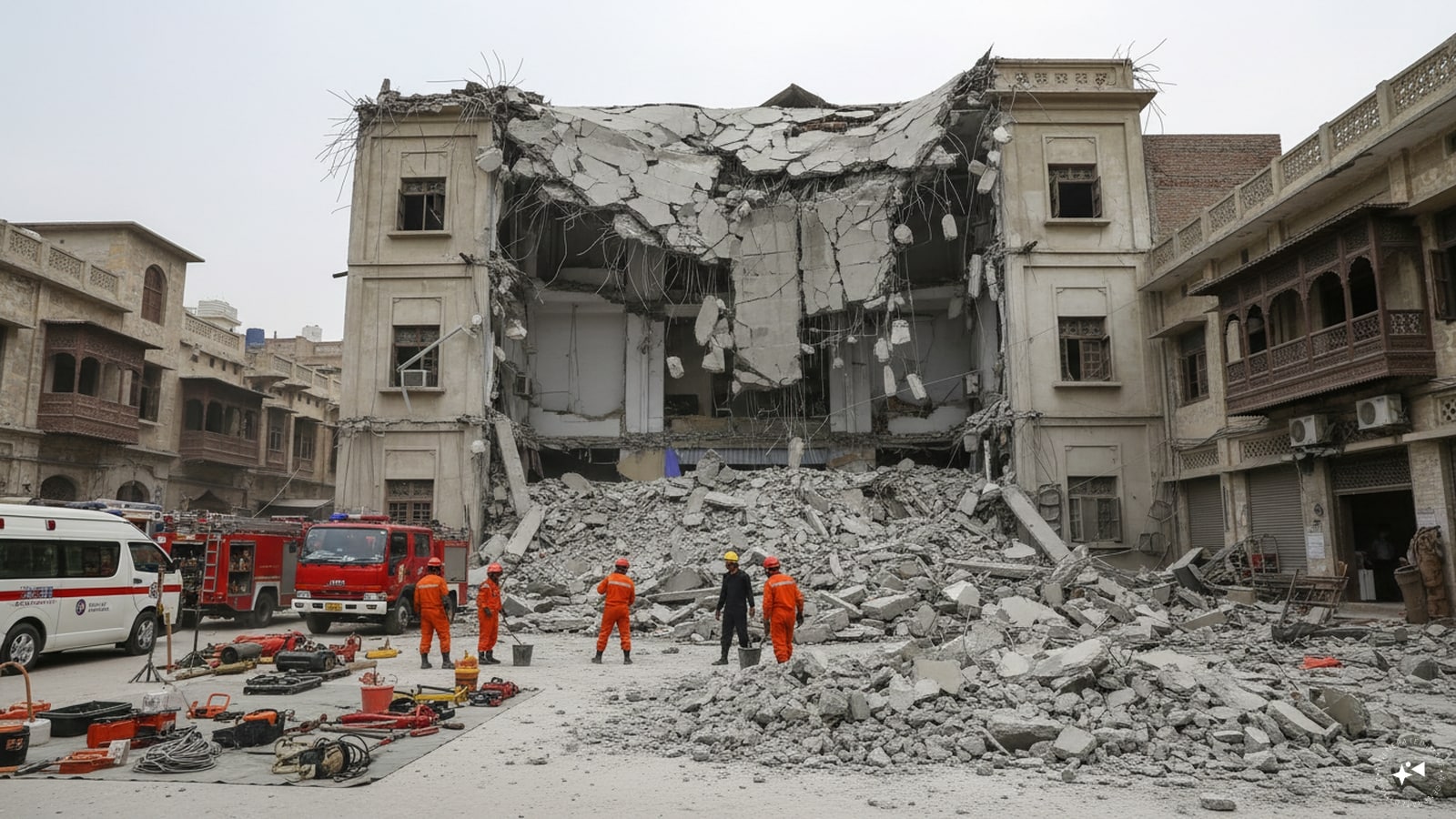
The roof collapse at Al-Khair Education Centre in Peshawar, Pakistan, killed 29 people—including children mostly aged 13 and younger alongside a teacher—and injured more than 40 others when a structure in the city's Dir Colony gave way on October 15, 2026. Police arrested the school's operator and said the building was structurally weak, even as rescue crews pulled victims from the debris and rushed the wounded to hospitals such as Lady Reading Hospital. Yet the raw body count tells only half the story. What fell on those classrooms was not an isolated bolt of bad luck; it was the predictable result of informal urban expansion, lax oversight of private education spaces, and a recurring pattern of structural failures across Pakistani cities.
Wire dispatches and breaking bulletins move fast on days like that. They count the dead, quote grieving relatives at hospital gates, record official condolences, and note that an arrest has been made. That speed serves an immediate public purpose, yet it often flattens a complex structural failure into a single headline number. In Peshawar, earlier tolls cited at least 29 deaths and over 40 injuries, while subsequent updates from outlets and officials pointed to shifting tallies as casualties were accounted for and treated. Numbers shift in the chaos of rescue operations. Accountability rarely moves with the same urgency.
Why Weak School Roofs Keep Giving Way
Look closely at how low-cost private schools and tuition centers grow inside dense neighborhoods like Dir Colony. Demand for affordable schooling outpaces purpose-built municipal infrastructure. Operators frequently adapt existing residential houses, add upper stories onto foundations never engineered for vertical loads, or cut corners on steel reinforcement, concrete mixing, and load-bearing spans to keep tuition low.
When a floor slab or roof assembly is under-designed, it does not always warn occupants with dramatic cracks weeks in advance. Materials fatigue slowly. Moisture seeps into hairline fissures, corroding rebar and weakening bonding strength long before the day a ceiling drops onto desks and schoolbags. Once a heavy masonry or reinforced concrete roof loses equilibrium, collapse happens in seconds—leaving almost no margin for escape when dozens of young children are seated beneath it.
Rescue officials credited rapid evacuation efforts with saving scores of lives during the Peshawar disaster, yet rapid response after a failure is a poor substitute for engineering verification before children walk through the gate. Once rubble buries a classroom, sirens and shovels cannot undo faulty structural math.
The Regulatory Blind Spot Behind Private Learning Spaces
Across Pakistan, structural collapses happen repeatedly across commercial, residential, and educational buildings. Earlier in 2026, roof collapses at educational and tutoring facilities—including deadly incidents in Lahore and Dera Ghazi Khan—put school safety back under a harsh spotlight. Each time, officials promise inquiries, governors and leaders express sorrow, and police open criminal cases against property owners or operators.
Arresting a school operator after a fatal collapse satisfies an immediate demand for visible justice. It rarely fixes the inspection gap that allowed an unsafe structure to house students in the first place.
When building codes exist on paper but routine structural checks rarely reach informal or converted properties, tragedy becomes a recurring calendar event rather than a one-off accident.
Enforcement faces steep practical hurdles on the ground. Municipal authorities often lack sufficient engineering inspectors to audit thousands of small private schools, religious seminaries, and neighborhood coaching centers operating inside residential wards. Meanwhile, families choosing between an overcrowded, distant public option and a nearby low-fee private school face real economic constraints. Shutting down every non-compliant building overnight without offering safe alternatives creates its own social friction, which is why regulators frequently look the other way until a roof falls in.
What Structural Safety Actually Requires
Fixing structural safety in dense urban wards takes unglamorous administrative discipline rather than post-disaster speeches. Any serious reform has to confront four realities at once:
- Mandatory structural audits: Every building used as a school, preschool, or tuition center—especially multi-story conversions or structures with older roof slabs—needs a signed structural stability assessment by a qualified engineer, not a rubber-stamp paper check.
- Clear occupancy limits: Upper floors and weaker spans should face strict weight and headcount caps, particularly when heavy furniture, water tanks, or crowded classrooms concentrate loads.
- Transparent compliance records: Parents deserve clear, accessible information on whether a school building has passed basic safety verification instead of guessing from a neat signboard outside.
- Practical transition support: Authorities must pair enforcement with phased remediation grants or relocation pathways for marginal operators so safety rules do not simply push classes into even more hidden, unmonitored rooms.
Hypothetical example: Imagine a two-story house in a crowded neighborhood converted into a primary school with an extra room added on top. Without an engineer checking beam depths, column reinforcement, and roof load capacity, the added weight can push an aging slab past its safety margin—even if the walls look freshly painted from the street.
Gray Areas Where Quick Fixes Fall Short
Even well-intentioned crackdowns run into messy trade-offs. Aggressive closures without transitional support can leave children out of school for months or push classes into basements and back alleys that are even harder for inspectors to find. Conversely, leniency in the name of affordability lets preventable hazards linger over young heads.
There is also a deeper institutional tension between reactive policing and preventive engineering. Criminal charges against an operator address negligence after harm is done, yet structural integrity depends on what happens before concrete is poured, before a second floor is added, and before a lease or registration is renewed. Until municipal building control, education oversight, and structural engineering standards operate together rather than in silos, headlines about collapsed roofs will keep returning.
Inspectors, municipal planners, and education officials should publish a mandatory structural safety checklist for every private school and tuition center in Peshawar—starting with older and multi-story buildings—before another term begins.