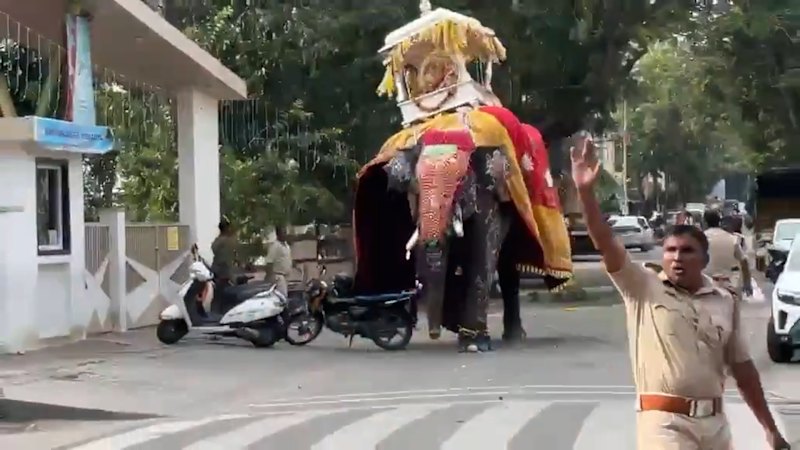
When a sacred elephant loaded with a 650kg gold shrine bolts through a crowded festival street, the headline almost always treats it as a freak accident or a sudden fit of animal madness. Decades of covering high-risk cultural spectacles and wildlife incidents suggest otherwise. A heavy ceremonial load does not merely sit on an elephant's back; it alters center of gravity, amplifies heat stress, restricts natural movement, and compounds psychological pressure in environments engineered for noise rather than animal welfare.
Most coverage stops at the spectacle. People watch the footage, marvel at the sheer weight of the gilded structure, and argue over whether the animal was startled by fireworks, drums, or heat. That narrow focus misses the structural mechanics behind how a sacred elephant reaches a breaking point while carrying hundreds of kilograms of metal and ornament. Meanwhile, you can read other events here: Feeding Coyotes and Charging Neighbors The Liability Chain Behind Suburban Wildlife Attacks.
What Really Happens Under a 650kg Gold Shrine
Weight alone tells only half the story. A 650kg gold shrine is rarely a neat, balanced slab of bullion resting quietly on a flat surface. Ceremonial housings are tall, ornate, and often top-heavy, shifting as the animal shifts its weight, turns corners, or steps onto uneven asphalt or packed earth.
Think about basic physics first. An elephant walking on level ground already manages massive musculoskeletal loads across four limbs. Add an elevated 650kg gold shrine strapped over padding and rigging, and every sway creates torque. When the animal accelerates or pivots sharply, inertia pulls the upper structure against the harness system, creating localized pressure spikes along the spine, ribs, and hindquarters. To see the bigger picture, we recommend the recent analysis by Al Jazeera.
Heat compounds that mechanical strain. Festival crowds generate body heat, generators hum nearby, pavement radiates warmth, and dark ceremonial drapery or dense rigging traps heat against thick hide. Elephants shed excess heat largely through their ears, skin, and respiratory effort, so prolonged exertion under a heavy load in warm weather can push an animal toward physical exhaustion long before spectators notice any outward sign of distress.
Noise and visual chaos turn physical strain into panic. Brass bands, cymbals, firecrackers, blinding spotlights, and dense walls of people pressing inward create a sensory trap with no quiet corner to retreat to. For an animal wired to read subtle threats and maintain social and spatial awareness, being hemmed in while strapped to a 650kg gold shrine removes normal flight options until the stress crosses a threshold.
The Myth of Instant Madness
Observers frequently describe an elephant that breaks ranks as suddenly snapping. In real-world incidents, suddenness is usually an illusion created by where people start filming.
Stress builds in layers. You see it in subtle shifts long before a sprint begins: tighter ear positioning, stiffened gait, repetitive head nodding or swaying, rapid tail flicking, or hesitation when handlers tug on lines or goads. Handlers who work closely with captive animals often recognize early tension, yet festival schedules run on rigid ritual clocks rather than animal readiness.
Once a procession enters a narrow street or a dense bottleneck, delaying or halting can feel logistically impossible to organizers. Hundreds of spectators are waiting. Cameras are rolling. Committees have spent months planning the route. That institutional momentum pushes animals forward into conditions where de-escalation becomes harder by the minute.
A hypothetical example helps illustrate how routine pressures stack up. Imagine a mature bull or adult elephant assigned to carry a 650kg gold shrine during a multi-hour evening parade. Morning training goes smoothly in a quiet yard, and the harness fits well enough during a short test walk. By late afternoon, however, the animal has stood for hours, temperatures remain high, drumbeats echo off concrete walls, and a sudden burst of pyrotechnics erupts fifty yards ahead. What looks like an unprovoked charge is often the final release of accumulated fear, pain, or exhaustion.
Why Handlers and Organizers Get Caught in the Middle
Blaming a single handler or a single committee member is easy. Fixing the underlying system is much harder.
Traditional ceremonial roles sit at the intersection of heritage, economics, and risk management. Temple trusts, cultural associations, sponsors, and private owners all have stakes in grand processions. A 650kg gold shrine signals prestige, devotion, and tradition, drawing larger crowds and greater visibility.
Yet safety margins rarely scale at the same pace as spectacle. A shrine weighing 650kg requires rigging engineered for dynamic forces, not static display. Straps stretch, padding compresses, metal brackets rub, and balance shifts when an animal stumbles on a pothole or reacts to a sudden lunge. If equipment inspection is treated as routine formality rather than load-bearing engineering, small failures become dangerous fast.
Handler dynamics add another layer of vulnerability. Experienced mahouts or handlers often carry deep personal bonds with their animals, alongside intense financial and social pressure to keep the procession moving without embarrassing patrons. When crowds surge or emergency vehicles cannot reach a congested avenue, even skilled handlers have limited leverage over hundreds of pounds of panicked momentum.
Equipment and Rigging Realities
Heavy ceremonial gear is built to impress from the ground. Up close, the engineering trade-offs are hard to ignore.
- Center of gravity: High-profile shrines raise the load well above the animal's back, increasing sway during turns or sudden stops.
- Pressure distribution: Under-padding can thin out over long events, concentrating weight along specific contact points rather than spreading it evenly.
- Attachment points: Rigging secured tightly enough to prevent slipping can restrict natural chest expansion or rub sensitive skin when motion increases.
- Emergency release: Complex ornamental fastenings designed for security and visual polish can slow down quick adjustments during an incident.
None of these factors automatically causes a runaway. Together, they narrow the margin for error when something unexpected happens on the street.
Cultural Tradition Versus Public and Animal Safety
Any honest examination of a sacred elephant incident runs straight into a cultural fault line. For communities that revere these animals as living symbols of divinity, sovereignty, or spiritual power, reducing or altering ceremonial roles can feel like an attack on identity itself.
That tension deserves candor rather than dismissal. Rituals carry memory, belonging, and continuity across generations. Telling a community that its traditions are outdated rarely changes behavior; showing how poorly managed spectacles endanger both the revered animal and the people lining the street carries far more weight.
At the same time, reverence should mean protection, not endurance testing. Calling an animal sacred while placing a 650kg gold shrine on its back in deafening noise and tight crowds exposes a glaring contradiction. True respect accounts for biology, heat tolerance, stress triggers, and escape space.
Critics of heavy ceremonial processions often argue for replacing live elephants with wheeled floats, replicas, or static temple displays. Defenders counter that tradition requires living presence and historic form. Between those two poles lies practical middle ground: lighter loads, shorter routes, cooler hours, wider crowd buffers, strict veterinary sign-off, and clear authority to halt an event the moment an animal shows acute distress.
What Investigators Look for After the Dust Settles
When an incident ends and viral clips circulate online, surface accounts usually conflict. Eyewitnesses swear the animal was calm one second and charging the next; organizers insist protocols were followed; activists demand immediate bans.
Serious investigations look past noise to reconstruct timelines. They examine veterinary records, rest intervals, transport conditions, ambient temperature, crowd density, noise sources, and harness design. They ask whether the 650kg gold shrine was tested under moving conditions, whether rest stops were actually taken, and whether crowd barriers kept people at a safe distance.
They also look at gray areas that never make neat headlines. Not every animal that bolts is abused in daily life, just as not every calm procession is free of stress. Sometimes a well-cared-for elephant simply hits an environmental wall—a loud pop, a blinding reflection, a pinched strap, or a crowd surge—that overwhelms its coping capacity.
| Risk Factor | How It Shows Up at Events | Practical Mitigation |
|---|---|---|
| Load & Balance | 650kg gold shrine shifts or sways during turns and uneven footing | Lower profile, verified balance, tested rigging, strict weight limits |
| Heat & Fatigue | Long standing periods, warm weather, trapped heat under gear | Cool-hour scheduling, mandatory shade and water breaks, hard duration caps |
| Sensory Overload | Fireworks, loud bands, flashing lights, enclosed streets | Ban pyrotechnics near routes, cap decibel exposure, avoid tight bottlenecks |
| Crowd Proximity | Spectators pressing in for photos or blocking exit paths | Wide buffer zones, trained stewards, immediate stop authority |
Why Spectacle Keeps Outrunning Reform
If the risks of strapping a 650kg gold shrine onto a sacred elephant in crowded settings are so visible, why do near-misses and full-blown runaways keep repeating?
Incentives explain most of it. Viral drama rewards shock, while quiet prevention rarely gets coverage. Nobody writes a dramatic story about a festival that scaled back load weight, moved a procession to dawn, kept crowds back, and finished without incident. Yet quiet prevention is the only outcome that protects everyone involved.
Institutional inertia plays its part too. Committees inherit old playbooks, budgets are locked in early, and nobody wants to be the person who cancels a centerpiece moment. Until safety rules carry real enforcement—and organizers treat animal stress as an immediate stop-work trigger rather than an inconvenience—high-load spectacles will keep testing human luck and animal endurance at the same time.
Check the rigging, the clock, and the crowd line before the drums ever start—because once a 650kg gold shrine is in motion on a packed street, nobody gets to negotiate with physics.