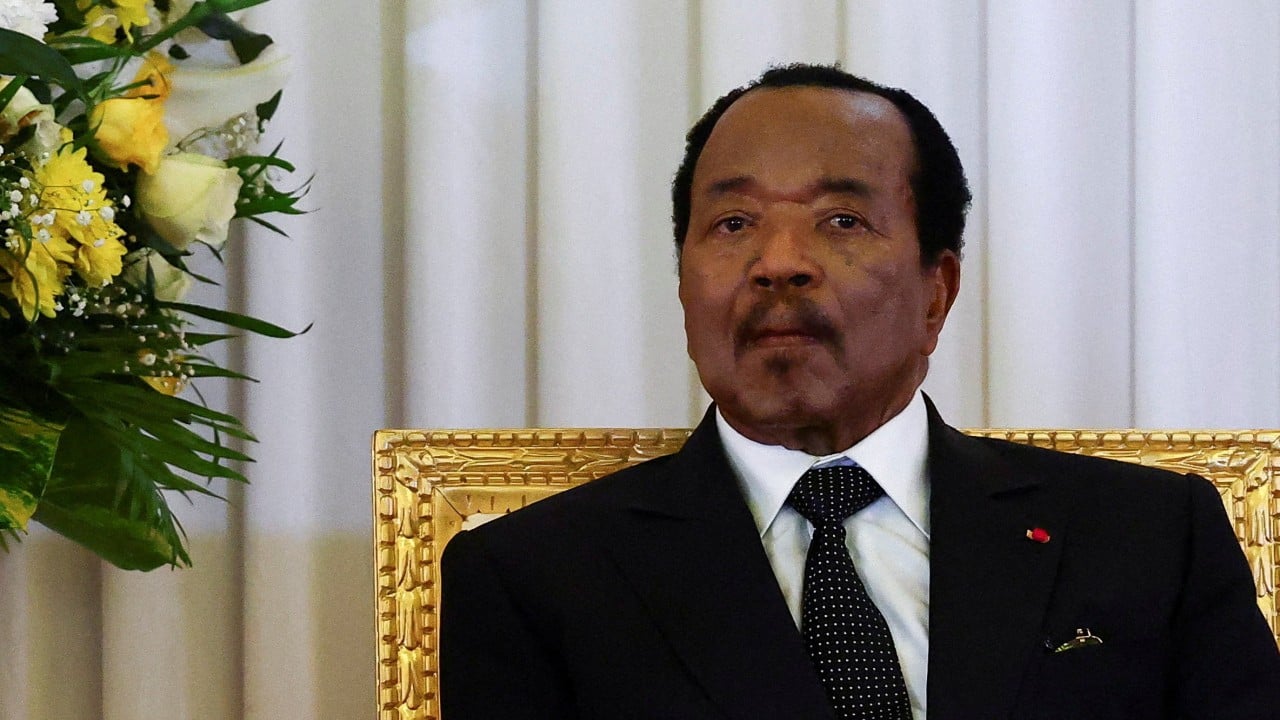
Planes land and engines shut down, but in Yaoundé, the landing gear of statecraft has been broken for years. When ninety-three-year-old Paul Biya touched down at Nsimalen International Airport following a seventy-four-day disappearance in Geneva, state media heralded a triumphant return. The streets filled with cadres wearing party regalia, waving banners for the Cameroon People's Democratic Movement, and shouting scripted praises. Behind the manufactured pageantry lies a stark political reality. The longest absence of the world's oldest head of state has not ended a crisis. It has merely exposed the structural decay of an executive branch operating completely detached from constitutional reality.
For over ten weeks, the apparatus of the Central African republic functioned on remote control. No vice president exists to step into the breach. No clear succession mechanism functions without acute factional warfare. Instead of calm continuity, the prolonged silence from Switzerland triggered institutional paralysis, frantic military realignments, and an underground scramble for leverage among competing inner-circle power brokers. Biya's physical return to the Unity Palace does not solve the governance vacuum. It simply moves the battlefield back behind gilded doors. Meanwhile, you can read other events here: The Weight of Empty Shelves and Stolen Bread.
The Machinery of Absence
A modern state requires continuous executive function. Budget allocations, emergency security directives, and judicial appointments demand active oversight. During Biya's seventy-four-day sojourn abroad, the country effectively operated on autopilot while an invisible hand signed decrees via social media channels and state organs. This arrangement suits the shadowy network surrounding the president precisely because it insulates them from accountability.
When power is personalized to an extreme degree, institutions atrophy. Ministers do not govern; they wait for signals from foreign clinics or private residences in Europe. The economic costs of this model compound daily. Critical structural reforms stall, foreign investment dries up amid political unpredictability, and international lenders grow wary of a state where the signature required for financial backing might be delayed indefinitely by private medical leaves. To see the full picture, check out the detailed analysis by Al Jazeera.
Opposition figures have long pointed out that this style of rule turns governance into a private enterprise. Yet, focusing solely on Biya's age misses the structural architecture holding him up. The system is designed to prevent consensus. By keeping subordinates weak, suspicious of one another, and entirely dependent on his personal patronage, Biya created an autocracy that cannot safely transition to anything else.
The Quiet Military Chessboard
Weeks before his flight touched down in Yaoundé, the administration issued a series of sudden military decrees that laid bare the underlying anxieties of the regime. Command structures across four of the nation's five integrated military zones shifted. Leadership changed within the elite Rapid Intervention Brigade, and the head of the Presidential Guard received an elevation in rank.
These are not random bureaucratic adjustments. They represent calculated defensive moves by factions within the presidential villa. Control over the Presidential Guard and specialized security units determines who survives the inevitable power struggle. As rumors swirled regarding the president's health and opposition lawmakers formally petitioned the constitutional council to declare the office vacant, the real power brokers were busy securing physical control over the capital's choke points.
Every appointment reflects a delicate calculus between rival camps. Family members, long-serving civilian aides, and military chiefs eye one another with deep paranoia. The restructuring of the armed forces during an extended presidential absence signals that the elite understand a basic truth. The transition will not be mediated by constitutional law. It will be decided by barrel-of-a-gun politics and backroom compromises among men who have enriched themselves under the current order.
The Cost of Deferred Reality
Stability built around a single nonagenarian figure is inherently fragile. When the physical body fails, the institutional fiction fails with it. By returning to the capital, Biya has temporarily quieted the immediate constitutional challenges and the frantic speculation of foreign press corps. He has stepped back into the grand salon to project normalcy.
Yet, the structural clock keeps ticking. The fundamental questions remain entirely unanswered. Who actually wields executive authority when the decrees are signed thousands of miles away? How can an economy of nearly thirty million people sustain long-term growth while pinned to an opaque succession battle?
The cheering crowds along the boulevard in Yaoundé will disperse. The flags will come down. What remains is a nation suspended in amber, waiting for a reality that its ruling class refuses to prepare for, trapped in a cycle where survival replaces governance and tomorrow is postponed indefinitely.
For a closer look at the forged documents and the internal power struggle that defined this historic absence, watch this analysis on Why Cameroon Can't Replace Its Missing President.