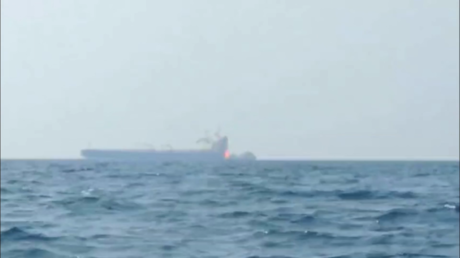
Reports that two supertankers struck mines in the Strait of Hormuz, backed by claims and video circulated around the Islamic Revolutionary Guard Corps, strike directly at the physical choke point carrying a massive share of seaborne crude and liquefied natural gas. Even when a single vessel avoids sinking, a hull breach or propulsion hit in narrow waters immediately rewrites war-risk insurance premiums, reroutes commercial shipping, and jolts global energy markets.
I have watched maritime security desks across London, Singapore, and New York react to chokepoint incidents for more than twenty years. The pattern rarely begins with a fleet blockade. It starts with ambiguity, grainy clips, contested coordinates, and a sudden spike in marine war-risk insurance quotes that forces shipowners to pause before the shooting even stops.
Whenever an incident involving supertankers and naval mines surfaces in the Strait of Hormuz, the headline tends to treat the waterway like a highway gate that either swings open or slams shut. In reality, maritime warfare in confined waters works through friction, doubt, and cost. A ship does not need to be destroyed at the bottom of the Persian Gulf to disrupt global trade; it only needs to become too expensive or too risky to insure and crew.
Why Video Claims and Mine Reports Move Markets Before Facts Land
Short clips and official-sounding statements travel faster than verified salvage reports. In modern maritime crises, information warfare runs alongside physical hazards, and traders often price in the risk of escalation minutes after a video surfaces online.
A video purporting to show a strike or mine detonation in the Strait of Hormuz is a classic tool of asymmetric deterrence. Even if footage is undated, mislocated, or cropped to hide what happened next, it forces commercial operators, naval commanders, and commodity desks to treat the threat as active until proven otherwise.
How Maritime Verification Actually Works
Confirming a mine strike on a Very Large Crude Carrier or Ultra Large Crude Carrier takes hours or days, not seconds. A master on the bridge feels a thud, checks ballast tanks, monitors draft changes, and calls company security while coast guards and coalition vessels sort out distress beacons.
Official announcements from military actors carry an obvious strategic purpose. They project reach and resolve while testing how adversaries and commercial shippers respond. Treating any single claim or clip as complete proof before independent vessel tracking, damage assessments, and port authorities weigh in is how analysts get burned.
- AIS signal gaps occur when vessels turn off transponders intentionally or lose reception near coastlines and islands.
- Hull and ballast data matter more than dramatic camera angles when judging whether a tanker can still safely transit or needs tug assistance.
- Commercial silence from charterers and P&I clubs often signals real alarm behind the scenes long before full public statements appear.
The Mechanics of Naval Mines in Confined Waters
Naval mines remain one of the most cost-effective weapons in maritime history. A simple moored or bottom mine costs a fraction of an anti-ship missile or patrol craft, yet it can tie up multimillion-dollar hulls and specialized mine countermeasures teams for weeks.
The Strait of Hormuz narrows to roughly twenty-one miles between Oman and Iran, with inbound and outbound shipping lanes squeezed into narrow traffic separation schemes. Deep-draft supertankers have limited room to maneuver, making route planning and depth clearance critical every single day.
Moored, Bottom, and Influence Triggers
Mines generally rely on contact or influence sensors. Contact mines detonate when a hull strikes a horn or trigger mechanism, while influence mines detect magnetic signatures, acoustic noise from propellers and machinery, or pressure changes caused by water displacement as a large vessel passes overhead.
A massive steel hull moving slowly through warm, shallow or semi-confined waters creates a distinct magnetic and acoustic footprint. That signature is precisely what influence fuzes are engineered to sense.
In narrow shipping lanes, a mine does not have to hit every vessel to succeed; uncertainty alone slows speeds, crowds channels, and multiplies collision risks.
Countering that threat is slow and painstaking. Sweeping and hunting channels requires dedicated vessels, unmanned underwater vehicles, divers, and clear weather windows, all while commercial traffic waits or weighs alternatives.
What Happens to Supertankers When Hulls Take a Hit
A supertanker is built to carry roughly two million barrels of crude oil, giving it enormous displacement and inertia. Stopping or turning a loaded hull takes miles, and any sudden loss of buoyancy, steering, or propulsion in busy waters creates a secondary hazard far worse than the initial blast.
Double-hull construction has improved survival rates after low-energy impacts compared with older single-hull designs. Still, an explosion near engine rooms, steering gear, cargo tanks, or pump rooms can leave a vessel drifting, leaking cargo, or struggling to maintain trim.
Salvage, Towage, and Environmental Fallout
Consider a hypothetical scenario where a loaded tanker takes a mine hit near a narrow fairway and loses main propulsion. Even if cargo tanks hold, the crew faces immediate danger from fire, structural stress, and passing traffic while tugs race to establish a tow line.
Salvage operations in contested or high-threat zones face steep hurdles. Commercial salvage tugs require clear safety guarantees, specialized firefighting and oil-spill gear, and permission from coastal states and insurers before moving in.
| Operational Dimension | Immediate Effect on Vessel | Broader Shipping Impact |
|---|---|---|
| Propulsion or Steering Loss | Vessel becomes unmaneuverable in traffic lane | Delays following ships and raises collision odds |
| Cargo Tank Breach | Oil slick, vapor hazard, and weight shift | Triggers environmental response and port holds |
| Crew Injury or Evacuation | Reduced watchkeeping and emergency strain | Prompts crew refusal to enter high-risk zone |
| War-Risk Repricing | Higher voyage cost before transit begins | Widens freight rate spreads across tanker classes |
Follow the Money Through Insurance, Freight, and Refineries
When ships face mine risks in the Strait of Hormuz, the financial shockwave hits long before crude shortages appear at retail pumps. War-risk insurance underwriters can raise premiums on a single transit within hours or withdraw coverage for specific zones altogether.
When coverage gets expensive or scarce, shipowners and charterers face hard choices. Some halt transits or wait at anchor outside the strait, while state-backed guarantees or negotiated terms sometimes step in to keep essential cargoes moving.
Pipelines, Alternative Routes, and Margin Compression
Alternative export routes exist in theory, yet every bypass has limits. Pipelines can shift some barrels away from the strait, but total bypass capacity falls well short of replacing the full volume of oil and LNG that normally passes through those waters.
Refiners in Asia and Europe feel the strain through wider crude differentials, higher VLCC spot rates, and tighter hedging margins. A refinery tuned to specific medium or heavy sour grades cannot always swap to distant light sweet crudes overnight without sacrificing yields or paying steep premiums.
- Freight rates spike first on prompt voyages as available tonnage tightens.
- Inventory buffers cushion the initial shock for buyers with healthy storage, but prolonged delays eat through reserves quickly.
- LNG carriers face even stricter safety and scheduling constraints than crude tankers due to cargo volatility and specialized terminal slots.
What Experienced Operators Look for Next
Veteran shipping executives and energy analysts rarely chase every rumor on social media. Instead, they watch quiet operational indicators that show whether a crisis is escalating, stabilizing, or turning into a prolonged grind.
Look at AIS density and anchorage queues outside the strait, check whether mine countermeasures assets are deploying or repositioning, and watch how insurance markets quote seven-day cover rather than reacting to a single hour of news. Pay close attention to whether major charterers pause fixtures or keep booking at higher rates.
A single incident involving two supertankers and naval mines in the Strait of Hormuz is never just a local maritime event. It is a stress test of global energy logistics where a handful of cheap underwater devices can hold billions of dollars in trade hostage.


