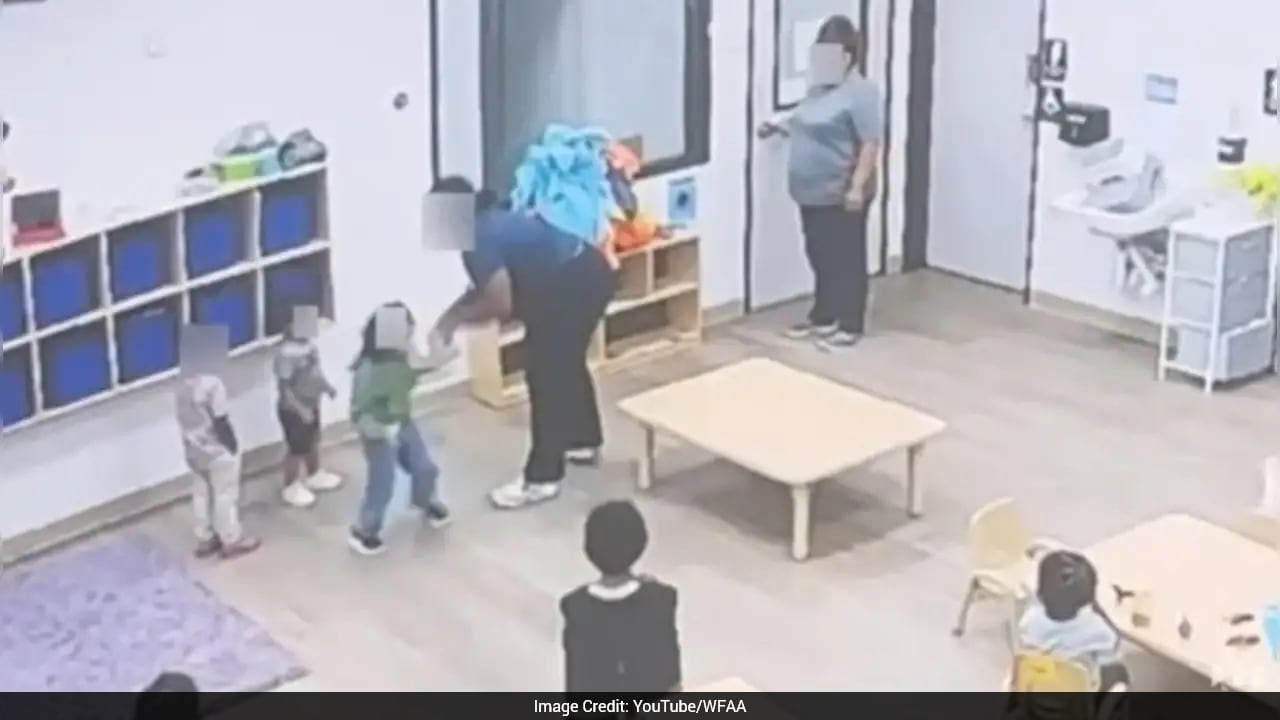
The security camera footage captured inside Arka Montessori Academy of Risinger in Fort Worth did not show a typical classroom management failure. It displayed something far darker, exposing an environment where basic custodial trust collapsed completely. When Heather and Richard Harris filed a million-dollar lawsuit against the facility, they pulled back the curtain on a horrifying reality that legal advocates and child protection experts have warned about for years. Their four-year-old son was not merely caught in an accidental scuffle between preschoolers. According to court documents and the visual evidence, a substitute caregiver actively encouraged toddlers to brawl, culminating in the young boy being yanked by the wrist and hurled onto a hardwood floor like a discarded object.
For working parents navigating an underfunded, hyper-stressed early education market, this Texas lawsuit serves as a terrifying wake-up call. The phrase "child fight club" sounds like hyperbole ripped from a dystopian screenplay. Yet, when examined through the lens of state compliance records and systemic labor shortages, the incident reveals the predictable outcome of an unregulated race to the bottom.
The Anatomy of a Breakdown
To understand how a classroom of four-year-olds turns into an arena, one must examine the operational mechanics of modern private childcare facilities. Arka Montessori opened its doors in early 2024, positioning itself as a premium choice for families seeking structured early development. Yet, state regulatory filings show a rapid accumulation of safety infractions totaling sixteen citations in a remarkably short operational window. These red flags included children left unattended outside and toddlers wandering unsupervised in classrooms.
The specific incident involving the Harris family began during a routine staff transition. As one teacher left the room for a restroom break, a substitute caregiver entered to cover the ratio. That substitute happened to be the mother of another child in the room. Surveillance footage reviewed by investigators shows that instead of defusing an escalating physical dispute between the children, the adult supervisor egged her own son on, instructing him to strike the Harris child.
When the four-year-old victim attempted to back away and defend himself, the adult intervened directly. She grabbed his wrist, pulled him close, and swept his legs out from underneath him, sending his small frame crashing hard to the floor while a secondary staff member watched without a single gesture of intervention.
The physical injuries—scratches, bruising, and subsequent post-traumatic headaches—were severe enough. However, the psychological fallout proved far more enduring. The child developed acute anxiety, freezing at the thresholds of rooms, clinging desperately to his parents, and experiencing intense emotional outbursts tied directly to the trauma of a place that should have offered absolute sanctuary. The family ultimately pulled him out of daycare entirely, realizing that institutional settings had become synonymous with threat rather than safety.
The Invisible Strain on Early Education
The legal strategy mounted by Russell Button of The Button Law Firm targets the facility on counts of negligence, negligence per se, and gross negligence. To secure exemplary damages meant to punish egregious misconduct, the plaintiffs must prove that the institution faced an extreme risk of harm, recognized that risk, and proceeded with conscious indifference.
Proving conscious indifference in the childcare sector requires looking past bad actors to examine the systemic rot underneath. Across the United States, early childhood education operates on razor-thin margins. Profitability for private facilities depends heavily on maintaining maximum child-to-teacher ratios while paying frontline staff wages that frequently fall below fast-food starting pay.
This economic pressure forces facilities to cut corners on background checks, ongoing training, and supervisory oversight. When qualified, empathetic educators exit the profession due to burnout and poverty wages, facilities are forced to rely on undertrained, unvetted, or desperate substitutes. The individual actions of the substitute teacher in Fort Worth are indefensible, but they occurred within an ecosystem starved of resources and starved of institutional accountability.
State licensing agencies are routinely overwhelmed. In Texas and across numerous other jurisdictions, the ratio of inspectors to facilities is staggering, meaning that oversight relies heavily on self-reporting and reactive investigations triggered only after a child is severely hurt or a parent demands security footage.
The Illusion of Parental Due Diligence
Before enrolling their son, Heather and Richard Harris did everything responsible parents are told to do. They toured the facility, checked out the environment, prioritized educational philosophy, verified cleanliness, and confirmed the presence of interior surveillance cameras. They even arranged a half-day trial run to ensure their child felt comfortable.
They believed they had found a gold standard. Instead, they fell victim to an illusion of safety that modern marketing creates for commercial daycares. Parents are encouraged to look for polished websites, Montessori buzzwords, and shiny facilities, while critical metrics—such as staff retention rates, internal disciplinary logs, and specific citation histories—are obscured or difficult to interpret without digging through state database portals.
When parents tour a facility, they see the best face a business can put forward. They do not see what happens at 4:30 PM on a Friday when ratios are stretched, original teachers have clocked out, and a substitute is managing a room of exhausted four-year-olds with zero supervision from management.
The Broader Reckoning
The lawsuit filed in Tarrant County District Court is more than a bid for financial compensation. It is a stress test for an industry that handles the most vulnerable population in society while remaining largely treated as a luxury consumer service rather than critical infrastructure.
When daycares operate with 16 safety citations in less than two years and continue to enroll children, the regulatory framework has failed. When employees can physically assault a four-year-old on camera while a coworker watches apathetically, internal culture has completely disintegrated.
Accountability cannot rest solely on post-incident civil litigation. Suing a defunct or shielded LLC after the damage is done does not restore a child's sense of security or erase the trauma of being treated like a ragdoll by an adult guardian. True reform requires mandatory criminal background reporting for all substitute pools, real-time public accessibility to state inspection violations right on facility websites, and severe financial penalties that pierce corporate veils when basic safety protocols are ignored.
Until systemic reform forces institutional transparency, parents are left standing in the lobby, trusting strangers with their children, and hoping the cameras are actually watching what the teachers are doing.


