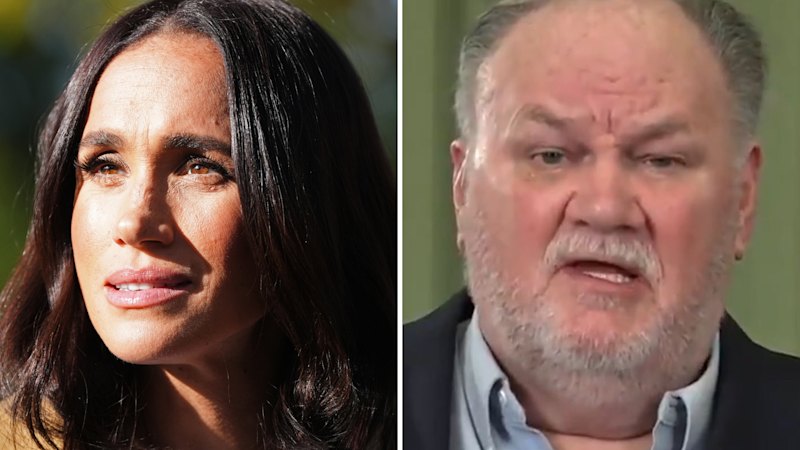
The relentless scrutiny surrounding Thomas Markle has evolved from a messy pre-wedding tabloid distraction into a severe, multi-year stress test for the British royal family's crisis management apparatus. What began in 2018 as a series of staged paparazzi photographs and canceled flights to Windsor has metastasized into a permanent, destabilizing proxy war. The core issue is no longer just one estranged father's grievances; it is the institutional vulnerability exposed when a private family rupture collides with the ruthless economics of the modern media ecosystem.
For decades, Buckingham Palace operated under a rigid, predictable playbook when dealing with in-laws and peripheral figures. The strategy relied on quiet NDAs, discrete financial settlements, or the sheer gravitational pull of royal prestige to enforce silence. Thomas Markle broke that model entirely. Operating outside the United Kingdom's legal jurisdiction and unbound by aristocratic deference, he became an unpredictable wildcard whose public commentary consistently undermined the carefully curated narratives of both Kensington Palace and, later, the Sussexes' California-based Archewell operation.
The Anatomy of a Modern Palace Crisis
To understand why the Thomas Markle situation remains so corrosive, you have to look at the mechanics of royal public relations. The British monarchy survives on mystique and controlled access. Every public appearance, charity patronage, and leaked briefing is calibrated to project stability. When an external actor refuses to play by the unwritten rules of the "Royal Rota"—the pool of accredited British journalists who trade favorable coverage for institutional access—the entire system short-circuits.
Thomas Markle did not go through palace press secretaries. He went directly to morning television hosts, tabloid editors, and YouTube commentators. Each interview created a lose-lose scenario for the Windsors and the Sussexes. Responding directly elevated the claims and dragged the Crown into a public mud-slinging match. Remaining silent allowed unchallenged narratives to harden into accepted public fact, fueling relentless speculation about estrangement, loyalty, and family values.
This dynamic exposed a fundamental structural flaw in how the monarchy handles modern celebrity culture. The institution was built to manage statecraft and ceremonial continuity, not the 24-hour outrage cycle of cable news and viral social media clips. When accusations—whether regarding leaked private letters, alleged financial abandonment, or deeper personal grievances—surface from within a royal's immediate family, the palace's traditional mantra of "never complain, never explain" begins to look less like dignified restraint and more like institutional paralysis.
The Legal and Financial Machinery Behind the Headlines
Behind the emotional television appearances lies a brutal commercial reality. The media ecosystem surrounding the royal family is a multi-billion-dollar global industry, and conflict is its highest-yielding commodity. When a figure like Thomas Markle steps in front of a camera, he is rarely operating in a vacuum. He is surrounded by an orbit of agents, documentary filmmakers, and tabloid middlemen who understand exactly how to monetize royal proximity.
Consider the legal battles that defined the post-Megxit era, particularly the landmark privacy and copyright lawsuit brought by Meghan, Duchess of Sussex, against Associated Newspapers over the publication of a handwritten letter she sent to her father in August 2018. That litigation pulled back the curtain on the mechanics of palace communication. Court filings revealed that senior aides—the so-called "Men in Grey"—were actively discussing how to manage the Thomas Markle fallout long before the public realized the extent of the rift.
The lawsuit established critical legal precedents regarding the privacy of personal correspondence, even for public figures. Yet, from a reputational standpoint, it was a Pyrrhic victory. The legal discovery process forced private text messages, internal palace memos, and intimate family dynamics into the public record. It demonstrated that in the modern information environment, attempting to suppress a story through the courts often guarantees that its most damaging details will be examined under oath and broadcast worldwide.
The Jurisdiction Problem
A major factor overlooked by casual observers is geography. Had Thomas Markle been a British citizen residing in Surrey, the palace's traditional levers of influence—social pressure, discreet legal warnings, and control over domestic press access—might have contained the fallout within months. Because he lived in Rosarito, Mexico, and held American citizenship, he was entirely insulated from the soft power of the British establishment.
American media outlets operate under the First Amendment, possessing vastly broader protections for publishing commentary and interviews than their British counterparts, who must navigate strict UK defamation and privacy laws. This transatlantic regulatory gap allowed stories and claims to gain traction in the United States and globally, effectively bypassing the traditional gatekeepers in London. Once a narrative is live on American digital platforms, British outlets can report on the existence of the controversy without assuming the same primary legal liability.
The Split Strategy Between London and Montecito
The handling of the Thomas Markle crisis also laid bare the widening ideological chasm between the working royal family in London and Prince Harry and Meghan in California. As the attacks and public pleas escalated, two distinct crisis management philosophies emerged, and they frequently clashed.
In London, the prevailing institutional view was that the Sussexes should have intervened earlier and more decisively to neutralize the threat before the May 2018 wedding. Senior courtiers believed that a private, unpublicized visit to Mexico—or a firm, centrally managed communications strategy—could have prevented Thomas Markle from becoming a recurring media fixture. From the palace perspective, the failure to contain a family member was a basic operational blunder that distracted from the broader mission of the monarchy.
In Montecito, the view was diametrically opposed. Harry and Meghan maintained that the palace press office actively discouraged them from reaching out directly to Thomas Markle out of fear that any communication would be immediately leaked to the press. They argued that the institution was more concerned with protecting its own relationship with British tabloids than with protecting Meghan from the fallout of her father's public statements.
This divergence highlights a critical truth about the modern royal family: it is no longer a single unified entity, but a collection of competing royal courts with distinct brand imperatives. King Charles III and Prince William are focused on constitutional survival, public funding justification, and Commonwealth stability. Harry and Meghan operate in the American entertainment, philanthropy, and media space, where personal narrative, trauma, and authenticity are the primary currencies.
Why Family Scandals Hit the Monarchy Harder Than Political Ones
History shows that the British monarchy can survive massive constitutional crises, economic depressions, and even abdications. What consistently threatens its public standing is domestic dysfunction. The Crown sells itself as the ultimate symbol of national unity and traditional family stability. When the core family unit appears broken, vindictive, or incapable of basic reconciliation, it strikes at the foundational myth of the institution.
Look at the historical parallels:
- The War of the Waleses (1990s): The mutual media briefings by Prince Charles and Princess Diana shattered the illusion of the fairy-tale marriage and drove public support for the monarchy to historic lows.
- The Prince Andrew Fallout: The disastrous 2019 Newsnight interview proved that senior royals attempting to manage severe personal scandals without institutional guardrails inevitably inflict catastrophic self-harm.
- The Markle Rupture: While different in nature from internal royal feuds, the ongoing public estrangement reinforces a narrative of coldness and emotional detachment that critics have long leveled against "The Firm."
Every time new, disturbing claims or desperate public pleas emerge from the Markle camp, they reactivate this exact vulnerability. They force the public to ask uncomfortable questions about how the world's most famous family treats its own, regardless of how estranged or problematic those relatives may be.
The Gray Areas of Accountability and Estrangement
Any honest analysis of this situation requires acknowledging the uncomfortable gray areas that partisan commentators on both sides routinely ignore. This is not a simple morality play with a clear hero and a singular villain.
On one hand, the public betrayal experienced by the Duchess of Sussex is undeniable. Having a parent repeatedly sell access, stage photographs, leak private letters, and publicly criticize one's spouse on international television is a profound violation of trust. In any non-royal family, cutting off contact with a relative who exhibits that behavior is widely recognized as a healthy, necessary boundary. Expecting someone to maintain a relationship simply to appease tabloid editors is neither realistic nor fair.
On the other hand, the optics of vast wealth and global influence juxtaposed against an aging, visibly unwell estranged father create a brutal public relations dynamic that cannot be easily explained away. Empathy is not a zero-sum game, and the public often struggles to reconcile messages of global compassion and mental health advocacy with a total, unyielding familial cutoff. Critics seize on this perceived contradiction, using it to frame the Sussexes as ruthless brand managers rather than genuine humanitarians.
Furthermore, the media's role in perpetuating the cycle cannot be overstated. Certain outlets have systematically exploited a vulnerable, isolated man, winding him up for soundbites and discarding him once the news cycle shifts. The very publications claiming to champion family values have profited handsomely from ensuring this particular family never heals.
The Permanent Shift in Royal Crisis Management
The Thomas Markle saga has permanently altered how the royal family—and high-profile public figures globally—approach family vetting and reputation defense. The era of assuming that peripheral relatives will naturally fall in line out of respect for the Crown is dead.
Modern palace advisors now treat extended family networks as primary security and reputational vectors. Before any high-profile marriage or appointment occurs, institutions must conduct exhaustive vulnerability assessments, establish clear financial and communication boundaries early, and accept that traditional silence is no longer a viable shield against algorithmic outrage.
Ultimately, the claims and controversies surrounding Thomas Markle serve as a stark reminder that even the most powerful, heavily guarded institutions in the world remain acutely vulnerable to human unpredictability. You can hire the best crisis communications firms in London and Los Angeles, secure ironclad copyright rulings, and control every frame of a documentary—yet you still cannot stop a single estranged relative with a webcam and an internet connection from rewriting the headlines tomorrow morning.