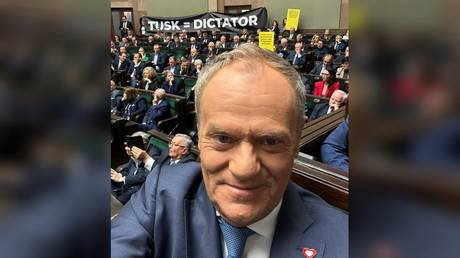
When European Parliament President Roberta Metsola walked into the Polish Sejm in Warsaw, she expected routine diplomatic pageantry ahead of Poland’s European Union Council presidency. Instead, opposition lawmakers from the nationalist Law and Justice (PiS) party greeted her with a coordinated protest, holding up placards reading "TUSK = DICTATOR" in front of television cameras. The stunt, aimed directly at Prime Minister Donald Tusk, transformed a standard institutional visit into an international spectacle. It was a calculated attempt by Poland’s ousted conservatives to bypass domestic media filters and broadcast their grievances directly to Brussels.
The immediate target of the protest was clear, yet the underlying mechanics were far more complex than a simple parliamentary heckle. By staging the demonstration in front of Metsola—a fellow member of the center-right European People’s Party (EPP) alongside Tusk—PiS lawmakers sought to expose what they characterize as European hypocrisy regarding the rule of law in Poland. For eight years under PiS governance, Warsaw was locked in bitter disputes with Brussels over judicial independence, media freedom, and democratic backsliding, resulting in billions of euros in frozen EU recovery funds. Now out of power, the party is inverting the exact rhetoric once used against them, accusing Tusk’s coalition government of authoritarian overreach while claiming Brussels turns a blind eye because the prime minister is an EU insider.
The Anatomy of a Parliamentary Ambush
Political theater in Warsaw is nothing new, but the timing and audience of the Metsola protest reveal a sharp shift in opposition strategy. The Sejm has long served as an arena for high-stakes visual politics, yet protests are typically designed for domestic consumption on Polish evening news broadcasts. This time, the signage was printed exclusively in English.
That linguistic choice tells you everything about the intended audience. PiS strategists knew that clips of Roberta Metsola standing against a backdrop of "TUSK = DICTATOR" signs would circulate rapidly across European newsrooms and social media feeds in Brussels, Berlin, and Paris. For a domestic voter in rural Poland, an English-language sign carries less immediate resonance than a Polish slogan. For a correspondent covering European institutions, however, it provides a ready-made, easily digestible visual hook that requires zero translation.
Metsola handled the disruption with practiced institutional restraint, continuing her remarks without directly engaging the protesters. Yet the visual damage, from the perspective of Tusk’s communications team, was already done. In modern political media, the image of a protest often outlives the substance of the speech it interrupted.
Why Roberta Metsola Was the Chosen Backdrop
Roberta Metsola occupies a delicate position within the European power structure. As President of the European Parliament, she is formally tasked with representing the institution as a whole, maintaining neutrality across political divides. At the same time, she hails from the Maltese Nationalist Party, which sits within the European People’s Party—the exact same pan-European political family that Donald Tusk once led as president before returning to Warsaw.
Opposition lawmakers in Poland view this institutional overlap not as a coincidence, but as a protective shield. During the years when Mateusz Morawiecki and Jarosław Kaczyński governed Poland, European Parliament debates regularly featured sharp condemnations of Warsaw’s judicial reforms, often spearheaded by EPP lawmakers and their liberal and socialist allies. Following the October 2023 Polish parliamentary elections and Tusk’s return to the premiership, the European Commission swiftly moved to unlock roughly 137 billion euros in cohesion and recovery funds that had been withheld over rule-of-law concerns.
To PiS politicians, the rapid release of those funds proved that Brussels’s previous objections were political rather than legal. By ambushing Metsola during her official visit, they aimed to force European leaders to confront the contradiction between their vocal scrutiny of the previous Polish government and their relative silence regarding Tusk’s aggressive methods of dismantling PiS-era institutions.
The Institutional Battlefield Behind the Slogans
To understand why opposition lawmakers are willing to brand a democratically elected prime minister a dictator in front of foreign dignitaries, one must look at the institutional warfare unfolding inside Poland since late 2023. Tusk’s coalition inherited a state apparatus deeply reshaped by eight years of PiS rule. Key judicial bodies, the Constitutional Tribunal, the National Council of the Judiciary, and state media networks were populated with PiS appointees and insulated by laws designed to survive a change of government.
Faced with a hostile president, Andrzej Duda—a PiS ally holding veto power over any new legislation until the end of his term—Tusk’s government opted for executive workarounds rather than waiting for legislative consensus. These maneuvers have triggered genuine constitutional friction, creating ample ammunition for the opposition's narrative.
State Media Takeovers and Prosecutorial Disputes
The flashpoints that fueled the "TUSK = DICTATOR" placards center on how the new administration reclaimed control over public institutions:
- Public Broadcasting: Within days of taking office, Tusk’s culture minister bypassed the PiS-dominated National Media Council by placing state television (TVP), Polish Radio, and the Polish Press Agency into formal liquidation. Armed police were deployed to secure studios, and broadcast signals were abruptly cut off before new management took over. Critics, including several independent legal watchdogs, questioned the statutory basis for using commercial liquidation laws to circumvent media regulators.
- The National Prosecutor’s Office: A bitter standoff erupted over the removal of the national prosecutor, Dariusz Barski, whom the justice ministry declared had been improperly reinstated from retirement years earlier. President Duda and Supreme Court judges aligned with PiS rejected the removal, resulting in a dual-power crisis where competing factions claimed legal authority over criminal investigations.
- Parliamentary Mandates: The arrest of former PiS interior minister Mariusz Kamiński and his deputy Maciej Wąsik inside the Presidential Palace—following a jurisdictional clash between different chambers of the Supreme Court over whether a presidential pardon remained valid—cemented the opposition’s claim that Poland now holds "political prisoners."
None of these actions occurred in a vacuum. Tusk’s supporters argue, with considerable justification, that restoring constitutional order after years of systemic capture cannot be achieved solely through rules written by the very actors who dismantled the checks and balances in the first place. They point out that state television under PiS functioned as a relentless partisan propaganda machine, and that waiting for President Duda’s veto power to expire would have left the incoming government paralyzed for nearly two years.
The European Double Standard Debate
The core argument embedded in the Sejm protest touches a raw nerve in European politics. Does Brussels apply rule-of-law standards evenly, or are those standards weaponized selectively against conservative and nationalist governments?
Legal scholars and diplomatic observers remain divided on the answer. On one hand, the European Commission’s decision to close the Article 7 rule-of-law procedure against Poland in May 2024 was tied to a formal action plan presented by Tusk’s justice minister, Adam Bodnar, outlining concrete steps to restore judicial independence and comply with European Court of Justice rulings. From Brussels’s vantage point, a government committed to rejoining the European legal mainstream deserves institutional support, even if the transition is messy.
On the other hand, critics outside the Polish opposition have raised eyebrows at the speed with which EU officials set aside concerns over executive overreach in Warsaw. When a right-wing government uses extraordinary decrees to reshape courts or media boards, Brussels responds with infringement procedures and financial penalties. When a pro-European centrist government uses creative legal interpretations to achieve the reverse outcome, European leaders praise the restoration of democracy.
By thrusting English-language signs into Roberta Metsola’s line of sight, PiS lawmakers were exploiting this exact gray area. They did not need to convince European viewers that Donald Tusk is literally an authoritarian ruler. They only needed to plant the seed of doubt that Brussels operates on political loyalty rather than consistent legal principles.
Domestic Desperation Meets International Strategy
While the protest targeted European institutions, its primary fuel was domestic political anxiety. Law and Justice spent eight years dominating Polish politics, backed by generous social spending programs, strong support from the Catholic Church, and near-total control over state-funded media. Losing power stripped the party of its patronage networks and exposed its former officials to parliamentary investigative committees and criminal probes.
At the same time, PiS has struggled to find a cohesive message in opposition. Internal fractures between party leader Jarosław Kaczyński’s old guard and younger, more pragmatic figures have complicated efforts to broaden their voter base ahead of crucial presidential elections. High-decibel stunts in parliament serve an immediate internal purpose: they rally the party’s core electorate, demonstrate fighting spirit to disillusioned supporters, and force the government onto the defensive.
Yet this strategy carries steep diminishing returns. Branding every policy disagreement or legal dispute as a "dictatorship" risks numbing the broader Polish public, many of whom remember genuine authoritarian rule under communism prior to 1989. Polling consistently shows that while swing voters harbor reservations about the methods Tusk’s coalition has used to purge state institutions, they remain deeply skeptical of PiS’s claims to be the defender of constitutional norms.
The Risk to Poland’s EU Presidency
The timing of the protest also intersected with a pivotal moment in Warsaw’s European trajectory. As Poland prepared to assume the rotating six-month presidency of the Council of the European Union in January 2025, Tusk’s government positioned itself as a stabilizing force on the continent—championing European defense integration, energy security, and continued military backing for Ukraine.
For Tusk, the EU presidency represents an opportunity to cement Poland’s status as a heavyweight decision-maker alongside France and Germany, erasing the diplomatic isolation of the PiS years. For the opposition, turning Warsaw’s parliamentary halls into a site of visible chaos threatens to undermine that image of stability. If foreign dignitaries cannot visit the Sejm without walking into an ambush of partisan placards, Poland’s credibility as an honest broker in European affairs suffers collateral damage.
When Political Theater Replaces Institutional Trust
The confrontation during Roberta Metsola’s visit exposes a deeper structural crisis in Polish democracy that neither side has found a way to resolve. Over the past decade, political competition in Warsaw has ceased to be a contest between rival policy agendas operating within shared rules. Instead, the rules themselves have become the primary weapon of partisan combat.
When one faction views the courts, the media, and the prosecution service as existential territory that must be captured to prevent the other side from destroying the country, every election becomes an all-or-nothing struggle for survival. In such an environment, parliamentary decorum is the first casualty. Protests cease to be expressions of dissent and become attempts to delegitimize the entire governing apparatus in the eyes of foreign allies.
Brussels officials watching the footage from Warsaw understand that the placards held up behind Metsola were not merely an attack on Donald Tusk. They were a preview of how deeply polarized European politics has become, where domestic constitutional warfare is routinely exported onto the continental stage, leaving institutional leaders to navigate the crossfire while the underlying legal disputes remain entirely unresolved.