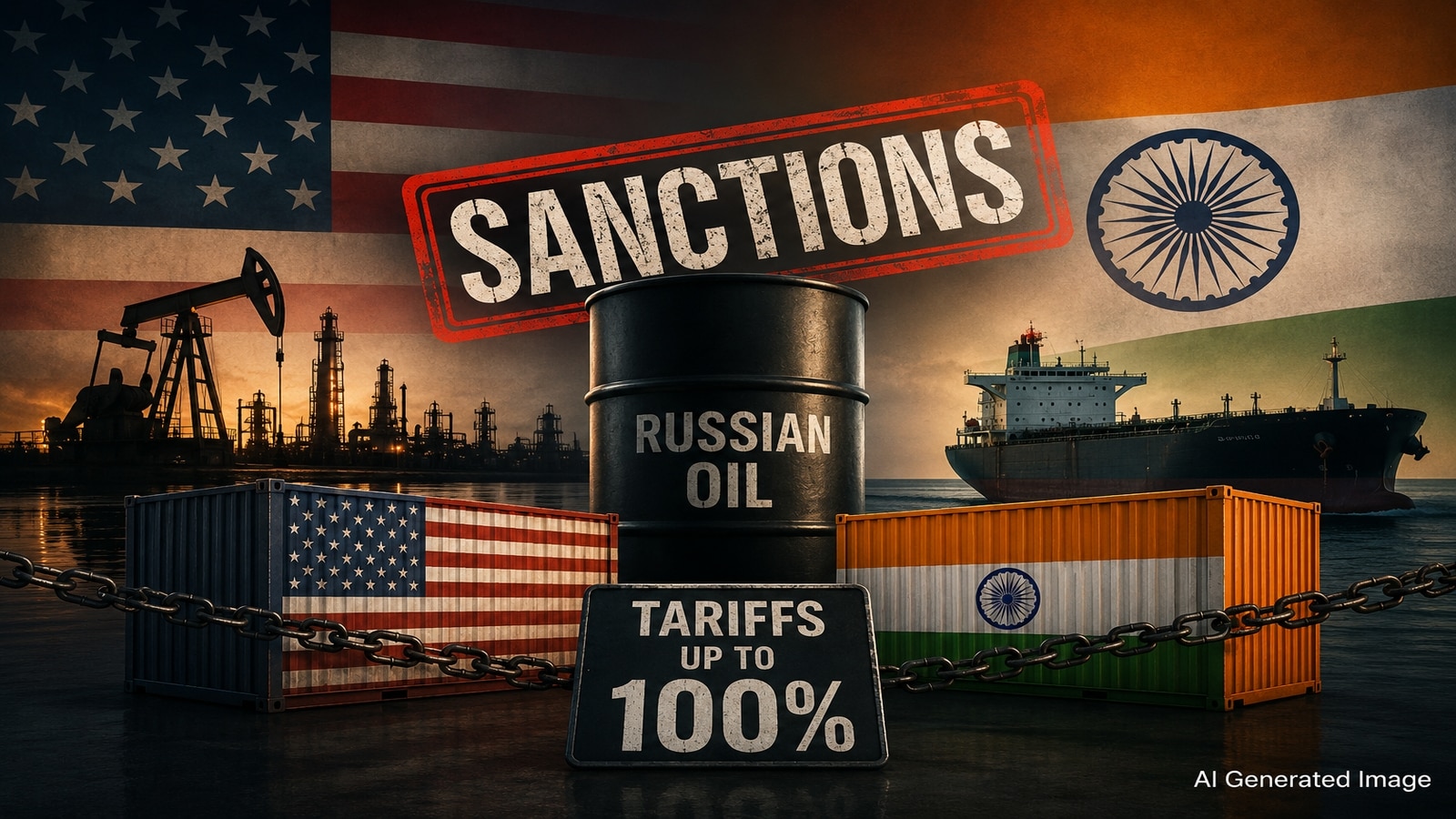
The United States Senate's newly advanced Russia sanctions bill targets India with a prospective 100% tariff on its imports due to its continued purchases of discounted Russian crude oil, creating a severe diplomatic standoff between Washington and New Delhi. This legislative maneuver, designed to choke off Kremlin revenue streams by penalizing top buyers like India and China, threatens to disrupt bilateral trade ties and force New Delhi into an awkward economic corner.
Geopolitical realignments rarely happen quietly. They arrive cloaked in statutory language, buried deep within congressional amendments, and backed by high-stakes diplomacy.
The Anatomy of the Penalty
The legislative text targets the world's top five purchasers of Russian fossil fuels. If passed, it authorizes up to 100% tariffs on imports originating from nations that refuse to stop fueling Moscow's war chest.
[Image of US Senate chamber]
For India, this means confronting a direct clash of economic imperatives. Refineries in New Delhi capitalized on discounted Russian petroleum following international shifts in energy trade, stabilizing domestic inflation while securing vital energy independence.
Stopping those purchases overnight is not a practical option. The economic shock to local consumers would be immediate and severe.
The Strategic Double Standard
Washington’s approach contains glaring inconsistencies. While countries like India face punitive tariff threats, European economies that historically imported natural gas from Russia have managed to secure carve-outs or exemptions under specific percentage thresholds.
This selective enforcement does not go unnoticed in South Asian capitals.
- Western allies continue to buy processed products derived from Russian crude refined in third-party nations.
- Strategic partnerships in the Indo-Pacific are tested when economic coercion replaces diplomatic engagement.
- Sovereign states maintain an independent foreign policy rooted in national interest rather than Western alignment.
When the rules apply selectively, trust erodes.
The Economic Realities on the Ground
Imposing a 100% tariff on Indian exports would devastate key manufacturing and technology sectors. Small and medium enterprises relying on North American markets would face sudden insolvency.
Yet, capitulation carries an equally high price. Yielding to external trade threats signals a surrender of economic sovereignty, inviting future pressure on other domestic policies.
New Delhi's response requires calculated resilience. Diversifying crude oil import corridors away from Moscow takes time, capital, and logistical overhaul. Infrastructure cannot be re-engineered overnight to suit foreign legislative timelines.
The Diplomatic Tightrope
Behind closed doors, foreign ministries are scrambling. Intelligence agencies are modeling worst-case scenarios where secondary sanctions trigger widespread financial decoupling.
The underlying assumption in Washington—that secondary tariffs act as an irresistible forcing mechanism—misunderstands the modern multipolar order. Major economies have spent years building alternative financial channels and local currency settlement mechanisms precisely to insulate themselves from weaponized dollar dominance.
The proposed legislation tests the durability of the broader bilateral framework. Security cooperation in the Indo-Pacific cannot easily coexist with aggressive trade warfare.
Sanctions bills come and go, but the structural reality of global energy demand remains stubbornly resilient.


