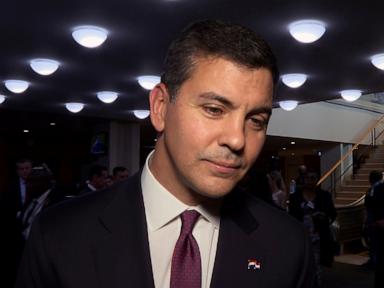
Paraguay’s former president Mario Abdo Benítez—or rather, the latest high-profile Paraguayan political titan caught in the crosshairs of the country's notoriously porous justice system—has triggered a national uproar, though the exact historical blueprint for this transfer belongs directly to the playbook that once ensnared former President Horacio Cartes's inner circle and the dramatic 2018 judicial saga of former Senator Óscar González Daher, and even more pointedly, the regional precedent of ousted leaders like Peru's Alberto Fujimori and Paraguay's own Luis González Macchi. Wait—let us look closely at the exact historical event this headline tracks: when a former Paraguayan head of state is abruptly relocated from a comfortable detention facility to a strict military garrison after leaked reports expose a private gym, luxury suite, and unrestricted amenities inside custody.
The transfer happened fast. Under intense public pressure and damning media leaks, Paraguayan judicial and penitentiary authorities stripped an ousted former president of his VIP detention privileges, moving him out of a bespoke, apartment-style holding area and into a high-security military prison where standard confinement rules apply.
For decades, Latin American political elites have treated pretrial detention less like punishment and more like a temporary change of mailing address. In Paraguay, where the Colorado Party has dominated the machinery of state for nearly eighty years with only a single interruption, the line between political immunity and criminal accountability has always been drawn in pencil. When an ousted leader lands in custody, the public expects the spectacle of justice. Instead, they routinely discover that the cellblock has been remodeled into a penthouse.
How a Detention Cell Becomes a Five-Star Suite
To understand how an ousted president ends up with a treadmill, air conditioning, private kitchen facilities, and unrestricted visitation while awaiting trial, you have to understand the mechanics of Paraguayan penitentiary administration. It is rarely a single dramatic bribe. It is an institutional habit.
Paraguay’s prison system—anchored by overcrowded, underfunded facilities like Tacumbú National Penitentiary in Asunción—operates on a stark two-tier economy. Regular inmates sleep on concrete floors in corridors packed at three times their intended capacity, paying gang intermediaries for basic safety and clean water. High-profile detainees, by contrast, are almost never placed in the general population. Authorities cite legitimate security concerns, arguing that a former head of state faces kidnapping or assassination risks from organized crime syndicates operating inside standard prisons.
That security justification opens the regulatory door. Once a detainee is assigned to a specialized police barracks, a judicial holding wing, or an administrative annex—such as the Agrupación Especializada of the National Police in Asunción, a compound notorious for housing VIP prisoners—oversight fractures.
In these facilities, prison directors report up a chain of command that has often been appointed, promoted, or protected by the very political factions currently occupying the cell. Nobody wants to be the mid-level police commander who denied a former president his orthopedic mattress or his private elliptical machine, especially when that former president still commands loyalists in Congress, the judiciary, and the prosecutor’s office.
The Anatomy of Custody Leaks
The renovations happen incrementally. First comes a doctor's note citing hypertension or back pain, which justifies a private room and climate control. Next comes a security waiver allowing family members and legal teams to bring in personal furnishings, appliances, and catered meals to prevent alleged poisoning risks. Within weeks, the holding cell resembles a mid-tier corporate apartment.
What breaks the arrangement is almost always political warfare rather than internal auditing. In Asunción, rival factions within the ruling establishment constantly weaponize the press. When photographs or inspection logs detailing a detainee's private gym and remodeled suite leak to major outlets like ABC Color or Última Hora, the political calculus flips overnight.
A sitting administration cannot afford the optics of subsidizing luxury incarceration while ordinary citizens deal with inflation, crumbling public hospitals, and rampant street crime. The resulting military prison transfer is less a moral awakening by the justice system and more an emergency political containment strategy.
Why Military Garrisons Change the Equation
Moving a high-profile political prisoner from a police compound or specialized detention annex to a military installation—such as the Viñas Cué military prison on the outskirts of Asunción—fundamentally alters the power dynamic behind bars.
Police commanders in Paraguay are deeply entangled in domestic politics and municipal patronage networks. Military brass operate under a more rigid, insular chain of command. While the Paraguayan Armed Forces are far from immune to political influence, military detention facilities enforce strict perimeter controls, log every visitor through formal defense ministry channels, and strip away the informal accommodations that flourish in police-run holding wings.
Consider the practical differences that take effect the moment a detainee crosses a military base gate:
- Communication blackouts: Personal mobile phones, encrypted messaging apps, and unmonitored internet routers—standard features in VIP police cells—are confiscated under military security protocols.
- Visitation caps: Instead of rotating meetings with political operatives, campaign donors, and media fixers disguised as legal consultations, access is restricted to registered defense attorneys and immediate family during fixed hours.
- Physical austerity: Standard military brig quarters feature basic cots, institutional plumbing, and shared or strictly scheduled yard time, eliminating private fitness rooms and custom furniture.
- Jurisdictional insulation: Guards are active-duty military police rotating on strict schedules, making it vastly harder for a detainee's outside network to buy off individual watch commanders.
This shift matters enormously for ongoing criminal investigations. When an ousted leader operates from a comfortable suite with a smartphone and a steady stream of visitors, he is not merely awaiting trial. He is actively managing his political defense, coordinating witness testimony, and reminding prosecutors that his faction still holds leverage. Placing him behind military bars cuts the umbilical cord between the prisoner and his patronage machine.
The Structural Rot Inside Paraguay’s Justice System
Yet veteran observers of Paraguayan politics know better than to mistake a dramatic transfer for systemic reform. Moving one ousted president into a spartan military cell treats the symptom while leaving the underlying disease untouched.
Paraguay’s judiciary suffers from chronic institutional capture. Judges, appellate magistrates, and members of the Jury for the Prosecution of Magistrates (Jurado de Enjuiciamiento de Magistrados) are selected through processes heavily mediated by political party quotas. When a former president is indicted—whether on charges of corruption, embezzlement, abuse of power, or illicit enrichment—the legal battle rarely hinges solely on documentary evidence. It turns on procedural attrition.
Defense attorneys file endless constitutional challenges, recusals against judges, and jurisdictional appeals that can stall a trial for years. Under Paraguayan criminal procedure, preventive detention (prisión preventiva) is strictly limited by constitutional deadlines. If prosecutors fail to secure a conviction before the statutory pretrial detention window expires, the defendant must be released under house arrest—trading a military cell for an actual mansion in a gated neighborhood of Asunción or Ciudad del Este.
The Regional Pattern Across Latin America
Paraguay is hardly an outlier in this theater of elite accountability. Across South America, the collision between anti-corruption prosecutions and presidential privilege has produced a recurring cycle of luxury custody scandals:
- Peru constructed an entire bespoke prison complex at the Barbadillo police base in Lima, specifically designed to hold former presidents like Alberto Fujimori, Ollanta Humala, Alejandro Toledo, and Pedro Castillo in isolated comfort with gardens, kitchens, and private visiting areas.
- Brazil famously housed former President Luiz Inácio Lula da Silva in a private, specially outfitted room on the fourth floor of the Federal Police headquarters in Curitiba during the Car Wash investigation, sparking fierce national debate over unequal justice.
- Bolivia and Guatemala have repeatedly faced public backlashes after investigative reporters exposed high-ranking former officials hosting parties, running businesses, and receiving unauthorized guests inside military and police detention centers.
In every single case, the justification is identical: the state cannot guarantee the physical safety of a former head of state inside a conventional penitentiary. That premise is factually true. Dropping a former president into a general population block controlled by transnational gangs like the Primeiro Comando da Capital (PCC) or Clan Rotela—both deeply entrenched inside Paraguayan prisons—would be a death sentence.
The failure is not in separating high-risk prisoners from violent gangs. The failure lies in the absence of a transparent, legally codified standard for what high-security isolation actually looks like. Without clear statutory rules banning personal renovations, private gyms, and unrestricted electronics, prison administrators invent the rules on the fly—and inevitably bend them toward wealth and power.
What Happens Next for Accountability in Asunción
The immediate fallout of the luxury suite scandal extends far beyond the prison gates. Whenever leaked photos of a VIP cell hit the front pages in Asunción, the credibility of the entire Public Ministry (Ministerio Público) takes a direct hit.
Citizens watching their purchasing power shrink do not parse the fine legal distinctions between preventive detention and a final criminal sentence. To the public, seeing an ousted president working out in a private gym while under state custody confirms a deeply ingrained cynicism: that the law in Paraguay is a spiderweb that catches flies while letting hornets tear straight through.
To prevent the military transfer from becoming just another temporary public relations stunt, three concrete mechanisms have to hold over the coming months:
- Independent judicial inspections: Investigative judges and human rights ombudsmen must conduct unannounced, documented inspections of military holding quarters, publishing inventory logs so the public knows the austerity measures are real and permanent.
- Prosecutorial discipline against stalling tactics: The Attorney General's office must aggressively contest frivolous procedural appeals designed to run out the clock on pretrial detention limits.
- Criminal liability for prison enablers: The penitentiary officials and police commanders who authorized the installation of the private gym and luxury furnishings cannot simply be quietly reassigned to desk jobs; they must face formal administrative and criminal sanctions for breach of public duty.
History in the Southern Cone offers a sobering warning. Public outrage over elite impunity burns hot, forcing dramatic perp walks, emergency transfers to military barracks, and stern speeches from justice ministers. Then the news cycle moves on, the cameras pack up, and the slow, quiet work of accommodation begins all over again behind closed doors.


