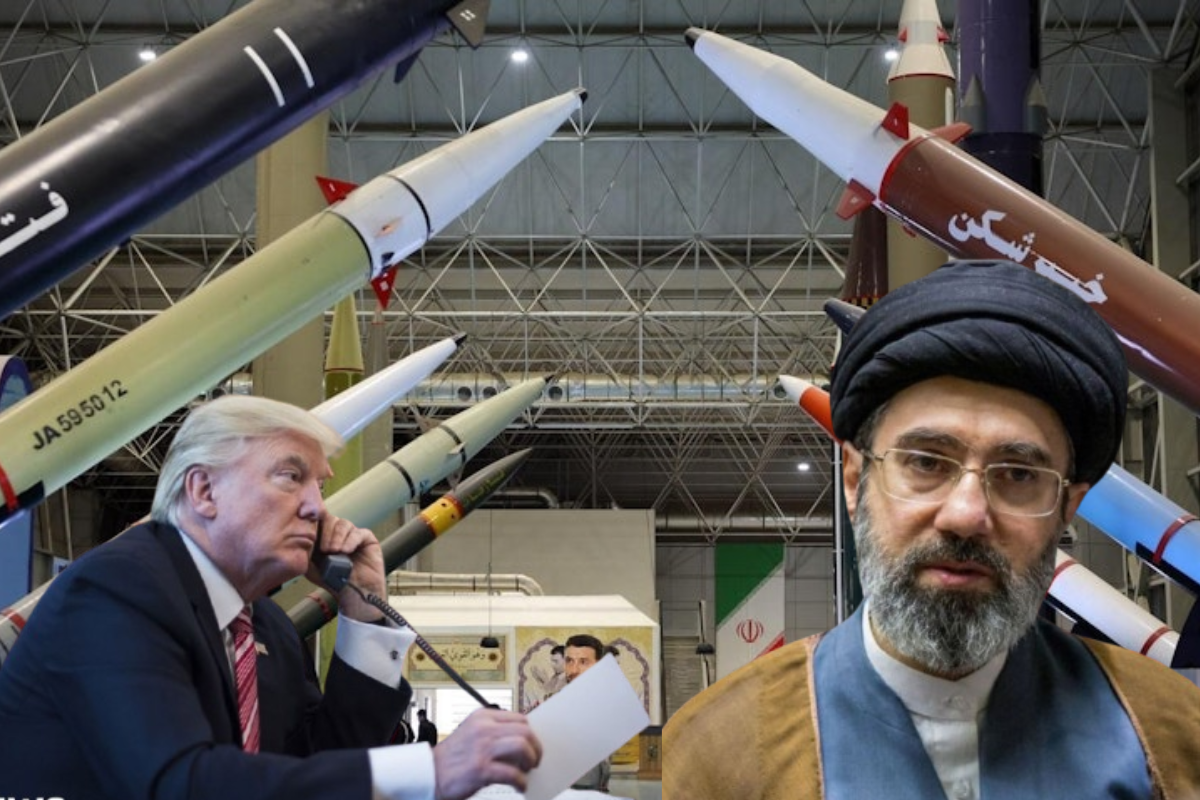
The ink on geopolitical maps suggests that conflicts have neat, shaded boundaries. We look at a globe and see borders, oceans, and distinct sovereign territories. But in the corridors of Tehran, Tel Aviv, and Washington, those lines are blurring into irrelevance. The traditional geometry of warfare is collapsing, replaced by a terrifyingly fluid reality where distance no longer offers protection.
When Iran issued its latest, chillingly precise warning—stating that a strike would land in a place entirely unexpected, pushing the conflict far beyond the geographical confines of the Middle East—it wasn't just standard political theater. It was an acknowledgment of how the modern world is wired. Meanwhile, you can find other stories here: Structural Mechanics of the US Iran De-escalation Framework.
To understand the weight of this threat, one must look past the standard headlines of military deployments and defense budgets. Consider instead a hypothetical cargo ship navigating the dark waters of the Indian Ocean, thousands of miles away from the immediate conflict zone. The crew is entirely disconnected from the ideological battles of the Levant. Yet, a single drone strike or a coordinated cyberattack on their navigation systems could instantly turn their vessel into a frontline casualty. This is the new architecture of confrontation. War is no longer a localized fire; it is a spark in a highly combustible, interconnected global room.
The Illusion of Distance
For decades, international relations operated under the assumption that conflicts could be contained. Diplomacy was the art of building a firewall around a crisis. If violence erupted in one region, the rest of the world felt the economic ripples, but rarely the physical impact. To see the complete picture, we recommend the excellent article by The Washington Post.
That buffer is gone.
Iran’s explicit communication to the United States and Israel marks a definitive shift in strategy. By declaring that the theater of war is no longer bound by the geography of the Middle East, Tehran is leveraging a reality that military strategists have feared for years. Asymmetric warfare means that a nation with inferior conventional firepower can project force globally through unorthodox means.
Think of a spiderweb. Touch one distant strand, and the vibration travels instantly to the center. Today, a geopolitical tremor in Damascus or Tehran can trigger a retaliatory strike in a Latin American port, a European capital, or a digital server hub in Virginia. The target is rarely the obvious military base; it is the unexpected vulnerability. The soft underbelly of a superpower.
This strategy relies entirely on psychological friction. By refusing to specify where or when a strike will occur, the state forces its adversaries to defend everything, everywhere, all the time. It is an exhausting, unsustainable posture for any military apparatus.
The Ripple in the Market and the Mind
When these threats are broadcast, the immediate reaction is often measured in financial volatility. Oil prices tick upward. Shipping insurance premiums skyrocket. But the true cost is human.
Behind every economic statistic is a person making a choice based on fear. A commercial airline pilot recalculating a flight path over Central Asia. An international student rethinking a semester abroad. A logistics manager sitting in an office in Rotterdam, staring at a monitor, wondering if a sudden supply chain disruption will tank their company.
The modern global economy was built on the assumption of predictability. We designed a just-in-time world where goods move effortlessly across oceans because we assumed the open seas would remain neutral ground. When a major regional power explicitly states that the conflict will spill outside the Middle East, that foundational assumption of predictability evaporates.
The threat shifts from a physical danger to an omnipresent anxiety. It changes how nations invest, how corporations plan, and how ordinary citizens view their safety in a hyper-connected world.
Redefining the Battleground
What does it mean to strike in a place where the opponent least expects it?
Historically, this meant unconventional sabotage or proxy operations. In the twenty-first century, the definition has expanded dramatically. The infrastructure of daily life has become weaponized.
Imagine a sudden, unexplained outage at a major maritime port. Cranes stop moving. Shipping containers stack up indefinitely. The digital ledger tracking global trade blinks out of existence. No missiles were fired. No blood was spilled on a traditional battlefield. Yet, the economic damage rivals a conventional bombardment, and the psychological impact paralyzes a nation. This is not science fiction; it is the reality of hybrid warfare.
By signaling that the West and its allies are vulnerable outside the immediate zone of active hostilities, Iran is exploiting the deep integration of the modern world. The very systems that make developed nations wealthy—their advanced digital networks, their reliance on global trade, their open societies—also make them uniquely vulnerable to asymmetric disruption.
The warning sent to Washington and Tel Aviv was not just about military retaliation. It was a reminder that in a globalized era, no one enjoys the luxury of a home-front sanctuary.
The Exhaustion of Containment
The traditional response to regional aggression has always been containment and deterrence. Deploy an aircraft carrier group. Strengthen missile defense shields. Tighten economic sanctions.
But these measures assume the adversary plays by the old rules of engagement. Deterrence works when both sides agree on what constitutes a red line. When one party declares that the entire globe is a potential theater, deterrence becomes a game of whack-a-mole played on a planetary scale.
The current tension reveals the limits of traditional diplomacy and military posturing. You cannot easily deter a threat that refuses to materialize in a predictable shape or location. The psychological weight of waiting for the other shoe to drop somewhere in the world is, in itself, a form of warfare. It erodes confidence, strains alliances, and forces democratic governments to justify massive security expenditures to an increasingly skeptical public.
We are left navigating a landscape where the old maps are useless. The conflict is no longer contained by desert borders or regional rivalries. It lives in the undersea fiber-optic cables that carry our data, the shipping lanes that fuel our economies, and the quiet, systemic vulnerabilities of an interconnected world.
A solitary watchman stands on the deck of a container ship moving through the dark waters of the Pacific, looking out at an empty horizon, entirely unaware that his safety is tied to a rhetorical standoff half a world away.