The modern world functions because we ignore the horizon.
We press a button on a smartphone, and a package arrives at the doorstep two days later. We turn a key, and gasoline flows into an engine. We sit in a cafe, watching steam rise from a porcelain mug, completely disconnected from the reality that the coffee beans inside it traveled ten thousand miles across an unpredictable, darkening ocean just to reach our hands.
We take the continuity of our lives for granted. We assume the shelf will always be stocked. We treat global trade like a natural law, as reliable as gravity or the sunrise.
It is a beautiful illusion.
But if you look at a map of the Indo-Pacific region, you begin to see the fragile threads holding that illusion together. You see narrow straits where hundreds of massive cargo ships squeeze through daily, flanked by competing naval powers and shifting geopolitical tides. You see the deep, blue expanse of the Indian Ocean, a body of water that carries half of the world’s container ships and two-thirds of its oil shipments.
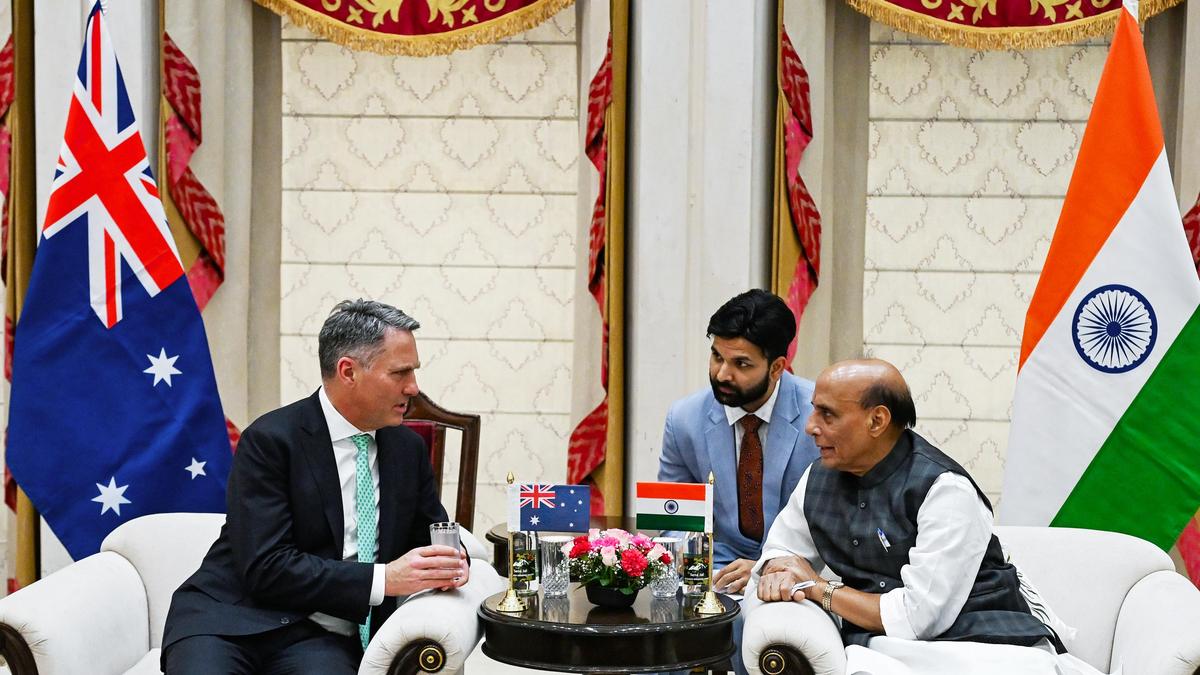
Recently, top defense and foreign affairs officials from India and Australia sat down in a quiet room for high-level talks. The official press releases used the sterile, bloodless language of diplomacy. They spoke of "maritime freedom," "supply chain resilience," and "strategic partnerships."
To the average reader, it sounds like bureaucratic white noise. Another meeting. Another joint statement.
But strip away the jargon, and the stakes become clear. These leaders were not just talking about politics. They were talking about the survival of the modern world. They were addressing a quiet, creeping vulnerability that affects every single person who buys a laptop, fills up a gas tank, or waits for a shipment of life-saving medication.
The Ghost Ship in the Strait
To understand why two democratic giants like India and Australia are suddenly tightening their embrace, we have to look through the eyes of someone whose life depends on these waters.
Let us look at a hypothetical merchant captain named Aarav.
Aarav commands a 1,200-foot container vessel carrying critical components—microchips from Taiwan, lithium batteries from Australia, and raw materials destined for manufacturing hubs in Mumbai. As his ship approaches the Malacca Strait, the mood on the bridge shifts. The crew grows quiet.
The Malacca Strait is a narrow choke point. At its narrowest, it is a mere 1.7 miles wide. It is one of the busiest shipping lanes on Earth, and it is also a geopolitical tinderbox.
For Aarav, the threat is not just a sudden storm or a freak wave. The threat is gray-hulled naval vessels playing aggressive games of chicken. The threat is a sudden, unannounced military exercise that closes an entire shipping lane for days, forcing his vessel to take a massive detour around Indonesia, burning through hundreds of thousands of dollars in fuel and throwing global supply chains into chaos.
When a single shipping lane stalls, the world feels it instantly.
Consider what happens next: a factory in Ohio stops production because a specific bracket is stuck on a ship in the South China Sea. A hospital in Sydney runs low on a critical anesthetic because the raw chemical compounds are idling outside a blockaded port. A small business owner in Delhi watches their margins evaporate as shipping insurance rates skyrocket overnight.
This is not a dystopian fantasy. We saw a microscopic version of this crisis when a single container ship, the Ever Given, wedged itself sideways across the Suez Canal for just six days. That single mishap stranded an estimated $9.6 billion worth of trade every day, causing ripples that lasted for months.
Now, imagine that disruption happening intentionally. Imagine it happening on a massive scale, driven not by an accidental steering failure, but by a superpower seeking to dominate the maritime commons.
That is the nightmare scenario keeping planners in New Delhi and Canberra awake at night.
The Logic of the Map
Geography dictates destiny. For decades, India and Australia viewed each other across a vast ocean distance, friendly but culturally and strategically distinct. One looked toward the Indian Ocean; the other looked toward the Pacific.
But the map has changed. Not the physical terrain, but the political reality imposed upon it.
The rise of an assertive, heavily armed power in the region has effectively fused these two oceans into a single, interconnected theater: the Indo-Pacific.
India sits like a massive peninsula thrust into the heart of the world's most critical trade routes. Australia sits as the southern anchor, guarding the eastern approaches and possessing vast reserves of the critical minerals that power the green energy revolution.
They are the bookends of a volatile region.
During their recent high-level dialogues, the two nations reinforced a shared truth: neither can protect these waters alone. The oceans are too vast, the threats too sophisticated.
Historically, maritime security was about hunting pirates or stopping smugglers. Today, it is about keeping the global nervous system from being severed. The talks focused heavily on underwater domain awareness—a dry phrase that means knowing exactly what is lurking beneath the waves.
The deep ocean floor is no longer just a silent abyss. It is a network of submarine data cables that carry over 95 percent of international data. If you send an email from Tokyo to London, or route a financial transaction from New York to Sydney, that data travels through a fragile cable resting on the seabed.
In a high-tech conflict, those cables are the first things to go.
By sharing radar data, satellite tracking, and naval intelligence, India and Australia are building a digital dome over the oceans. They are trying to ensure that if a rogue submarine approaches a data cable, or if an unidentified fleet attempts to shadow a commercial convoy, the world knows about it instantly. Sunlight is the best disinfectant, even at sea.
The Myth of Self-Reliance
There is a tempting counterargument that often arises during times of global tension. Why don't we just build everything at home? Why rely on these dangerous, vulnerable oceanic highways at all?
It is a seductive thought. Politicians love to promise absolute self-reliance.
But true isolation is a mathematical impossibility in the 21st century.
Take the electric vehicle industry, a sector that both India and Australia are betting their economic futures on. To build a single advanced battery, you need lithium from Western Australia, cobalt from Africa, processing facilities in Asia, and advanced engineering talent in India.
No single nation possesses the entire deck of cards.
If you attempt to build a completely closed wall around your economy, you don't achieve security; you achieve poverty. The cost of goods skyrockets. Technology stagnates. Your medical systems degrade because you cannot access the global pool of pharmaceutical innovation.
Therefore, the solution is not to retreat from the world, but to make the world’s connections resilient.
This is what India and Australia mean when they talk about supply chain diversification. They are trying to build an economic insurance policy. If one factory grid goes dark due to a political crisis, another grid in a friendly nation must be ready to spin up immediately. They are moving away from a system based purely on efficiency—where everything is made in the cheapest possible place—to a system based on trust.
They call it "friend-shoring." It is the economic equivalent of choosing your neighbors wisely before a storm hits.
What Happens in the Dark
It is easy to get lost in the grand strategy of it all, to view the world as a giant chessboard where prime ministers and admirals move tiny wooden pieces across a map.
But grand strategy always lands on the backs of ordinary people.
When maritime freedom degrades, the first symptom isn't a declaration of war. It is a subtle creeping anxiety. It is the sudden inflation spike at the grocery store. It is the car dealership telling you your hybrid vehicle will take fourteen months to arrive because a factory across the world is waiting on a single batch of semiconductors.
It is the slow, painful realization that the invisible systems we trusted to keep our lives running smoothly are cracking under the pressure.
The high-level talks between India and Australia were a declaration that these systems will not be allowed to fail quietly. By conducting joint naval exercises, sharing logistics bases, and aligning their economic policies, these two democracies are drawing a line in the sand—or rather, a line in the water.
They are signaling to any revisionist power that the oceans belong to everyone. That the highway remains open.
As the sun sets over the Indian Ocean, Captain Aarav stands on the bridge of his cargo ship. The radar screen blinks with green light, showing a clear path ahead through the crowded shipping lanes. Far off the starboard bow, the sleek silhouette of an Indian Navy frigate glides silently through the swells, its presence a quiet guarantee of safe passage.
Aarav checks his watch, notes the coordinates, and sips his coffee. The brew is warm, rich, and ordinary. He does not think about the immense, fragile web of geopolitics that allowed that cup to reach his hands, and that is precisely the point. The ultimate success of diplomacy is when the world remains beautifully, boringly normal.