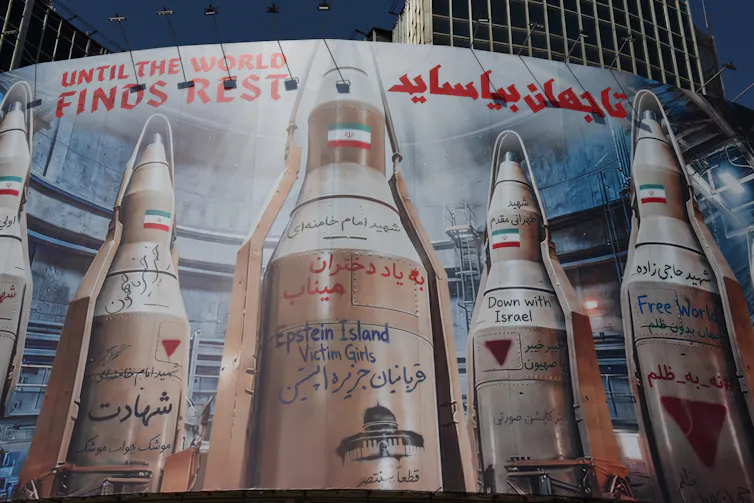
Drive through Tehran, and you can't miss them. Massive, multi-story banners hanging over Enqelab Square and Vali Asr Square. They change fast, sometimes overnight. For decades, these public installations broadcasted a predictable mix of fierce religious duty and grim promises of martyrdom.
But things are shifting. Look closely at the latest towering images appearing across the Iranian capital, and you'll see a profound pivot in how the Islamic Republic communicates during a crisis. Facing severe economic strain, air raid fears, and a deeply fractured domestic population, the state is quietly tweaking its visual strategy. It isn't just about religious devotion anymore. It's about raw nationalism.
Understanding why this change is happening tells us exactly where the state feels most vulnerable.
The Pivot From Faith to Country
The traditional playbook relied heavily on Shi'ite religious iconography. You used to see endless tributes to martyrs, laced with deeply spiritual calls to sacrifice. That imagery worked wonders with the regime's hardline core support base, but it doesn't move the needle for the broader, younger, and highly cynical Iranian public anymore.
Following years of domestic unrest and economic stagnation, the state recognizes that old ideological slogans have lost their teeth. The solution? Lean heavily into history, national pride, and ancient Persian motifs.
We're seeing an intentional pivot toward a military-first narrative rather than a purely theocratic one. By wrapping the state's survival in the Iranian flag, the message transforms from defend the government to defend your homeland. It's a psychological attempt to capture the middle ground—the citizens who might despise the current leadership but fiercely love their country.
Deconstructing Five Key Visual Themes
To understand how this messaging functions on the ground, look at five specific billboard strategies that have dominated Tehran's streets recently.
1. The Armed Forces Subverting Global Superpowers
A massive banner over Enqelab Square caught global attention by depicting an American aircraft carrier battered, torn, and trailing blood. Next to it, bold English text reads, "If you sow the wind, you will reap the whirlwind."
This isn't just a threat aimed at the US Navy fleet navigating nearby waters. It's a calculated media hack. Western news agencies photograph these building-sized graphics, share them globally, and inadvertently blast Iran's internal messaging across international social media networks. For a relatively low printing cost, the state projects an image of absolute, unflinching strength.
2. Blending Modern Commanders With Historical Guerillas
One striking billboard features a contemporary Revolutionary Guard commander standing shoulder-to-shoulder with Rais Ali Delvari. Delvari is a legendary early 20th-century history figure who led the regional resistance against British colonial forces on Iran's Gulf coast.
By placing a modern military figure next to a secular anti-imperialist icon, the state tries to legitimize its current actions. They want you to view today's regional standoff not as a modern political conflict, but as the continuation of a century-old struggle to protect Persian soil from foreign invaders.
3. Turning Sports and Culture Patriotic
When international pressure mounts, the regime aggressively co-opts secular culture. Billboards featuring the Iranian national football team standing in salute, framed by massive national flags, have replaced purely religious murals.
It's a direct response to recent years of internal protests where national athletes occasionally refused to sing the national anthem. By plastering these images across major intersections, the state attempts to reclaim the narrative of unity, forcing a public image of total alignment between citizens, sports culture, and the military apparatus.
4. Highlighting Technological Defiance
Another prominent theme focuses heavily on domestic technology and scientific achievements. Billboards showcasing massive centrifuges and faces of assassinated nuclear scientists are accompanied by slogans like "science is power."
These banners serve a dual purpose. Internationally, they signal that sanctions haven't broken the country's technological progress. Domestically, they attempt to stir up a sense of modern patriotic pride, framing the nuclear program not as a geopolitical liability, but as a crowning achievement of Iranian intellect.
5. Weaponizing the Pop Culture Aesthetic
Perhaps the most bizarre shift in recent propaganda is the move toward digital memes and pop-culture trolling. Online and on digital street screens, the state has rolled out animations featuring political adversaries rendered as Lego characters or cartoon figures reacting in panic to Iranian missile strikes.
This short, cynical, and highly shareable content is built for the TikTok era. It signals a move away from the hyper-serious, somber tones of the past. Instead, it embraces a sarcastic, internet-savvy attitude designed to make the adversary look weak, small, and easily defeated.
The Gap Between Public Image and Private Reality
While these displays scream total defiance, analysts note they often reveal exactly what the state is trying to hide. Image is everything to a government under siege. When internal economic pressures or external military threats peak, the propaganda gets noticeably louder and more aggressive.
Many residents view these installations with deep skepticism or outright exhaustion. While some report that the patriotic themes help steady nerves during active military tensions, others find the constant threats of war exhausting. During recent domestic uprisings, smaller, localized propaganda banners were frequently targeted by protesters and burned. The giant installations over Enqelab Square, however, remain heavily guarded, serving as a vital rallying point for pro-government demonstrations.
The state's shift toward nationalistic imagery shows they're fully aware of their ideological limitations. They know they can no longer command unity through religious devotion alone. By wrapping themselves in the historic symbols of the nation, they hope to make dissent look like treason against Iran itself.
Tehran Residents Say Wartime Banners Bring Strength, Motivation
This video offers direct, on-the-ground footage of the massive wartime billboards across Tehran and includes raw reactions from local residents navigating the psychological weight of these displays.