Bombing a nuclear program back to the stone age sounds great in a press briefing. It feels decisive. It makes for incredible television when the grainy gun-camera footage shows buildings turning into clouds of dust. But anyone who has spent time analyzing how state-backed weapons programs actually operate knows a dirty little secret. You can't bomb knowledge, and you certainly can't bomb a regime's geographic will to dig deeper.
Fresh commercial satellite imagery from Vantor and Planet Labs just dropped, and it shows exactly what happens after the smoke clears. Iran is already back at work. Weeks after a massive wave of US and Israeli airstrikes pummeled sensitive military and nuclear installations, the backhoes are running, concrete is being poured, and heavy machinery is actively clearing rubble.
If you thought the summer military campaign permanently ended Tehran’s nuclear ambitions, you're missing the bigger picture. The reality on the ground is far more complicated, and frankly, a lot more stubborn.
What the Eyes in the Sky Actually See
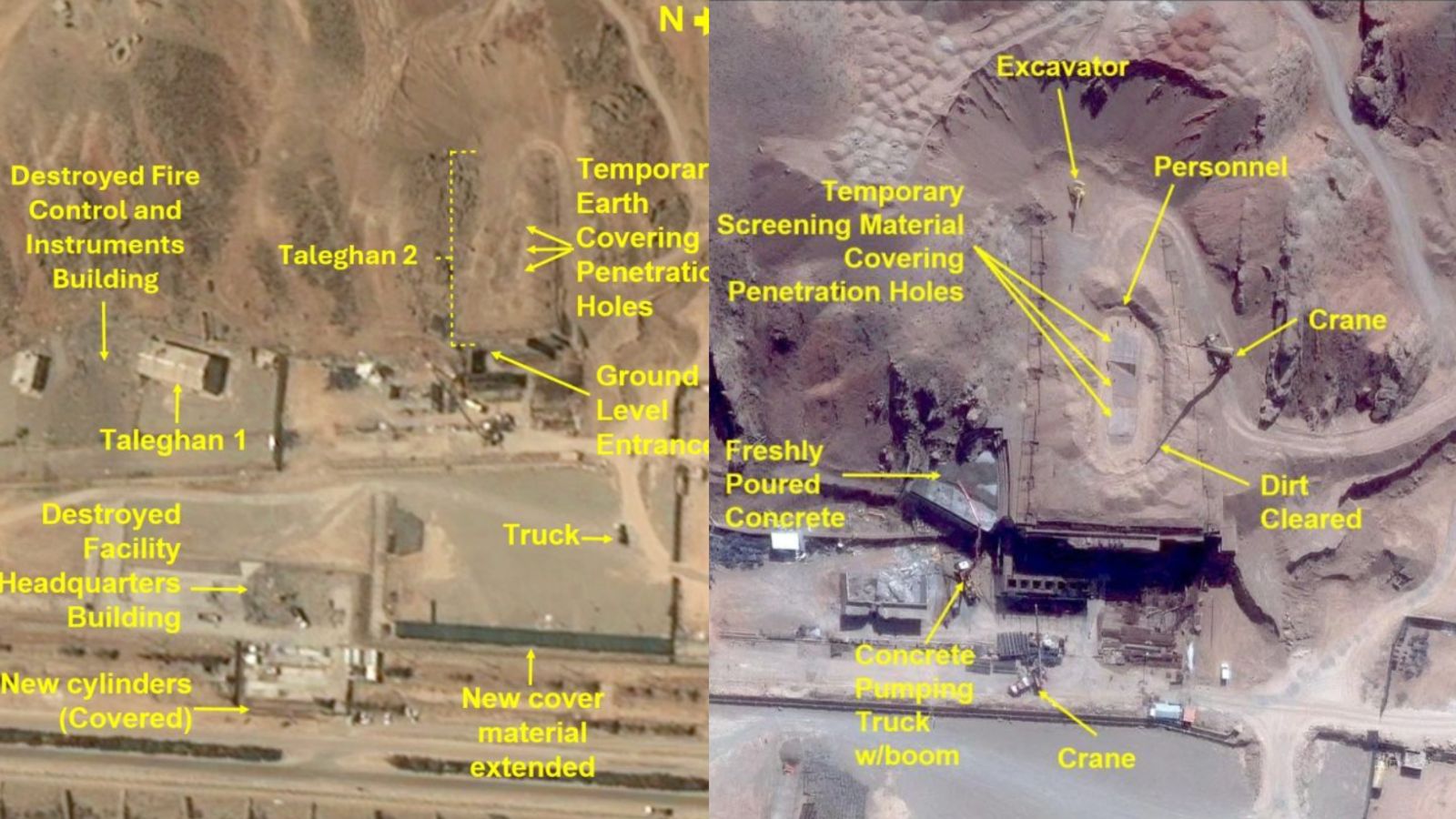
The most glaring activity is centered right at the Parchin military complex, located roughly 30 kilometers southeast of Tehran. Western intelligence agencies have kept a laser focus on this area for decades because of its historical links to high-explosives testing. Specifically, the latest imagery focuses on a highly controversial location known as the Taleghan 2 facility.
Taleghan 2 has been a repeated target. It was hit heavily by Israel back in late 2024, only for Iran to quietly start rebuilding it by mid-2025. Then came the devastating joint strikes in June, which punched massive holes directly into the hardened structures.
The new satellite data shows that the regime didn't walk away. By mid-June, workers had already thrown temporary dirt coverings over the massive penetration holes. By July, heavy cranes were spotted hovering right over the impact zones, and crews were seen laying down a thick steel rebar mesh. They aren't just cleaning up; they're prepping to pour reinforced concrete to patch the roof and restore the structural integrity of the facility.
But it doesn't stop at Parchin. Look closely at the data coming out of other critical nodes in the Iranian nuclear matrix and you see a clear pattern of resilience and concealment:
- Isfahan Nuclear Complex: This site got hammered during the airstrikes because it produces the uranium gas fed into enrichment centrifuges. The latest images show a massive spike in heavy vehicle activity on the access roads. Instead of rebuilding the damaged structures out in the open, Iran is actively using earth-moving equipment to bury the southern and middle tunnel entrances with thick layers of soil.
- Natanz Enrichment Site: Nearby at the heavily fortified Pickaxe Mountain facility, dump trucks and cement mixers are working overtime. They are aggressively hardening and structurally reinforcing the entrances to the underground tunnel networks.
- The Drone Protections: At the Pilot Fuel Enrichment Plant in Natanz, Iran recently built a brand-new panel roof completely covering the anti-drone cages.
The Recovery Strategy
What we are witnessing isn't an immediate return to full-scale uranium enrichment. Let's be realistic here. Experts from the Institute for Science and International Security have made it clear that the recent strikes completely disrupted Iran's open-air enrichment capability. The program was severely set back, and you can't just flip a switch to bring sophisticated centrifuge cascades back online when the supporting infrastructure is in pieces.
What the regime is doing right now is basically a salvaging and cloaking operation. By slapping roofs over bombed-out hulls and sealing off tunnel entrances, they are blocking peering eyes from overhead satellites. They want to hide the internal movement of equipment. If a piece of high-tech centrifuge manufacturing machinery survived the blast under a collapsed roof, Iran wants to pull it out, refurbish it, and move it deep underground without the Pentagon watching them do it.
It is a shell game. By burying the access points to underground facilities under tons of dirt and rock, they make any future airstrikes drastically less effective. They are playing for time, ensuring that whatever remains of their scientific and technological asset base is safely tucked away where conventional munitions can no longer reach them.
The Diplomatic Illusion
This sudden rush to secure the ruins comes at a highly inconvenient time for diplomats. It directly flies in the face of the recent memorandum of understanding signed with the United States, which was supposed to freeze nuclear advancements in exchange for a tense de-escalation.
Some political factions within Iran's parliament are already issuing warnings, claiming they will react aggressively if Washington uses this imagery to declare the understanding dead. Meanwhile, the economic reality inside Iran is getting uglier by the day. Local reformist media outlets are openly complaining about hyperinflation and public dissatisfaction, arguing that the regime's obsession with defensive infrastructure is bankrupting the country.
But for the hardliners running the Islamic Revolutionary Guard Corps, the economic pain is secondary to strategic survival. They saw how easily their above-ground structures were dismantled. The lesson they took away wasn't to stop; it was to build deeper, thicker, and darker.
If you want to understand where this situation goes next, keep your eyes on the supply lines. Watch for clandestine shipments of dual-use manufacturing equipment, like heavy-duty planetary mixers used for missile fuel or specialized carbon fiber for centrifuges, often routed through willing partners in Asia. The real indicator of Iran's nuclear timeline isn't how fast they can patch a hole in a roof at Parchin—it's how quickly they can reconstitute their supply chains in the dark.
Watch this raw analysis of the latest satellite imagery to see the exact locations of the ongoing construction and how intelligence analysts interpret these sudden architectural changes on the ground.