The morning mist in the mountains of Gyeongsangbuk-do used to smell of pine and damp earth. If you stood on the ridge, you could see the green canopy stretching toward the horizon like a thick, velvet rug thrown over the jagged granite of South Korea. For generations, this was the deal: the forest breathed for us, and we stayed out of its way.
Then the lights came on.
As South Korea climbed from the rubble of the mid-century into a neon-soaked hyper-power, our appetite for energy became a physical weight. We needed space for power plants. We needed room for solar arrays. But when you live in a country where 70% of the land is vertical, rocky, and covered in trees, you eventually run out of flat ground. You reach a point where you have to choose between the lungs of the earth and the pulse of the grid.
For years, the solution was brutal. We shaved the mountains. We bulldozed the pine and the oak to make room for flat, black sheets of silicon. To save the planet from carbon, we were killing the very things that inhaled it. It felt like a betrayal.
The Ghost in the Forest
Consider a man named Min-ho. He isn't a scientist or a CEO. He’s a hiker who grew up in the shadow of Mount Jiri. Ten years ago, he watched a hillside he loved turn into a construction zone. The trees were hauled away on flatbed trucks. In their place, a sea of solar panels was bolted to the earth.
"The birds didn't come back," he told me once. "And when the heavy rains came, the soil just... left."
Without the roots of the trees to hold the mountain together, the "green" energy project caused a landslide. The irony was bitter. To generate clean power, we had sacrificed the ecosystem’s stability. This is the hidden friction of the energy transition. We want the result, but we hate the cost. We are desperate for a way to generate power that doesn't feel like a scar on the land.
The answer didn't come from a bigger bulldozer. It came from looking at the architecture of the forest itself.
The Geometry of a Fake Leaf
Nature figured out the energy crisis millions of years ago. A tree is essentially a biological machine designed to maximize surface area. It doesn't sit flat on the ground. It reaches. It layers its leaves so that even the filtered light hitting the bottom branches is put to work.
South Korean engineers began to ask a strange question: Why are we laying solar panels down like blankets when we should be planting them like oaks?
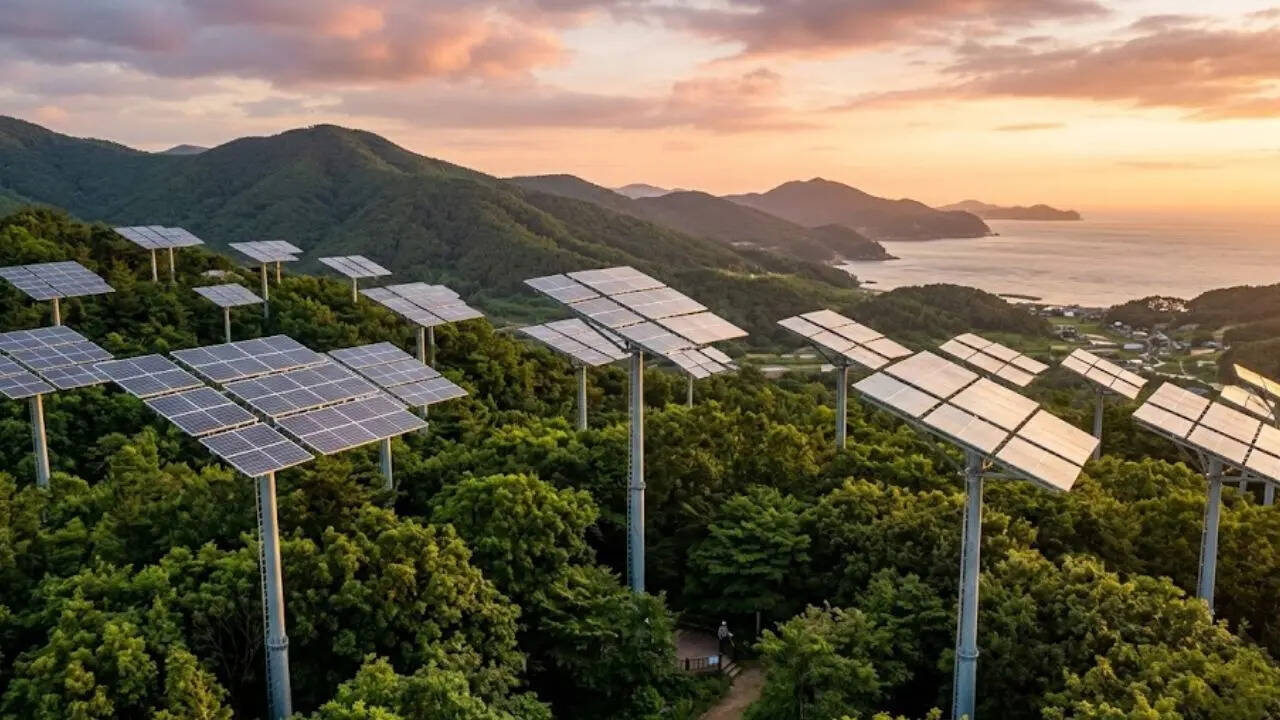
The result is the "solar tree." These aren't the clunky, rectangular blocks you see in a desert. They are vertical, branching structures made of steel and high-efficiency photovoltaic cells. They mimic the canopy. By moving upward instead of outward, these structures can generate the same amount of power as a traditional solar farm while occupying a fraction of the physical footprint on the forest floor.
Instead of clearing a hectare of woods, you plant a cluster of these iron trees in a small clearing. The sunlight hits the top "leaves," then filters down to the secondary tiers. Because the panels are angled and elevated, they catch the sun as it moves across the sky, rather than just during the high noon peak.
But the engineering isn't the most important part. The space underneath is.
A New Kind of Shade
In a traditional solar installation, the land beneath the panels becomes a dead zone. Nothing grows in the permanent, artificial dark. The soil sours.
But beneath a solar tree, the world stays alive. Because the "canopy" is elevated and spaced, sunlight still reaches the ground in dappled patterns. Grass grows. Insects remain. Most importantly, the mountain stays intact. We no longer have to choose between the panel and the pine. They can coexist in a strange, bionic marriage.
I visited one of these sites recently. From a distance, it looks like a piece of modern art—a sculpture of silver and glass rising from the brush. It doesn't feel like an industrial intrusion. It feels like an evolution.
The air still smells like pine.
The birds have stayed. They sit on the steel "branches" of the solar trees, unaware that the perch beneath their feet is currently sending electricity to a high-rise in Seoul. There is a quietness to it that feels right. We are finally moving away from the era of "conquering" nature to make room for our gadgets. We are learning to mimic it instead.
The Math of the Mountain
The efficiency numbers are staggering, but they often mask the human reality. A single solar tree can produce enough energy to power several homes, but its real value is in the land it saves. In South Korea, land is the most precious commodity we have. Every square meter of forest we don't cut down is a win for air quality, for water retention, and for the psychological health of a crowded nation.
Think about the sheer scale of the challenge. To meet global climate goals, we need to triple our renewable capacity by 2030. If we do that using old methods, we will have to clear-cut forests the size of entire nations. That isn't a solution. That’s just trading one disaster for another.
The iron orchard offers a different path. It suggests that our technology doesn't have to be an enemy of the landscape. It can be a graft.
The Cost of the Invisible
There is, of course, a catch. Building upward is harder than laying flat. It’s more expensive. It requires more sophisticated materials to ensure the structures can withstand the typhoons that whip across the Korean peninsula.
Critics point to the price tag. They say we should just stick to the cheapest, flattest options. But they are only looking at the balance sheet of the power company. They aren't looking at the balance sheet of the mountain.
What is the price of a landslide? What is the value of a forest that has stood for two hundred years? When you factor in the cost of environmental destruction, the "expensive" solar tree suddenly looks like a bargain. We are finally starting to account for the invisible stakes—the things we didn't realize we’d miss until they were gone.
The View from the Ridge
Min-ho doesn't hate the solar trees. He actually likes them.
"They look like they belong there," he said, looking out over a ridge where a few of the structures poked through the greenery. "They aren't trying to hide, but they aren't trying to destroy everything either. It’s a compromise I can live with."
We often talk about "saving the world" as if it’s a grand, cinematic event. We imagine heroes in capes or massive, sweeping laws. But the reality of saving the world is usually much smaller, much more technical, and much more beautiful. It’s a group of engineers in a lab in Daejeon figuring out how to angle a piece of glass so a fern can still grow beneath it.
It’s the realization that we don't have to choose between our progress and our home.
The sun hits the silicon leaves, and the wires hum with a low, steady vibration. Below, the roots of the real trees dig deep into the earth, holding the mountain steady against the wind. Two different systems, one ancient and one brand new, working the same shift.
The mist still rolls in from the sea, catching on the steel branches. The mountain is still here. And for the first time in a long time, the lights are on, and the forest is breathing.